Is a Higher-Protein Diet Right for Women Over 40?
More protein isn’t automatically better: the answer depends on your goal, your exercise, and your kidney health.
A higher-protein diet may be worth considering for a specific goal, but evidence doesn’t show that every woman over 40 needs more. In a 12-week trial of older women doing resistance training, higher protein did not add measurable gains in muscle size or strength beyond the gains seen with training. Weight-loss findings in younger women don’t settle the question for midlife women. If you have chronic kidney disease, get individualized advice before increasing protein. 3 4 2
First, define what “higher protein” means
There isn’t one definition that fits every study. In a randomized trial of women with an average age of 66, researchers compared diets providing 0.8 grams of protein per kilogram of body weight per day with diets providing 1.4 grams per kilogram per day. Those are the study’s comparison levels, not a prescription for you. The researchers supplied the participants’ food, so the results may not translate directly to everyday eating. 4
That distinction matters: a study calling one diet “high protein” may be testing a different intake, population, or eating plan from another study. A label alone doesn’t tell you whether the diet will help with your own goal.
For muscle, the exercise context matters
In that 12-week trial, older women did resistance training three times a week. Strength and quadriceps muscle volume increased with training, but the higher-protein diets did not produce greater increases than the comparison diet. The trial tested a specific group of women, training program, and timeframe; it doesn’t establish that protein never matters. 4
The useful takeaway is not to treat protein as a replacement for resistance exercise, or to assume that adding more will necessarily amplify the results. If your goal is strength or function, consider the exercise and nutrition plan together. This study measured strength and muscle volume, not every aspect of daily function or long-term health.
For weight loss, don’t overread a breakfast study
A 12-week randomized breakfast intervention studied women ages 18 to 30 with overweight, not women over 40. Participants kept their usual diets and activity outside breakfast. The related metabolomics analysis examined differences between women who did and didn’t lose weight; it doesn’t establish that a higher-protein breakfast reliably causes weight loss in midlife or older women. The researchers also described substantial variation in weight response in the intervention groups. 3
So if your goal is weight loss, these findings don’t show that simply raising protein will make the scale move. They also don’t answer whether a different higher-protein eating pattern could help a particular woman. The age group and study question are too narrow to support a general promise for women over 40.
When kidney health changes the decision
If you have chronic kidney disease (CKD), don’t make a large change in protein intake based on a general diet trend. A review of guidelines for people with type 2 diabetes and CKD found recommendations that ranged from no protein restriction to a specified limit. The authors noted differences in guideline methods and a need for better-quality, longer-term research. That variation is a reason to get advice based on your own kidney health, not to choose a target from a general article. 2
CKD can have no symptoms in its early stages and may be found through blood or urine tests. If you already know you have CKD, ask your clinician or a registered dietitian familiar with kidney disease before deliberately increasing protein. 1 2
Match the protein question to strength, weight or kidney health
Start with the goal: are you trying to change body weight, build strength, or address another concern? Then consider what evidence actually applies. The muscle trial was in older women doing resistance training; the weight-related breakfast study was in much younger women. Neither supports a single protein target for all women over 40. 3 4
If you have CKD, or diabetes with known kidney disease, make the decision with someone who can account for your kidney status and overall eating pattern. For everyone else, these studies don’t establish that a higher-protein diet is a must. It’s a choice to evaluate against a specific goal, rather than a rule of midlife nutrition.
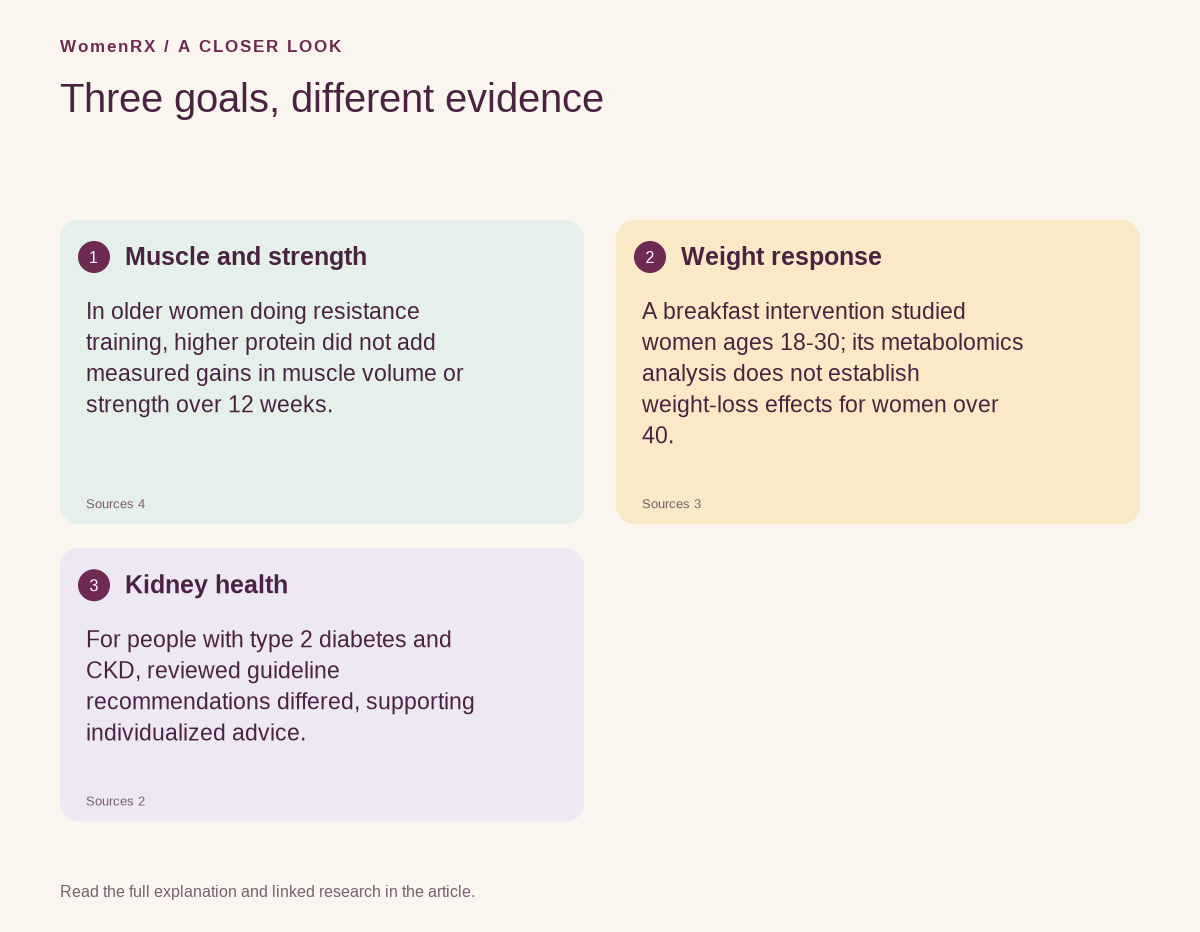
Three goals, different evidence
Muscle and strength: In older women doing resistance training, higher protein did not add measured gains in muscle volume or strength over 12 weeks.4
Weight response: A breakfast intervention studied women ages 18-30; its metabolomics analysis does not establish weight-loss effects for women over 40.3
Kidney health: For people with type 2 diabetes and CKD, reviewed guideline recommendations differed, supporting individualized advice.2
Read the figure as text
These studies answer different questions. The population and exercise context help show what each result can, and can’t, tell you.- Muscle and strength: In older women doing resistance training, higher protein did not add measured gains in muscle volume or strength over 12 weeks.4
- Weight response: A breakfast intervention studied women ages 18-30; its metabolomics analysis does not establish weight-loss effects for women over 40.3
- Kidney health: For people with type 2 diabetes and CKD, reviewed guideline recommendations differed, supporting individualized advice.2
More questions, answered
Does the older-women trial show that protein has no role in muscle health?
No. It found no additional improvement in the measured muscle volume or strength outcomes from the higher-protein diets in that 12-week resistance-training trial. It doesn’t answer every question about protein, other exercise plans, or longer timeframes. 4
Does being over 40 mean I should get my kidneys checked before changing my diet?
Age alone isn’t the question addressed here. If you have diagnosed chronic kidney disease, or diabetes with known kidney disease, get individualized guidance before deliberately increasing protein. CKD may not cause symptoms early and can be detected with blood or urine tests. 1 2
Sources you can check
- Chronic Kidney Disease | Kidney Disease | CKD | MedlineplusAccessed 2026-09-25Return to first citation
- Current Guidelines on Dietary Protein Intake for Patients with Diabetic Kidney Disease: A Scoping Review.Ravi S, Fahrner A, Rühli F, Bender N. · Current developments in nutrition · 2025Return to first citation
- Changes in the urinary metabolome accompanied alterations in body mass and composition in women with overweight - impact of high versus low protein breakfast.Correia BSB, Dalgaard LB, Thams L, Hansen M, Bertram HC. · Metabolomics : Official journal of the Metabolomic Society · 2024Return to first citation
- Greater Protein Intake Emphasizing Lean Beef Does Not Affect Resistance Training-Induced Adaptations in Skeletal Muscle and Tendon of Older Women: A Randomized Controlled Feeding Trial.Carroll CC, Campbell NW, Lewis RL, Preston SE, Garrett CM, Winstone HM, Barker AC, Vanos JM, Stouder LS, Reyes C, Fortino MA, Goergen CJ, Hass ZJ, Campbell WW. · The Journal of nutrition · 2024Return to first citation