Nutrition for Women: How to Judge Diet Claims and Evidence
A useful diet claim should match the people studied, the outcome measured, and the decision you’re trying to make.
Start by asking exactly what a diet is said to change, and in whom. Evidence about an overall eating pattern doesn’t automatically prove a claim about one food or nutrient. Check whether a study measured the outcome you care about, whether its participants resemble you, and whether it found an association or tested a specific intervention. Pregnancy and menopause studies, for example, answer different questions. 2 5
Start with the promise, not the headline
“Supports women’s health” sounds reassuring, but it’s too broad to assess. Translate the claim into a specific question: Is this eating pattern linked with a health outcome, or is one food or nutrient supposed to cause a change? What outcome: weight, a lab measure, symptoms, or a pregnancy outcome? And over what period?
That distinction matters because evidence about an overall dietary pattern cannot, on its own, establish that one food explains the result. A review of healthy-diet research found poor evidence for health-protective effects from single foods or nutrients. MedlinePlus describes healthy eating more broadly: a varied plan that provides energy and nutrients while allowing for preferences, culture, and budget. 3 1
Check who was studied and what was measured
A finding applies most directly to people like those in the study, and to the outcome the researchers actually measured. A pregnancy study about child allergies does not answer whether a diet eases pregnancy symptoms. A menopause study about weight change does not establish effects on menstrual symptoms or breastfeeding.
For example, a systematic review of 28 papers on maternal dietary patterns and children’s allergy outcomes found a modest association between greater dietary diversity during pregnancy and lower food-allergy odds in children (OR 0.95, 95% CI 0.92-0.99). The review also reported high heterogeneity for associations between pro-inflammatory dietary patterns and asthma or wheeze in children under five. These are specific findings about pregnancy and child allergy outcomes, not proof that a particular diet prevents allergies or benefits every pregnant person. 2
A review of interventions for Black pregnant individuals in high-income countries included 14 articles from 10 studies. Only one intervention was reported to improve participants’ dietary intake, and the review described a need for more research in this population. That’s a reminder to check whose experience is represented, not assume results from one group apply equally to all women. 4
Read the study type without asking it to do too much
Look for whether a study followed people’s usual diets or evaluated an intervention. Then read its conclusion at the same level of certainty as its design and results. For instance, a prospective study followed 38,283 women around menopause and found that several dietary-pattern scores were associated with weight change and obesity risk. It offers evidence about associations in that population; it doesn’t promise that an individual woman will have the same result if she adopts a particular pattern. 5
Reviews can help show whether findings repeat across studies, but the details still matter: which studies were included, whether their participants and outcomes were similar, and whether the review reports mixed or inconsistent results. A large review title or a statistically notable result doesn’t replace those checks.
Keep life stage and daily life in the picture
The evidence for one life stage doesn’t automatically answer questions about another. The pregnancy findings above concern maternal diets and child allergy outcomes. The menopause cohort concerns weight change and obesity risk. Neither tells you what to expect for menstruation, lactation, or older age; for those questions, look for evidence that actually addresses the relevant group and outcome.
Your circumstances matter, too. A plan that looks sound on paper still needs to provide the energy and nutrients you need and fit your preferences, traditions, and budget. 1 If a claim asks you to cut out whole food groups, use a supplement instead of food, or make a major change during pregnancy or while breastfeeding, the practical safety question is part of the decision, not an afterthought.
A quick claim check
Before acting on a nutrition claim, ask:
- What exactly is promised? Name the food or pattern, the outcome, and the timeframe.
- Who was studied? Check life stage, health status, and whether the group resembles you.
- What did researchers measure? Don’t treat a change in one outcome as proof of a different benefit.
- What kind of evidence is it? Notice whether the finding is an association, an intervention result, or a review of multiple studies.
- Can the advice fit your situation safely? Consider your nutritional needs, preferences, budget, and whether pregnancy, breastfeeding, or a health condition changes the question. 1
If the claim is much broader than the evidence, you don’t have to reject the entire eating pattern. You can simply hold the specific promise lightly and look for evidence that matches the decision you’re making.
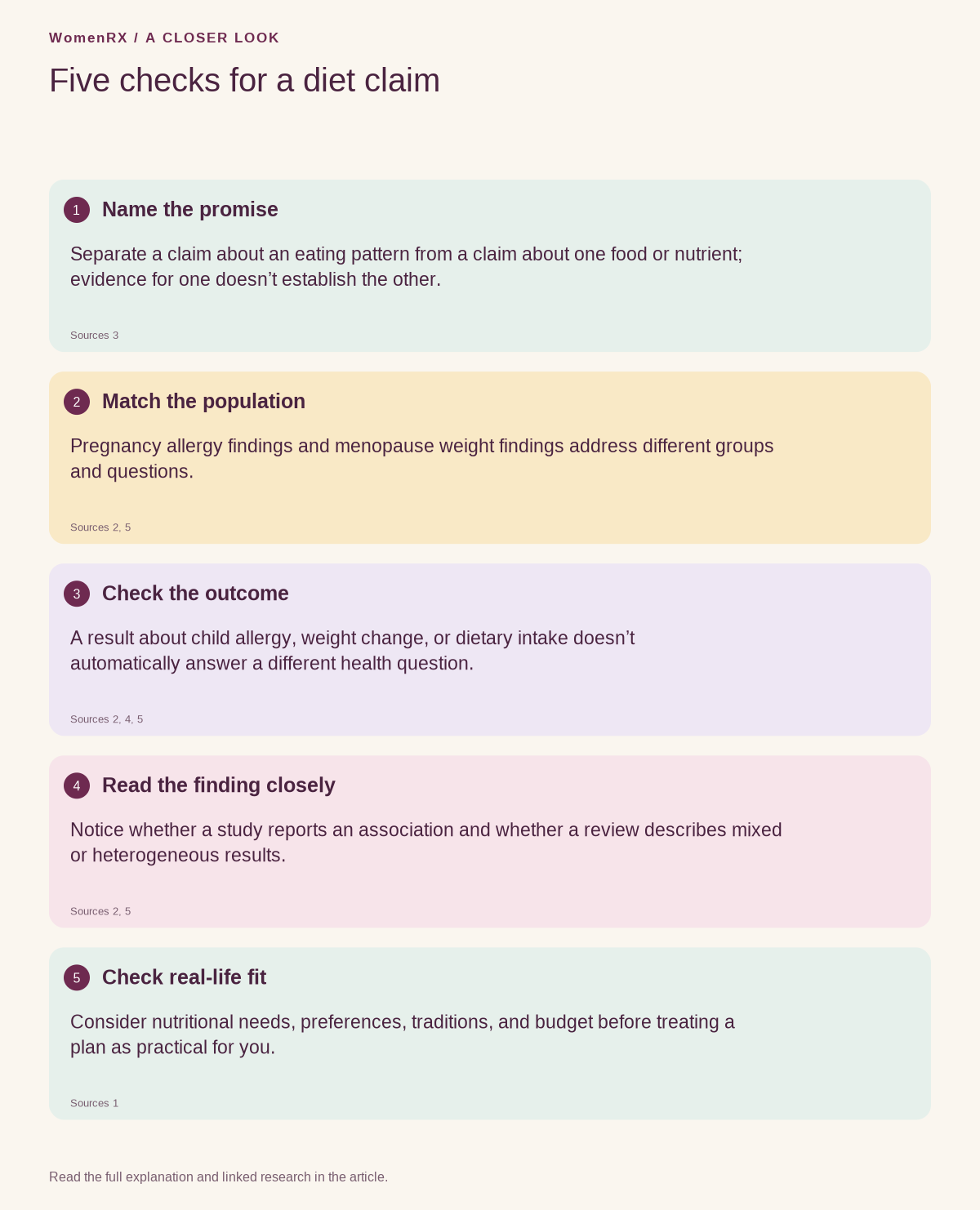
Five checks for a diet claim
Name the promise: Separate a claim about an eating pattern from a claim about one food or nutrient; evidence for one doesn’t establish the other.3
Match the population: Pregnancy allergy findings and menopause weight findings address different groups and questions.25
Check the outcome: A result about child allergy, weight change, or dietary intake doesn’t automatically answer a different health question.245
Read the finding closely: Notice whether a study reports an association and whether a review describes mixed or heterogeneous results.25
Check real-life fit: Consider nutritional needs, preferences, traditions, and budget before treating a plan as practical for you.1
Read the figure as text
Use these questions to see whether the claim, study population, outcome, and practical decision actually line up.- Name the promise: Separate a claim about an eating pattern from a claim about one food or nutrient; evidence for one doesn’t establish the other.3
- Match the population: Pregnancy allergy findings and menopause weight findings address different groups and questions.25
- Check the outcome: A result about child allergy, weight change, or dietary intake doesn’t automatically answer a different health question.245
- Read the finding closely: Notice whether a study reports an association and whether a review describes mixed or heterogeneous results.25
- Check real-life fit: Consider nutritional needs, preferences, traditions, and budget before treating a plan as practical for you.1
More questions, answered
Does a study in women mean the finding applies to every woman?
No. Check the study’s participants and outcome. A cohort of women around menopause, for example, can inform questions about that group, but it doesn’t settle claims about pregnancy, menstruation, or breastfeeding. 5
What if a diet claim is based on a review?
Check what studies the review included and whether their findings were consistent. One pregnancy review found a modest association for one specific outcome, while reporting high heterogeneity for other associations. A review can summarize evidence without making every individual study or result equally persuasive. 2
Sources you can check
- Nutrition: MedlinePlusAccessed 2026-09-25Return to first citation
- Systematic review of maternal dietary patterns during pregnancy and offspring allergy.Tan W, Amara S, Venter M, Wang L, Bodén S, Simonpietri Tesoro ME, Pickett-Nairne K, Glueck D, O'Mahony L, Comotti A, Venter C. · Pediatric allergy and immunology : official publication of the European Society of Pediatric Allergy and Immunology · 2025Return to first citation
- Healthy diet: Health impact, prevalence, correlates, and interventions.de Ridder D, Kroese F, Evers C, Adriaanse M, Gillebaart M. · Psychology & health · 2017Return to first citation
- Interventions to Optimize Dietary Patterns in Black Pregnant Individuals: An Integrative Review.Erbe K, Thorndike AN, Nelson M, Lydston M, Looby SE. · Birth (Berkeley, Calif.) · 2026Return to first citation
- Optimal Dietary Patterns for Lower Weight Gain and Risk of Obesity Surrounding Menopause.Xia T, Haslam DE, Eliassen AH, Manson JE, Sun Q, Willett WC, Bhupathiraju SN, Zhang C, Hu FB. · JAMA network open · 2026Return to first citation