Do You Need to Track Macros to Eat Well?
You can eat well without counting macros; tracking is most useful when it answers a specific question about your intake.
You don’t need to count protein, carbohydrate, and fat to eat well. A varied eating pattern that supplies the energy and nutrients you need can fit your preferences, culture, and budget without strict tracking. An app may help you compare what you report eating with a specific target, but it can’t determine whether that target fits you. 2 6
Start with the question you want answered
If you’re considering a macro-tracking app, ask what you hope the numbers will tell you. Are you trying to understand what’s in your usual meals? Are you following a nutrition target that’s already part of a performance or health plan? Or are you hoping an app will tell you the one right way to eat?
Those are different tasks. Tracking records estimates of what you eat. It doesn’t, by itself, establish what your needs are or whether a particular ratio is right for you. Protein needs, for example, vary with age, sex, health, and physical activity. 1
For a general goal of eating well, you can start without calculating percentages. MedlinePlus describes healthy eating as a plan that supplies needed energy and nutrients, includes a variety of foods, and takes preferences, traditions, and budget into account. It doesn’t require a very strict diet. 2
When tracking may answer a useful question
A food log can give you an estimate to review when you have a specific reason to look more closely at your intake. For example, if you’re training and already have an individualized protein target, logging your usual meals may help you see whether your reported protein intake is near it. You could focus on that question without trying to hit an app-generated percentage for every macro. Then look beyond the protein total: are your meals still providing enough food, varied sources of carbohydrate and fat, and other needed nutrients? A protein number alone can’t answer that. 1 2 6
Food-tracking tools also aren’t exact measuring instruments. In a randomized crossover study, 136 adults, including 87 women and people with and without diabetes, used an image-assisted app and a web-based recall tool. Average reported macronutrient intakes were similar between the tools, but individual agreement for classifying intake was fair for protein and fat and moderate for carbohydrates and energy. The study compared reporting methods, not whether tracking improved health or performance. 6
So use a logged number as a clue about what you reported eating, not a verdict on whether you’ve eaten correctly. If it raises a useful question, check the meals behind the number as well as the number itself.
When a food-based approach may be enough
If your aim is simply to eat well, look at the foods across your meals rather than aiming for a fixed percentage of calories from each macro. Make room for varied sources of protein, such as beans, nuts, dairy, or meat if you eat it, alongside a variety of other foods. For example, a meal of beans, rice, vegetables, and a food you enjoy doesn’t need a macro calculation to be part of a varied pattern. This isn’t a prescribed plate formula; it’s a way to notice variety while keeping your energy needs, preferences, and budget in view. 1 2
MedlinePlus also notes that healthy eating doesn’t mean giving up every favorite food or eating only a small set of foods. If a proposed target leaves you eating too little to meet your energy needs, rules out so many foods that variety becomes difficult, or crowds out foods that supply other needed nutrients, question the target rather than treating the app’s numbers as instructions. Those are practical reasons to reconsider a plan, not a diagnostic test for whether it’s safe. 2
There’s some evidence that eating attentively can be useful without conscious calorie counting. A systematic review of 24 experiments found that distraction affected how much people ate, and its authors suggested that attentive-eating principles could aid weight loss and maintenance without conscious counting. Those experiments did not compare macro tracking with this food-based approach. 4
In practice, you can choose the least complicated method that addresses your goal. If a varied, flexible pattern works for you and you have no specific reason to measure macros, tracking is optional. If you do log, treat the result as an estimate to interpret, not a score you have to earn.
Your circumstances matter more than a generic ratio
A generic “women’s macro split” overlooks differences between people. Protein needs vary with activity, age, and health. If you’re changing how you train or thinking about nutrition as you get older, start with your actual goal and eating pattern rather than assuming an app’s default protein percentage was built for you. 1 2
During pregnancy, requirements rise for many nutrients, including folate and iron, that a protein-carbohydrate-fat tally won’t show. If you’re pregnant, a restrictive macro target or a plan that cuts out many foods deserves an individualized look at your whole diet, not just a check of its percentages. 2 3
Postpartum needs deserve their own consideration, particularly if you’re breastfeeding; don’t treat a pre-pregnancy app setting as a personal target. In a small observational study, 28 women reported no significant change in energy or macronutrient intake from late pregnancy to six months postpartum, while several micronutrient intakes declined, largely alongside changes in supplement use. That describes what this group reported eating, not what an individual postpartum or breastfeeding woman needs. 5
The same goal-first approach applies during your cycling years. If your appetite, activity, or usual meals differ at certain times, you can take that experience into account without assuming your menstrual cycle calls for a preset change in macro percentages. A generic ratio can’t settle an individual nutrition question. 1 2
A simple decision path
Eating well is the goal, with no specific measurement question? Start with varied meals that supply enough energy and nutrients and fit your life. You don’t need a macro app to qualify as eating well. 2
You have a defined question and a target chosen for your goal? Tracking may help you compare your reported intake with that target. Check the foods and overall adequacy behind the total, and remember that app entries are estimates. 2 6
Your needs are changing, or the target is narrowing your meals? Don’t try to fix the problem by chasing a different app percentage. Pregnancy, breastfeeding, a health condition, or a plan that makes adequate, varied eating difficult may call for individualized nutrition support. Bring the goal and the proposed target to that conversation so they can be considered together. 1 2 3
The most useful question isn’t whether every meal hits a number. It’s whether the approach helps you meet your actual goal while still leaving room for the variety and preferences that belong in a healthy eating pattern. 2
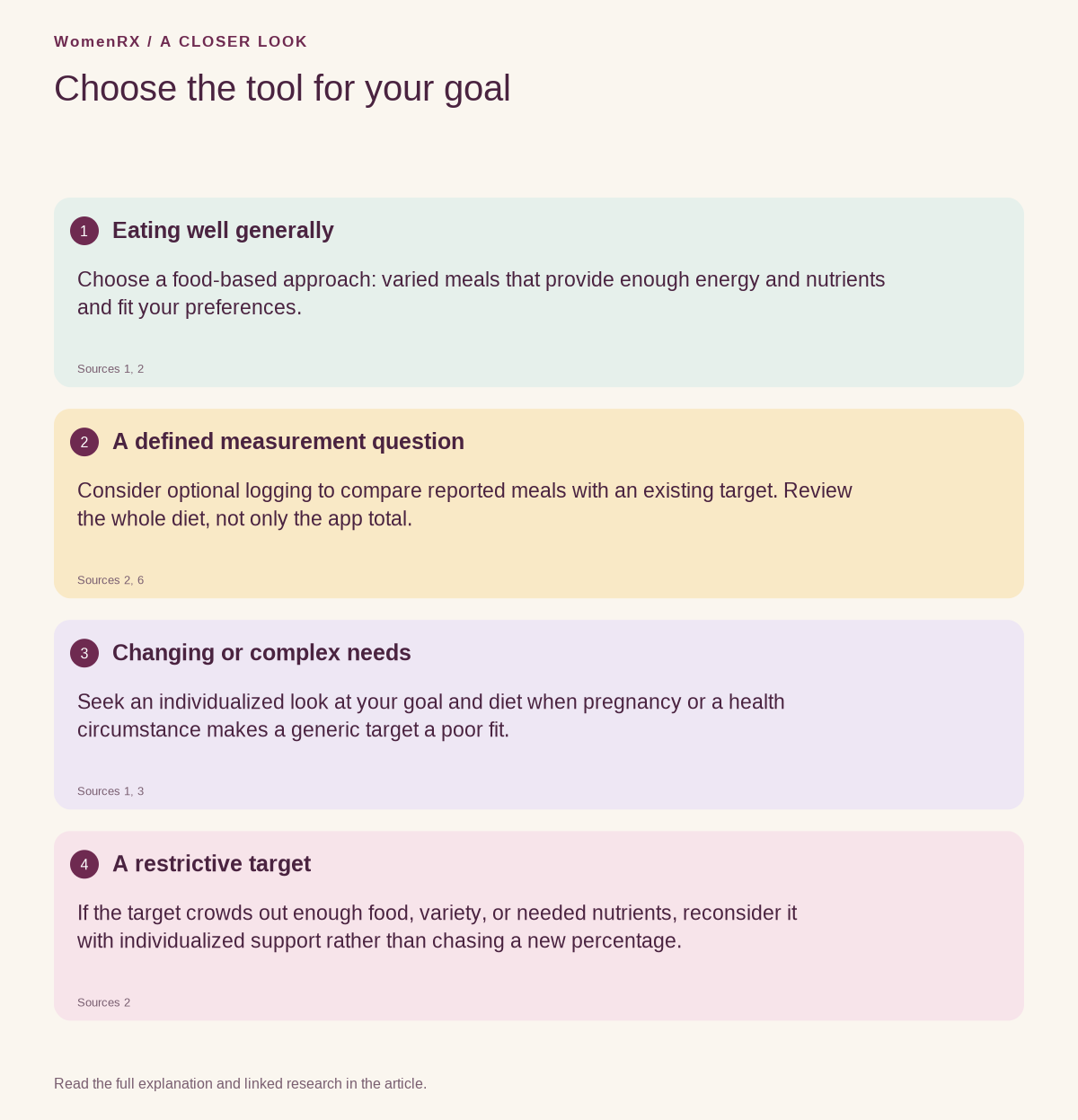
Choose the tool for your goal
Eating well generally: Choose a food-based approach: varied meals that provide enough energy and nutrients and fit your preferences.12
A defined measurement question: Consider optional logging to compare reported meals with an existing target. Review the whole diet, not only the app total.26
Changing or complex needs: Seek an individualized look at your goal and diet when pregnancy or a health circumstance makes a generic target a poor fit.13
A restrictive target: If the target crowds out enough food, variety, or needed nutrients, reconsider it with individualized support rather than chasing a new percentage.2
Read the figure as text
Start with why you’re considering a target. Each route leads to a different next move, not a recommended macro split.- Eating well generally: Choose a food-based approach: varied meals that provide enough energy and nutrients and fit your preferences.12
- A defined measurement question: Consider optional logging to compare reported meals with an existing target. Review the whole diet, not only the app total.26
- Changing or complex needs: Seek an individualized look at your goal and diet when pregnancy or a health circumstance makes a generic target a poor fit.13
- A restrictive target: If the target crowds out enough food, variety, or needed nutrients, reconsider it with individualized support rather than chasing a new percentage.2
More questions, answered
Can an app tell me my ideal macro ratio?
An app can estimate and display your reported intake, but it doesn’t establish an ideal personal ratio. Protein needs vary with factors including age, health, and activity. Pregnancy also changes requirements for nutrients that a macro ratio doesn’t capture. 1 3 6
Do I have to track all three macros to check a protein goal?
No. If you already have a protein target chosen for your circumstances, you can use a food log to estimate how your usual meals compare without adopting the app’s carbohydrate and fat percentages. Keep the whole eating pattern in view: it still needs enough energy, other nutrients, and variety. 1 2 6
Sources you can check
- Dietary Proteins: MedlinePlusAccessed 2026-09-25Return to first citation
- Nutrition: MedlinePlusAccessed 2026-09-25Return to first citation
- Dietary Supplements and Life Stages: Pregnancy - Health Professional Fact SheetAccessed 2026-09-25Return to first citation
- Eating attentively: a systematic review and meta-analysis of the effect of food intake memory and awareness on eating.Robinson E, Aveyard P, Daley A, Jolly K, Lewis A, Lycett D, Higgs S. · The American journal of clinical nutrition · 2013Return to first citation
- Tracking of Dietary Intake and Diet Quality from Late Pregnancy to the Postpartum Period.Lebrun A, Plante AS, Savard C, Dugas C, Fontaine-Bisson B, Lemieux S, Robitaille J, Morisset AS. · Nutrients · 2019Return to first citation
- Relative Validation of an Artificial Intelligence-Enhanced, Image-Assisted Mobile App for Dietary Assessment in Adults: Randomized Crossover Study.Moyen A, Rappaport AI, Fleurent-Grégoire C, Tessier AJ, Brazeau AS, Chevalier S. · Journal of medical Internet research · 2022Return to first citation