How Much Protein Should You Eat While Losing Weight?
A body-weight calculation can give you a useful protein reference point, but it isn’t a proven target for every woman.
If you’re an adult losing weight, about 1.2 grams of protein per kilogram of body weight per day is a practical number to compare with what you eat, not a proven minimum or ideal target. That amount was used in a small weight-loss trial in women and was the lowest intake tested in a trial of athletes; neither trial established the best dose for everyone. 39
Start with a reference point, not a rule
Protein helps your body build and maintain muscle and other tissues. During weight loss, the question isn’t just what happens to the number on the scale: body weight includes fat, muscle, bone and water. That makes preserving lean tissue a worthwhile consideration, even though a higher protein target by itself won’t guarantee it. 125
For a concrete starting comparison, 1.2 grams per kilogram of body weight per day works out to about 0.55 grams per pound. For example, at 150 pounds, the calculation comes to roughly 82 grams a day. This is a way to check an ordinary day of eating, not a requirement to hit an exact number.
The current Dietary Guidelines for Americans give 1.2-1.6 g/kg/day as a general protein-food goal, adjusted for individual calorie needs. That’s different from the National Academies’ 0.8 g/kg/day adult Recommended Dietary Allowance, which describes an intake sufficient for nearly all healthy adults in a group, not an ideal weight-loss target. Neither figure determines your personal needs on its own. 1211
Why use 1.2 as a reference? In a 12-week trial of 30 women with obesity, both calorie-restriction groups were assigned 1.2 g/kg/day; the study compared how calories were restricted, not different amounts of protein. In a separate six-week trial of 21 recreational athletes who restricted calories and did resistance training, groups assigned about 1.2, 1.6 or 2.2 g/kg/day did not differ significantly in their changes in fat-free mass. Neither study proves that 1.2 is optimal for you, but they give the number more context than a blanket high-protein claim does. 39
What protein can and can’t do during weight loss
Eating more protein isn’t a substitute for an eating pattern you can sustain or for physical activity. A review of trials involving 1,161 pre- and postmenopausal women found that body-composition results were more consistent when protein interventions were paired with calorie restriction or exercise. When the effects of protein were considered apart from those strategies, the review could not confirm a benefit from simply increasing protein. 5
Lean-mass findings also need careful reading. In a secondary analysis of three weight-loss trials involving 191 adults aged 55 or older, higher protein intake was associated with more appendicular lean tissue, the lean tissue measured in the arms and legs. It was not associated with better measured strength, walking speed or other physical-performance outcomes. The analysis included sex in its statistical adjustment but did not report a separate result for women. An association in that setting doesn’t establish a dose that will preserve muscle or strength for every older woman. 6
Check a day of food before changing it
You don’t need a protein powder to find out where you stand. Pick a typical day and write down the foods and portions you actually eat. Check the protein grams on packages or in a food-composition listing, then add them across breakfast, lunch, dinner and snacks. Meat, fish, dairy, beans, soy foods, nuts and some grains can all contribute. 17
For a specific example of how portions matter, USDA reference data list about 21 grams of protein in 3 ounces (85 grams) of raw yellowfin tuna. That’s one food entry, not a suggested meal or a stand-in for all fish. A day with yogurt at breakfast, lentils at lunch and tofu or fish at dinner will depend on the amounts eaten; the food names alone can’t tell you whether it reaches your reference point. 817
If your total is already near your reference point, you may not need to change anything. If it’s well below, look first at the meals where protein is scarce and consider foods you enjoy that fit the rest of your eating pattern. There’s no need to force equal amounts into every meal: a 16-week trial in 43 women of reproductive age found no significant body-composition difference between evenly distributed protein and a pattern with more protein at dinner when the total protein level was held fixed. 4
When the calculation may not fit
A grams-per-kilogram figure grows as the weight entered into it grows. The studies above do not establish that simply scaling 1.2 g/kg upward gives the right personal target at every body size. Age, health and activity also affect protein needs. If you have kidney disease, are receiving weight-loss medication, or are trying to protect strength as you get older, a dietitian or your care team can help put a target in the context of your health and overall food intake. A review addressing nutrition during GLP-1-based treatment proposes protein targets for appropriate adults without chronic kidney disease; its proposal should not be applied unchanged to someone with it. 1610
Pregnancy and breastfeeding call for a different conversation, too. The National Academies list different protein allowances for pregnancy and lactation than for other adult women, and lactation increases energy as well as nutrient needs. If either applies to you, get guidance that accounts for that life stage rather than using this weight-loss calculation as your personal target. 1112
Put a protein number in context
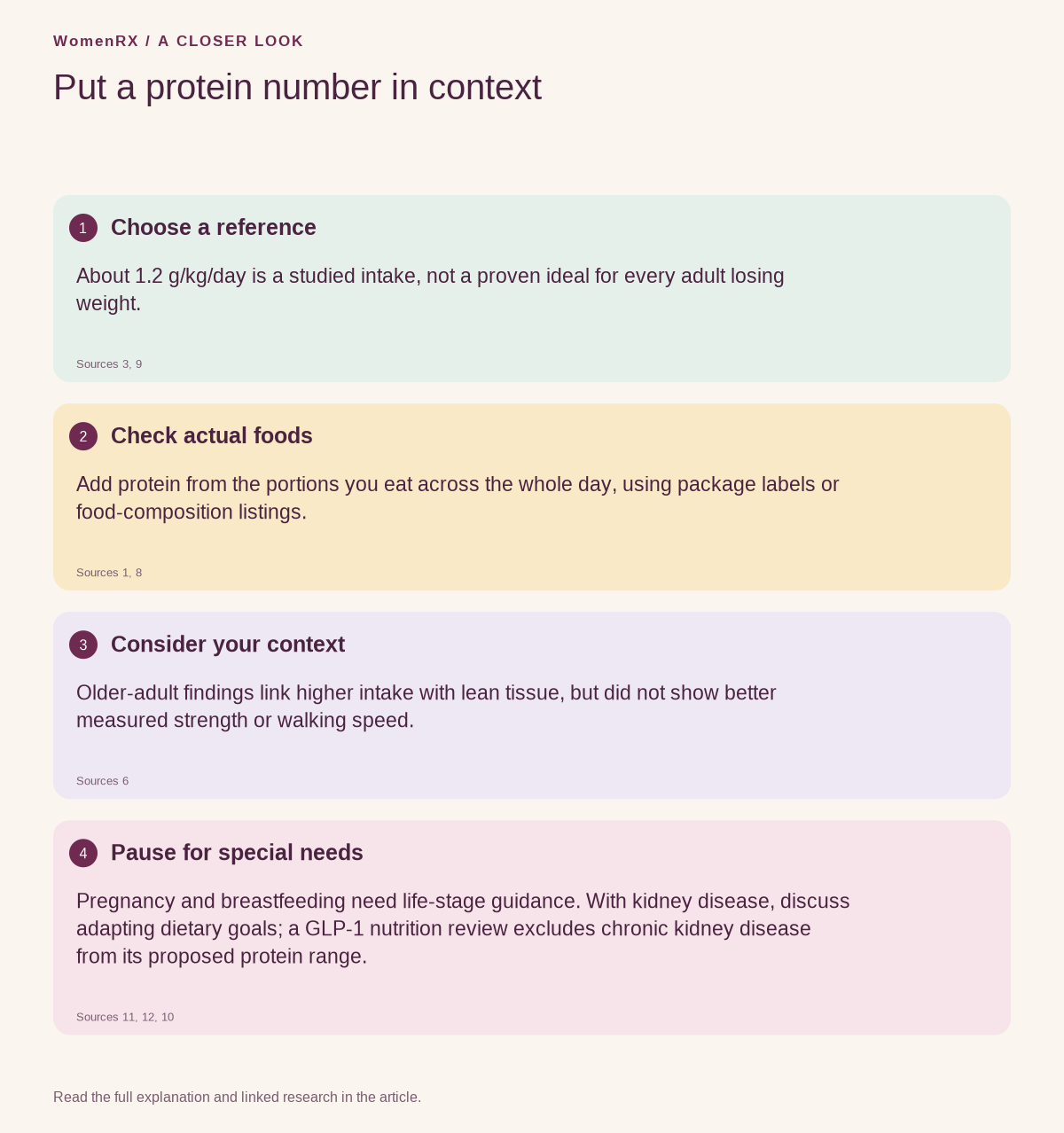
Choose a reference: About 1.2 g/kg/day is a studied intake, not a proven ideal for every adult losing weight.39
Check actual foods: Add protein from the portions you eat across the whole day, using package labels or food-composition listings.18
Consider your context: Older-adult findings link higher intake with lean tissue, but did not show better measured strength or walking speed.6
Pause for special needs: Pregnancy and breastfeeding need life-stage guidance. With kidney disease, discuss adapting dietary goals; a GLP-1 nutrition review excludes chronic kidney disease from its proposed protein range.111210
Read the figure as text
Use the calculation as a comparison, then check whether it fits your situation.- Choose a reference: About 1.2 g/kg/day is a studied intake, not a proven ideal for every adult losing weight.39
- Check actual foods: Add protein from the portions you eat across the whole day, using package labels or food-composition listings.18
- Consider your context: Older-adult findings link higher intake with lean tissue, but did not show better measured strength or walking speed.6
- Pause for special needs: Pregnancy and breastfeeding need life-stage guidance. With kidney disease, discuss adapting dietary goals; a GLP-1 nutrition review excludes chronic kidney disease from its proposed protein range.111210
More questions, answered
Do I need to spread protein evenly across meals?
Not necessarily for body composition during weight loss. In a trial of 43 women aged 20-44 with overweight or obesity, an even distribution did not outperform a dinner-heavy distribution when total protein was held fixed. The study doesn’t mean meal timing can never matter for another goal. 4
Sources you can check
- Dietary Proteins: MedlinePlusAccessed 2026-09-25Return to first citation
- Body Weight: MedlinePlusAccessed 2026-09-25Return to first citation
- The Effects of Continuous vs. Intermittent Caloric Restriction on Fat Loss: A Randomized Controlled Trial.Johnson KE, Curran B, Roberson S, Corso H, Hoelscher E, Campbell BI, Rabon K, Lovering A, Albert M. · Nutrients · 2026Return to first citation
- Daily Dietary Protein Distribution Does Not Influence Changes in Body Composition During Weight Loss in Women of Reproductive Years with Overweight or Obesity: A Randomized Controlled Trial.De Leon A, Roemmich JN, Casperson SL. · The Journal of nutrition · 2024Return to first citation
- Dietary Intake of Animal and Plant-Based Protein on Adiposity Measurements and Body Composition in Pre- and Postmenopausal Women: A Systematic Review of Randomized Clinical Trials.Fialho SN, de Souza Ferreira ML, Ribeiro SAV, Kravchychyn ACP, Hermsdorff HHM. · FASEB journal : official publication of the Federation of American Societies for Experimental Biology · 2026Return to first citation
- Is higher protein intake during weight loss interventions in older adults associated with improved outcomes? A secondary data analysis of three randomised controlled trials.Eglseer D, Reiter L, Schoufour JD, Vágnerová T, Memelink RG, Verreijen AM, Borenich A, Bauer S, Weijs PJ. · Nutrition journal · 2026Return to first citation
- MedlinePlus: Managing weight with healthy eatingAccessed 2026-09-25Return to first citation
- USDA SR Legacy reference composition: tunaAccessed 2026-09-25Return to first citation
- The effects of high protein intakes during energy restriction on body composition, energy metabolism and physical performance in recreational athletes.Kanaan MF, Nait-Yahia S, Doucet É. · European journal of clinical nutrition · 2025Return to first citation
- Medical nutrition in the glucagon-like peptide-1 (GLP-1) era: Protein strategies, micronutrient monitoring, and lean mass preservation.Arslan S. · Clinical nutrition ESPEN · 2026Return to first citation
- National Academies DRI summary table: total water and macronutrientsAccessed 2026-09-25Return to first citation
- Dietary Guidelines for Americans, 2025-2030Accessed 2026-09-25Return to first citation