How to Track Food Without Letting Numbers Take Over
Calorie tracking can be one way to observe eating, but whether it helps depends on what it does to your choices and stress.
Calorie tracking may be useful if it gives you information for a specific goal without making eating more rigid or distressing. It isn’t the only way to pay attention to food: you can notice meal patterns, build more variety, or track a symptom instead. If logging leads you to skip meals, obey harsh rules, or feel preoccupied, switch approaches and consider support.
Start with the job you want tracking to do
Before opening an app, name the question you hope numbers will answer. Are you trying to understand an eating pattern, follow a plan recommended for a health condition, or observe how a routine feels? If you can’t name a useful question, logging may create work without giving you much back.
Food self-monitoring is common in adult weight-management programs, but that doesn’t prove calorie counting itself is necessary or helpful for every person. A 2026 systematic review found dietary self-monitoring in 80% of the intervention arms it coded. The programs combined many strategies, and the review did not establish which individual strategies changed outcomes or eating-disorder risk. 4
A useful test is whether tracking gives you information you can act on while leaving room for ordinary flexibility. It may be less useful if the number becomes a daily grade, overrides hunger or fullness, or makes meals feel harder to manage.
Use a quick self-check, not a score
Tracking may be serving you if you can miss an entry without panic, eat with other people without needing exact numbers, and use what you notice to make a choice that fits your goal.
It may be costing you more than it gives if you feel compelled to log every bite, treat a number as a rule you must obey, skip or delay food to stay under a limit, or find yourself increasingly anxious or preoccupied with eating. These are reasons to pause and reassess, not a diagnosis. Research on inflexible eating describes rigid, all-or-nothing rules around food, including calorie counting, and links this pattern with disordered eating. The cited study was a survey of Lebanese adults evaluating an Arabic questionnaire; it does not show that calorie counting alone causes an eating disorder. 5
This self-check is a practical reflection, not a validated screening tool. You don’t have to wait for a crisis to change methods. If eating rules are taking up a lot of mental space, or you have a current or past eating disorder, you could ask a clinician or dietitian with eating-disorder experience about options that fit your needs.
Try a lower-burden way to notice patterns
You can keep the question and change the tool. For example, if you want to make meals more balanced, notice whether your usual meals include a mix of foods rather than recording every calorie. A healthy eating plan can include variety and personal preferences; it doesn’t have to be extremely strict or exclude favorite foods. 3
Other options include:
- A meal-pattern note: Record roughly when you ate and whether meals felt satisfying, without assigning a score.
- A single-focus experiment: Notice one behavior relevant to your goal, such as whether a planned lunch makes your afternoon easier.
- Symptom-focused notes: If a clinician is helping you investigate a symptom, track that symptom alongside relevant context rather than turning every meal into a calorie calculation.
These are alternatives to try, not proven replacements that work equally well for everyone. Choose the least burdensome method that can answer your actual question. If it stops being useful, you can stop.
Pregnancy and postpartum call for their own context
Findings from adult weight-management programs don’t establish what food tracking is right for you during pregnancy or postpartum. If you have a current or past eating disorder, or tracking is bringing up rigid rules, skipped meals, or distress, bring that up when discussing food with your prenatal or postpartum care team. You can be specific: “I’m skipping food to stay under a number” tells them more than “I use an app.” Rigid rules and skipped meals are features described in adult research on inflexible eating, but that research did not test a pregnancy or postpartum screening method. 5
For gestational diabetes, blood-glucose checks and nutrition guidance have a specific medical purpose; calorie logging is not a substitute for the monitoring plan from your care team. 1 2
After birth, your recovery and eating history may also shape what kind of tracking feels appropriate. If you’re unsure, you could ask your care team about an approach that fits your circumstances.
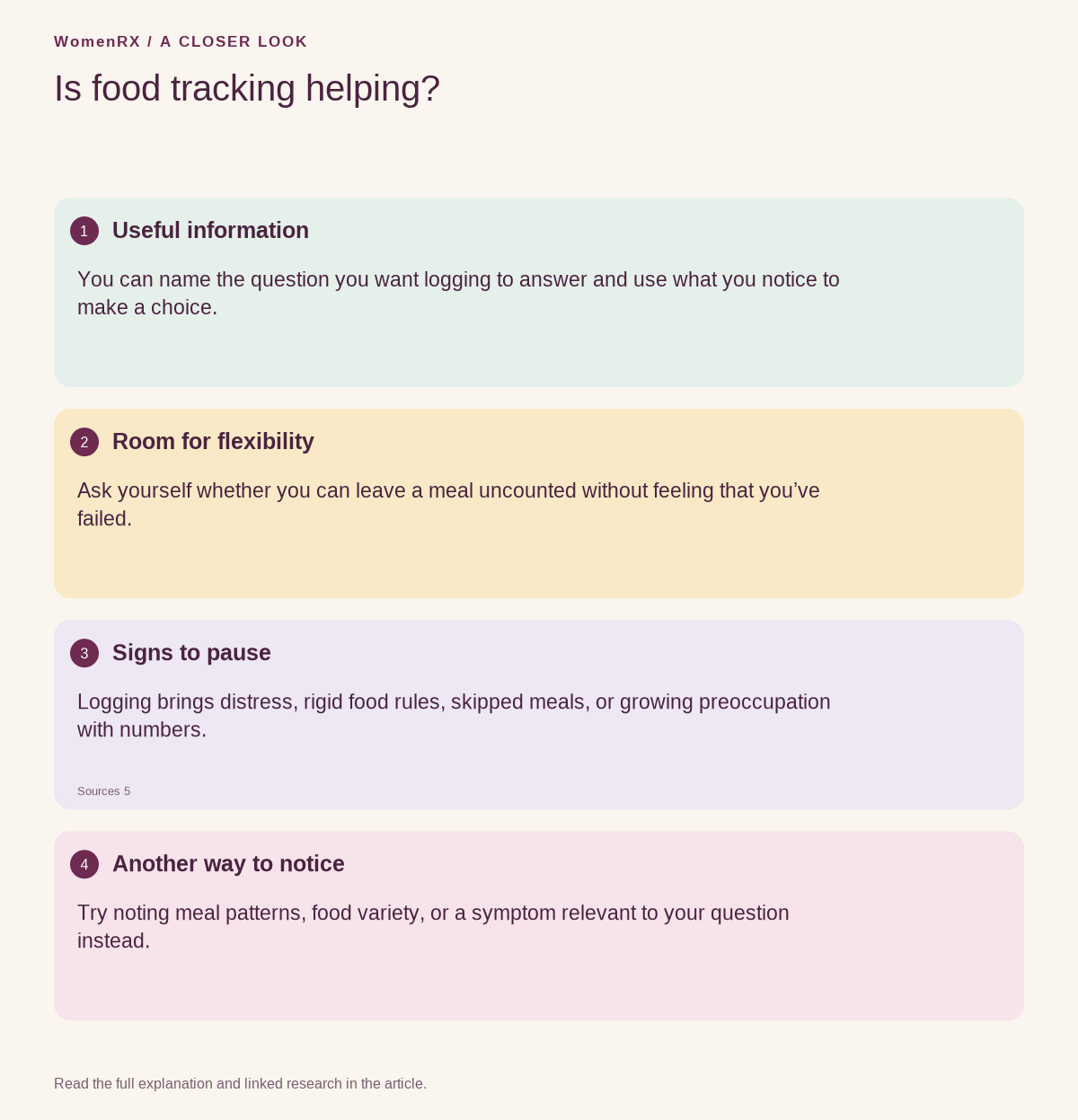
Is food tracking helping?
Useful information: You can name the question you want logging to answer and use what you notice to make a choice.
Room for flexibility: Ask yourself whether you can leave a meal uncounted without feeling that you’ve failed.
Signs to pause: Logging brings distress, rigid food rules, skipped meals, or growing preoccupation with numbers.5
Another way to notice: Try noting meal patterns, food variety, or a symptom relevant to your question instead.
Read the figure as text
Use these prompts to decide whether logging is answering a real question or adding pressure. They are reflection prompts, not a diagnostic screen.- Useful information: You can name the question you want logging to answer and use what you notice to make a choice.
- Room for flexibility: Ask yourself whether you can leave a meal uncounted without feeling that you’ve failed.
- Signs to pause: Logging brings distress, rigid food rules, skipped meals, or growing preoccupation with numbers.5
- Another way to notice: Try noting meal patterns, food variety, or a symptom relevant to your question instead.
More questions, answered
Does using a food log mean I have an eating disorder?
No. A food log by itself doesn’t establish a diagnosis. The more useful question is whether the method is becoming rigid, distressing, or tied to skipping meals and other restrictive rules. Research distinguishes flexible choices from inflexible, all-or-nothing eating patterns, but the cited survey does not show that tracking alone causes disordered eating. 5
Is tracking food the same as monitoring blood sugar?
No. Food logging records what you eat; blood-glucose monitoring measures blood sugar. In gestational diabetes care, glucose checks and nutrition guidance are described as parts of managing the condition. Follow your care team’s plan for that medical monitoring. 1 2
Sources you can check
- Gestational diabetes - NHSAccessed 2026-09-25Return to first citation
- Gestational diabetes - Treatment - NHSAccessed 2026-09-25Return to first citation
- Nutrition: MedlinePlusAccessed 2026-09-25Return to first citation
- Unpacking weight management interventions measuring eating disorder risk in adults: coding of components of interventions in a systematic review.Lister NB, Khalid R, Jardine IR, Pryde S, Melville H, Seidler AL, Hunter KE, Ahern AL, Baur LA, Braet C, Garnett SP, Hill AJ, Maguire S, Nicholls D, Paxton SJ, Piya MK, Sainsbury A... · Journal of eating disorders · 2026Return to first citation
- Psychometric properties of an Arabic translation of the Inflexible Eating Questionnaire (IEQ) in a non-clinical sample of adults.Fekih-Romdhane F, Azzi V, Malaeb D, Sarray El Dine A, Obeid S, Hallit S. · Journal of eating disorders · 2023Return to first citation