Eating Below Energy Needs Without Losing the Bigger Picture
An energy deficit can support weight loss, but the eating pattern still needs to provide nourishment and fit your life.
An energy deficit means taking in less energy than your body expends over time. 4 Weight-loss programs can emphasize food quality, reducing intake, or changing the mix of foods; trials in specific groups have found weight loss with different approaches, but they cannot identify the best plan for everyone. 59 The better question is whether a plan lets you eat a varied diet, manage hunger, and keep living your life. 7 If you’re pregnant or breastfeeding, your periods change, or you have an eating-disorder history, it’s prudent to seek individualized advice rather than assume a generic weight-loss plan fits your circumstances. 236810
What a deficit tells you, and what it doesn’t
An energy deficit means taking in less energy than your body expends over time. 4 It doesn’t tell you which foods to choose, whether you’re getting enough nutrients, or how you’ll feel following a plan. Individual energy needs vary with factors including age, body size, activity, and medical conditions, so a calorie target borrowed from someone else may be a poor fit. 7
It’s also worth separating weight from health. The scale reflects muscle, bone, fat, and water, and it can’t show whether an eating approach supports your energy or nutritional needs. 1 Rather than treating the lowest possible intake as the goal, look at what a proposed plan asks you to eat and what it asks you to give up.
Different patterns, different tradeoffs
A diet-quality-first approach starts by improving the foods you eat, then addresses weight loss within that pattern. For example, a Mediterranean-style pattern might make room for vegetables, beans, whole grains, and other foods you enjoy rather than defining success by a short list of exclusions. In the DELISH randomized trial, 360 adults with obesity were assigned either a program that first emphasized Mediterranean-style diet quality or a control weight-loss program focused on reducing energy intake. At two years, estimated average weight changes were similar, about 3.4% and 3.5% below starting weight, respectively. Among those who attended follow-up, the Mediterranean-style group had a higher diet-quality score. The trial doesn’t show that one approach works best for everyone, but it does show that attention to food quality needn’t be set aside to pursue weight loss. Women made up 55.6% of participants; a separate outcome for women wasn’t reported. 5
An intake-focused approach makes eating less the more explicit task. It may give you a clear way to notice habits you want to change, but an energy target alone won’t tell you whether meals include enough variety. For example, replacing a usual snack with an apple and cheese or vegetables and hummus changes the eating pattern differently from simply skipping the snack. MedlinePlus recommends varied foods, including produce, protein foods, dairy, and whole grains, and gives those snack combinations as examples. They’re options, not a required menu. 7
A lower-carbohydrate or lower-fat approach changes the mix of foods as well as, potentially, how much you eat. Neither label guarantees an energy deficit or nutritional adequacy. In a two-year randomized trial of 115 adults with type 2 diabetes, researchers compared planned energy-matched, reduced-energy lower-carbohydrate and higher-carbohydrate diets alongside exercise. Weight loss was similar between groups; some diabetes-related outcomes differed. That’s useful evidence that different food mixes can accompany weight loss, not proof that either plan is the right choice for a woman without diabetes. The abstract didn’t report women’s results separately. 9
The practical tradeoff is this: more rules may make a plan feel straightforward at first, while also making familiar meals or social occasions harder to accommodate. A flexible plan still needs enough structure to help you eat in a way that serves your goal. Neither feature makes a diet automatically effective. Ask whether you can picture eating this way on an ordinary workday and at a meal with other people, without routinely leaving foods you need or enjoy off the table.
Look at the meals, not just the math
To judge a proposed plan, picture a full day of food. Where do its vegetables and fruit, protein foods, whole grains, and dairy foods fit? If it cuts out an entire category, what takes its place? Beans, lentils, tofu, tempeh, and edamame, for instance, are among the plant-based protein options identified by MedlinePlus. 7 A plan made mostly of foods you dislike, or one that leaves you preoccupied with hunger, deserves another look even if its calorie arithmetic appears tidy.
Consider how much work the plan requires, too. Can you shop for it, prepare it, and eat enough at times that work with your schedule? If following it depends on missing regular meals or making up for eating with extra exercise, that’s a different proposition from finding a pattern you can sustain. Weight-control guidance emphasizes healthy eating patterns and physical activity as part of a healthy lifestyle, not a particular rigid menu. 8
Times to set aside a generic deficit plan
If you’re pregnant, consider discussing your eating goals individually rather than assuming a standard weight-loss target accounts for your needs. Several nutrients have particular importance before and during pregnancy, and some are commonly underconsumed. 3 If you’re breastfeeding, breast milk provides nutrients for your baby. 2 As a precaution, consider discussing your eating and weight goals with your care team rather than assuming a generic plan fits while you’re feeding your baby.
If your periods become irregular or stop while you’re eating less or exercising more, don’t treat that as an expected price of weight loss. In a controlled study of 34 previously regularly menstruating women ages 18 to 30, larger energy deficits combined with exercise were associated with more menstrual disturbances over three intervention cycles. That study can’t identify a safe cutoff for any individual, but it gives you a concrete reason to seek an assessment and revisit the plan. 10
If you have an eating-disorder history or restriction is bringing back distress around food, consider individualized support instead of following a generic deficit plan. This is a precaution, not a finding that everyone with that history will be harmed by dieting. In interviews with 12 current or former lightweight rowers who had experienced symptoms of low energy availability, participants described effects including food-related guilt, anxiety, and disordered eating. 6 Their experiences don’t predict what will happen to you; they do underline that a weight plan should be judged by its effect on your life, not only by a change on the scale.
A useful plan leaves room to eat well, respond to hunger, and adjust when your circumstances change. If it can’t do those things, the answer isn’t necessarily to try harder. It may be to choose a different approach.
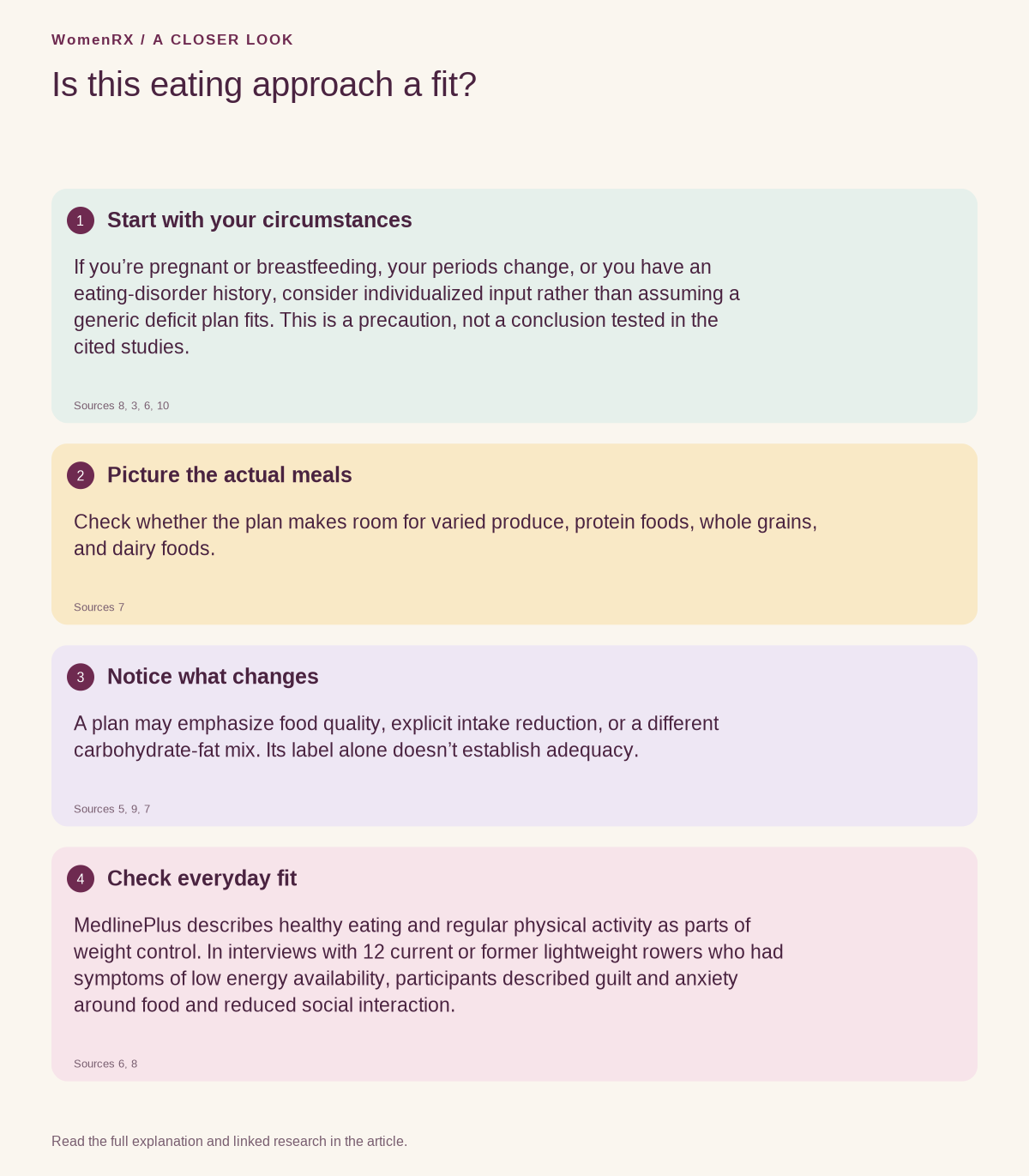
Is this eating approach a fit?
Start with your circumstances: If you’re pregnant or breastfeeding, your periods change, or you have an eating-disorder history, consider individualized input rather than assuming a generic deficit plan fits. This is a precaution, not a conclusion tested in the cited studies.83610
Picture the actual meals: Check whether the plan makes room for varied produce, protein foods, whole grains, and dairy foods.7
Notice what changes: A plan may emphasize food quality, explicit intake reduction, or a different carbohydrate-fat mix. Its label alone doesn’t establish adequacy.597
Check everyday fit: MedlinePlus describes healthy eating and regular physical activity as parts of weight control. In interviews with 12 current or former lightweight rowers who had symptoms of low energy availability, participants described guilt and anxiety around food and reduced social interaction.68
Read the figure as text
Use these questions in order to examine what a proposed weight-loss plan asks of you; this is a decision aid, not a diagnostic test.- Start with your circumstances: If you’re pregnant or breastfeeding, your periods change, or you have an eating-disorder history, consider individualized input rather than assuming a generic deficit plan fits. This is a precaution, not a conclusion tested in the cited studies.83610
- Picture the actual meals: Check whether the plan makes room for varied produce, protein foods, whole grains, and dairy foods.7
- Notice what changes: A plan may emphasize food quality, explicit intake reduction, or a different carbohydrate-fat mix. Its label alone doesn’t establish adequacy.597
- Check everyday fit: MedlinePlus describes healthy eating and regular physical activity as parts of weight control. In interviews with 12 current or former lightweight rowers who had symptoms of low energy availability, participants described guilt and anxiety around food and reduced social interaction.68
More questions, answered
Do I need to count calories to create an energy deficit?
The DELISH trial cannot answer that question. It compared a diet-quality-first program with a program focused on reducing energy intake, but did not report whether participants counted calories. Their similar average weight changes therefore do not show whether counting is necessary. 5
Sources you can check
- Body Weight: MedlinePlusAccessed 2026-09-25Return to first citation
- Breastfeeding | Benefits of Breastfeeding | MedlinePlusAccessed 2026-09-25Return to first citation
- Dietary Supplements and Life Stages: Pregnancy - Health Professional Fact SheetAccessed 2026-09-25Return to first citation
- The Physiology Of the WEight Reduced State (POWERS) study: assessing energy balance.Rosenbaum M, Allison KC, Laughlin MR, Whyte K, Jakicic JM, Mayer LES, Ashby-Thompson M, Hayes MR, Speakman J, Leibel RL, Das SK, Gallagher D, Roberts SB, POWERS Consortium. · International journal of obesity (2005) · 2025Return to first citation
- Weight Loss Intervention Promoting an Adapted Mediterranean-Style Dietary Pattern: The DELISH Randomized Clinical Trial.Keyserling TC, Wu Q, Ammerman AS, Berkowitz SA, Buse JB, Couper DJ, Evenson KR, Hursting SD, Sotres-Alvarez D, Lyons K, Saraiya VM, Alick CL, Skinner HG, Nelson C, Kruse LM, Mather... · JAMA network open · 2026Return to first citation
- Lightweight rowers' perspectives of living with Relative Energy Deficiency in Sport (RED-S).Gillbanks L, Mountjoy M, Filbay SR. · PloS one · 2022Return to first citation
- MedlinePlus: Managing weight with healthy eatingAccessed 2026-09-25Return to first citation
- Weight Control: MedlinePlusAccessed 2026-09-25Return to first citation
- Effects of an energy-restricted low-carbohydrate, high unsaturated fat/low saturated fat diet versus a high-carbohydrate, low-fat diet in type 2 diabetes: A 2-year randomized clinical trial.Tay J, Thompson CH, Luscombe-Marsh ND, Wycherley TP, Noakes M, Buckley JD, Wittert GA, Yancy WS, Brinkworth GD. · Diabetes, obesity & metabolism · 2018Return to first citation
- Magnitude of daily energy deficit predicts frequency but not severity of menstrual disturbances associated with exercise and caloric restriction.Williams NI, Leidy HJ, Hill BR, Lieberman JL, Legro RS, De Souza MJ. · American journal of physiology. Endocrinology and metabolism · 2015Return to first citation