Weight Goals After 50: Keep Health in the Picture
After 50, a useful weight goal considers strength, waist changes, mobility, and health history, not only the scale.
There isn’t one weight target that fits every woman after 50. Weight reflects muscle, bone, fat, and water, while BMI can miss changes in body composition. Consider weight alongside waist trend, strength, mobility, and health conditions. 1 If you’re postmenopausal, body composition may matter for bone health. 3 Age alone doesn’t define your goal; make it a decision with your health history and priorities in view. 1
Start with the outcome you want
A weight goal is most useful when it connects to something that matters in your everyday life: managing a health condition, moving more comfortably, or maintaining strength. The scale can show a change, but it can’t tell you whether that change came from muscle, bone, fat, or water. BMI has a similar limitation: it compares weight with height but doesn’t distinguish those tissues, and it can underestimate body fat in some older adults who have lost muscle. 1
That doesn’t make weight or BMI meaningless. They’re pieces of information, not a full picture. A clinician can consider them alongside your health history, risk factors, and waist circumference. More fat carried around the abdomen can be associated with greater risk of heart disease and type 2 diabetes. 1
Menopause matters, but it isn’t a weight-loss rule
Menopause and body composition can change during the same broad stage of life, but that doesn’t mean every woman will gain weight or respond to weight loss in the same way. A study following 223 Swedish women aged 50-60 in the first one to four years after menopause found that changes in lean mass were associated with changes in several bone measures. This was an observational analysis, so it doesn’t prove that changing lean mass will produce a particular result for an individual woman. It does support looking beyond body weight when considering bone and muscle health. 3
In a separate, small randomized trial, 26 postmenopausal women with obesity, aged 68-72, were assigned to a walking program or a control group. After 12 weeks, the exercise group had lower weight, BMI, and body-fat percentage. That result comes from a small group of older women in South Korea; it isn’t a guarantee of the same outcome for you, or a complete plan for preserving strength during weight loss. 2
So, don’t treat turning 50 or reaching menopause as a biological deadline for a new diet. Ask what goal makes sense for your own health, and how to pursue it without losing sight of strength, mobility, and adequate nourishment.
Use more than one measure
You don’t need to replace the scale with a complicated tracking system. Instead, consider a few measures together, choosing only those that are useful and comfortable for you:
- Weight trend: Is it changing, stable, or changing without your intention?
- Waist trend: Is it changing along with weight? Waist measurement can add context, though it isn’t a complete health assessment. 1
- Strength and mobility: Are everyday tasks, such as carrying groceries or getting up from a chair, becoming easier or harder? These are practical observations, not a diagnostic test.
- Health priorities: How do your weight and body-composition goals fit with your medical history and risks? Those factors belong in determining a healthy target. 1
For older adults, MedlinePlus specifically highlights keeping muscle and strength as key. It also says unexpected weight loss should be checked with a provider. 1 If you’re losing weight without trying, don’t assume it’s a menopause change or a welcome result; bring it up.
Make a plan that protects function
If weight loss is a reasonable goal for you, ask how to approach it while keeping strength and mobility in view. MedlinePlus notes that good nutrition and exercise can support weight loss, and that a provider may refer you to a dietitian when weight loss or gain is recommended. 1 The studies described above don’t establish a particular calorie or protein target, a specific exercise prescription, or one best pace of loss for women after 50. Those details need to fit your health, ability, and preferences.
A useful plan might therefore begin with a review of what you can do comfortably now, what you’d like daily movement to help you do, and whether you need support adapting activity or food choices. Avoid treating a lower scale reading as success if strength or everyday function is getting worse. The point is not to pursue weight loss at any cost; it’s to choose a health goal that still serves the life you want to live.
Questions to take to a care visit
You could ask:
- Given my health history, is losing weight likely to help, or would maintaining my current weight be a better goal?
- Which measures should we use alongside weight, such as waist, strength, mobility, or relevant health markers?
- How can I approach food and activity while protecting muscle, bone, and everyday function?
- Would a dietitian or another kind of support help me make a plan I can sustain?
- If my weight has changed unexpectedly, what should we check?
These questions keep the conversation individualized. They also leave room for a goal other than weight loss, including maintaining strength or investigating an unexplained change.
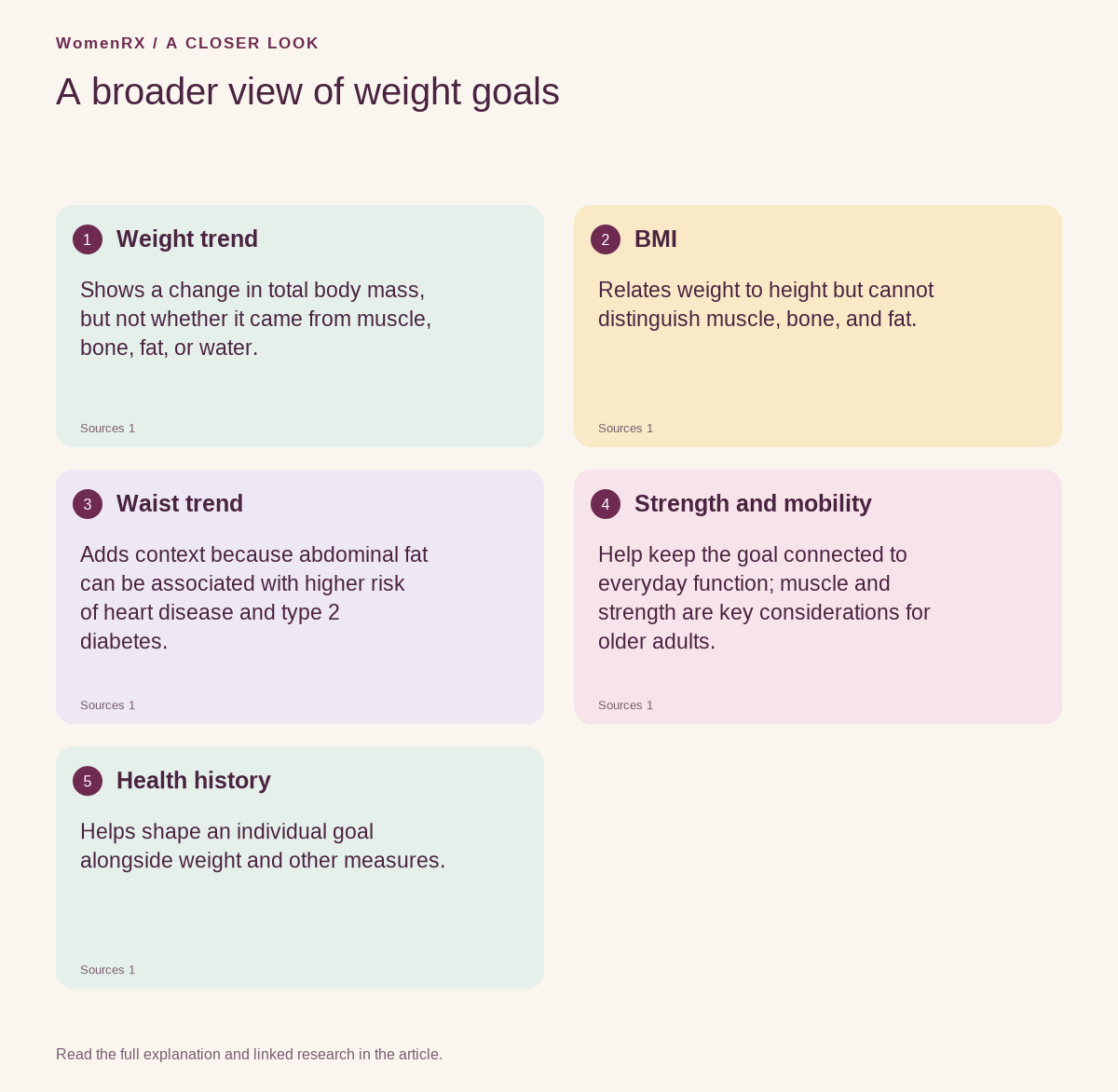
A broader view of weight goals
Weight trend: Shows a change in total body mass, but not whether it came from muscle, bone, fat, or water.1
BMI: Relates weight to height but cannot distinguish muscle, bone, and fat.1
Waist trend: Adds context because abdominal fat can be associated with higher risk of heart disease and type 2 diabetes.1
Strength and mobility: Help keep the goal connected to everyday function; muscle and strength are key considerations for older adults.1
Health history: Helps shape an individual goal alongside weight and other measures.1
Read the figure as text
Compare what the scale can tell you with other useful context. No single measure is a complete assessment.- Weight trend: Shows a change in total body mass, but not whether it came from muscle, bone, fat, or water.1
- BMI: Relates weight to height but cannot distinguish muscle, bone, and fat.1
- Waist trend: Adds context because abdominal fat can be associated with higher risk of heart disease and type 2 diabetes.1
- Strength and mobility: Help keep the goal connected to everyday function; muscle and strength are key considerations for older adults.1
- Health history: Helps shape an individual goal alongside weight and other measures.1
More questions, answered
Is BMI enough to judge whether my weight is healthy?
No. BMI compares weight with height but doesn’t distinguish muscle, bone, and fat. It can also underestimate body fat in some older adults who have lost muscle, so it’s best considered with other information, including health history and waist circumference. 1
Should I ignore weight loss that I didn’t intend?
No. MedlinePlus advises discussing unexpected weight loss with a provider. Don’t assume it’s simply a menopause-related change. 1
Sources you can check
- Body Weight: MedlinePlusAccessed 2026-09-25Return to first citation
- Moderate intensity walking exercises reduce the body mass index and vascular inflammatory factors in postmenopausal women with obesity: a randomized controlled trial.Son WH, Park HT, Jeon BH, Ha MS. · Scientific reports · 2023Return to first citation
- Associations between body composition and bone loss in early postmenopausal women.Geraldi MV, Gregori G, Johansson L, Hjertonsson U, Brättemark E, Lorentzon M. · Journal of bone and mineral research : the official journal of the American Society for Bone and Mineral Research · 2026Return to first citation