Is It Safe to Keep Taking a Fiber Supplement?
If a fiber supplement helps and you tolerate it, the next question is whether your symptoms, medicines, or health conditions call for a closer look.
There’s no single long-term safety answer for every fiber supplement. Studies of psyllium for constipation provide useful short-term information, but they don’t establish years of safety for every fiber type or person. Gas, bloating, and cramps can follow a rapid increase in fiber. If you take levothyroxine, have a persistent change in bowel habits, or need a supplement without getting relief, it’s worth reviewing your plan. 12457
Start with the fiber you’re actually taking
“Fiber supplement” isn’t one ingredient. Psyllium and calcium polycarbophil are examples of bulk-forming agents, while a product containing other ingredients may work differently. Even when two products are sold for constipation, evidence about one shouldn’t be treated as a safety finding for the other. 6
Psyllium has been studied in adults with chronic constipation. In one US trial, 79 adults were assigned to psyllium, prunes, or green kiwifruit for four weeks. All three groups improved on some constipation measures, and adverse events were most common in the psyllium group. That’s a reason to pay attention to how you feel, not proof that psyllium is unsafe to continue. The trial was too short to answer a years-long safety question. 5
A separate four-week trial in 172 adults with functional constipation found no serious adverse events among those assigned psyllium, lactitol, their combination, or placebo. Bowel movement frequency improved in all groups, with no difference from placebo on that measure. Read together, these trials describe short-term experience in particular groups, not a guarantee of benefit or safety with ongoing use. 6
Sort out discomfort from a reason to reassess
A quick increase in dietary fiber can cause gas, bloating, and cramps. If those symptoms began when you added fiber, the change itself may be relevant. Bulk-forming agents also expand with water, so fluid intake matters. Check the directions for your specific product rather than assuming all supplements are prepared the same way. 16
The more useful test of an ongoing routine is whether it’s helping the problem you started it for. For example, if you began psyllium because stools were hard to pass, consider whether passing them has become easier, not just whether you have a bowel movement every day. Daily bowel movements aren’t necessary for everyone. If your bowel habits have changed, however, MedlinePlus recommends checking with a clinician. 2
Constipation can have more than one cause. Medicines may contribute, and the NHS specifically identifies opioid painkillers as an example. It also advises assessment for a sudden change in bowel habits or constipation accompanied by feeling tired all the time. Don’t stop a prescribed medicine on your own to test whether it’s the cause. Persistent constipation deserves a closer look rather than an endless switch between fiber products. 23
One medicine interaction worth checking
Levothyroxine is a concrete reason to review your fiber routine. US prescribing information says dietary fiber may bind levothyroxine in the gut and reduce its absorption. If you take levothyroxine and regularly use a fiber supplement, tell your prescriber or pharmacist what product you use and when you take it. The cited labeling does not establish a single spacing rule for every supplement, so don’t guess at a timing change or adjust your thyroid medicine yourself. 4
Your medical history matters too. A psyllium trial excluded people with conditions such as inflammatory bowel disease, irritable bowel syndrome, and prior bowel surgery. That does not mean a supplement is automatically unsafe with any of those histories. It means the trial’s reassuring short-term findings don’t directly answer the question for those groups. 6
What changes across life stages?
Constipation is common during pregnancy and after giving birth, but that doesn’t establish that a particular fiber supplement has been tested for long-term use at those times. The four-week psyllium-and-lactitol trial excluded people who were pregnant, breastfeeding, planning pregnancy, or had given birth in the previous three months. Its findings also don’t establish a different safety rule for cycling years, perimenopause, or postmenopause. 36
For older adults, a review found that several constipation treatments, including bulk-forming agents, had reasonable short-term safety in trials lasting less than three months. The studies were generally small and of limited quality. Its finding about use for around six months concerned polyethylene glycol, not fiber supplements. 7
If your supplement helps and feels comfortable, there’s no need to treat the calendar alone as proof of a problem. But continued use is worth reassessing when symptoms persist or change, a medicine interaction is possible, or a health condition makes the short-term study findings a poor fit for you. Fruit, vegetables, and whole grains are also sources of dietary fiber if you’re considering how much of your routine comes from food rather than a supplement. 1246
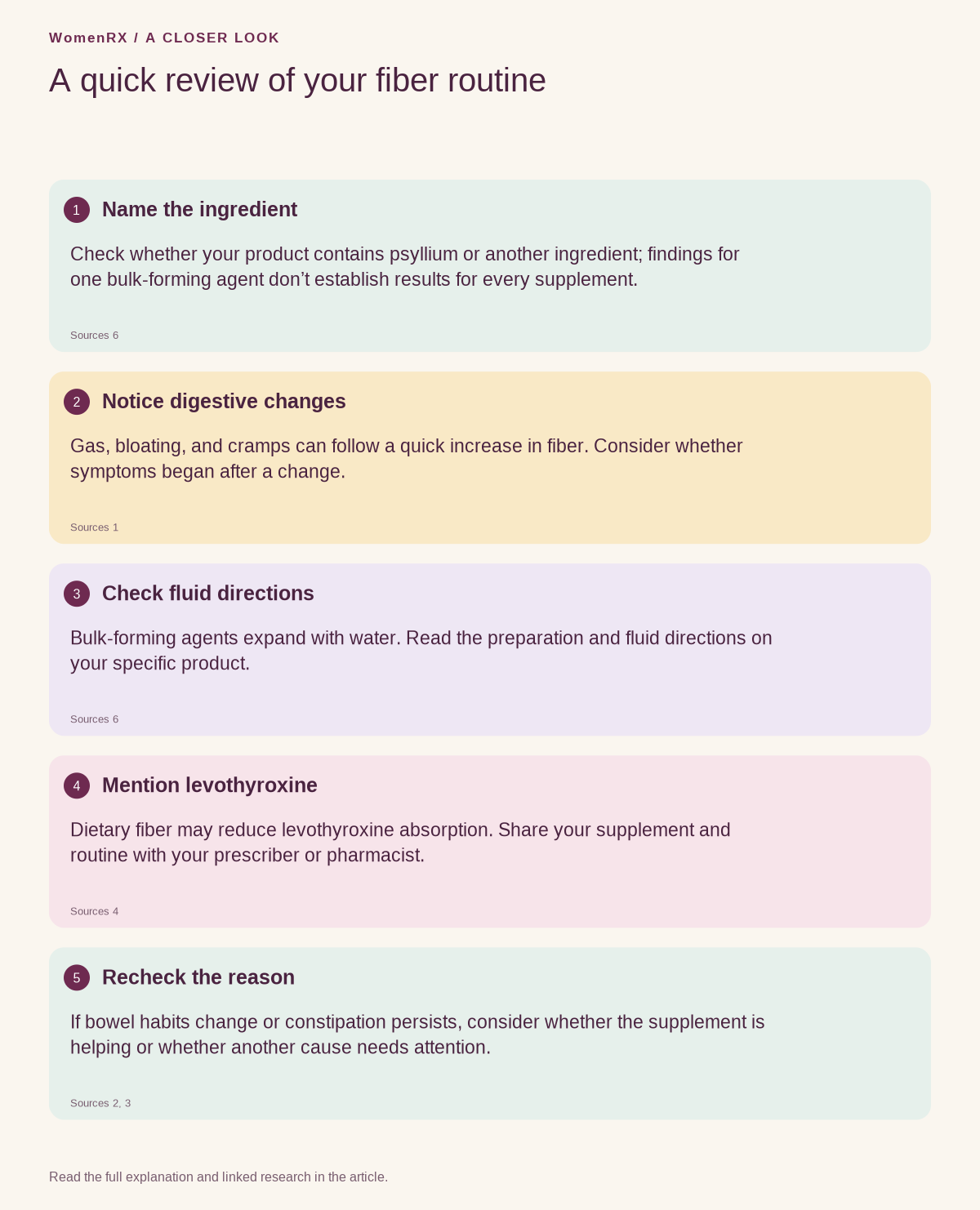
A quick review of your fiber routine
Name the ingredient: Check whether your product contains psyllium or another ingredient; findings for one bulk-forming agent don’t establish results for every supplement.6
Notice digestive changes: Gas, bloating, and cramps can follow a quick increase in fiber. Consider whether symptoms began after a change.1
Check fluid directions: Bulk-forming agents expand with water. Read the preparation and fluid directions on your specific product.6
Mention levothyroxine: Dietary fiber may reduce levothyroxine absorption. Share your supplement and routine with your prescriber or pharmacist.4
Recheck the reason: If bowel habits change or constipation persists, consider whether the supplement is helping or whether another cause needs attention.23
Read the figure as text
These checks help separate an ingredient question, a tolerance issue, and a reason to ask for individualized advice. They are not a diagnostic score.- Name the ingredient: Check whether your product contains psyllium or another ingredient; findings for one bulk-forming agent don’t establish results for every supplement.6
- Notice digestive changes: Gas, bloating, and cramps can follow a quick increase in fiber. Consider whether symptoms began after a change.1
- Check fluid directions: Bulk-forming agents expand with water. Read the preparation and fluid directions on your specific product.6
- Mention levothyroxine: Dietary fiber may reduce levothyroxine absorption. Share your supplement and routine with your prescriber or pharmacist.4
- Recheck the reason: If bowel habits change or constipation persists, consider whether the supplement is helping or whether another cause needs attention.23
More questions, answered
Do I need a fiber supplement to have a bowel movement every day?
No. A daily bowel movement isn’t necessary for everyone. Pay more attention to a change from your usual pattern or stools that are hard or painful to pass. 2
Sources you can check
- Dietary Fiber: MedlinePlusAccessed 2026-09-25Return to first citation
- Constipation | MedlinePlusAccessed 2026-09-25Return to first citation
- Constipation - NHSAccessed 2026-09-25Return to first citation
- LEVOTHYROXINE SODIUM TABLET [CARDINAL HEALTH 107, LLC] | US prescribing information and patient instructionsAccessed 2026-09-25Return to first citation
- Exploratory Comparative Effectiveness Trial of Green Kiwifruit, Psyllium, or Prunes in US Patients With Chronic Constipation.Chey SW, Chey WD, Jackson K, Eswaran S. · The American journal of gastroenterology · 2021Return to first citation
- Influence of Lactitol and Psyllium on Bowel Function in Constipated Indian Volunteers: A Randomized, Controlled Trial.Cheng J, Tennilä J, Stenman L, Ibarra A, Kumar M, Gupta KK, Sharma SS, Sen D, Garg S, Penurkar M, Kumar S, Ouwehand AC. · Nutrients · 2019Return to first citation
- Medical Management of Constipation in Elderly Patients: Systematic Review.Kang SJ, Cho YS, Lee TH, Kim SE, Ryu HS, Kim JW, Park SY, Lee YJ, Shin JE, Constipation Research Group of the Korean Society of Neurogastroenterology and Motility. · Journal of neurogastroenterology and motility · 2021Return to first citation