How to Compare Fiber Supplement Labels by Fiber Type
The ingredient name, fiber amount, and directions matter more than a “best for women” label.
Start with the named fiber and grams per serving, then compare other ingredients and the package’s fluid and timing directions. Psyllium has guideline support for IBS symptoms, while pooled bran studies did not show the same benefit. Glucomannan is notably viscous, but that property alone doesn’t establish how it compares with psyllium for constipation. 5 4
Start with the ingredient, not the promise
A fiber supplement label can tell you what kind of fiber you’re buying and how much is in a serving. It can’t, by itself, show that two products work the same way. Compare the actual fiber ingredient and the directions, rather than relying on broad claims such as “gentle,” “regularity,” or “women’s wellness.”
Soluble and insoluble describe broad fiber categories. Psyllium, also called ispaghula husk, is soluble, and a Canadian IBS guideline found evidence of benefit for psyllium supplementation. That does not mean all soluble fibers have the same clinical evidence or effect. 5
Viscosity is another useful clue, but it isn’t a synonym for “soluble.” A review describes konjac glucomannan as highly viscous and gel-forming. That property alone doesn’t establish that it works as well as psyllium for constipation or IBS. 4
Bulk-forming describes an action, not a separate soluble-or-insoluble category. Fiber can add bulk to stool, but the IBS guideline notes that psyllium’s effects are unlikely to come solely from bulking. A “bulk-forming” description therefore doesn’t tell you that two ingredients have the same evidence or will feel the same to take. 5
What the named fibers can tell you
Psyllium: This is the clearest evidence distinction in the comparison. In the guideline’s review of IBS studies, psyllium improved overall IBS symptoms compared with placebo or no treatment; the guideline also notes it may help with constipation and diarrhea. The result is specific to IBS evidence and shouldn’t be treated as proof that psyllium is best for every kind of constipation. 5
Glucomannan: This fiber is described as highly viscous and gel-forming. A review discusses its interactions with gut microbes, but that is not a head-to-head clinical comparison showing it relieves constipation as well as psyllium. Look at the product’s own stated use and directions rather than translating its texture-related properties into a treatment promise. 4
Bran: This offers a useful contrast if you’re comparing fiber types for IBS symptoms. In the guideline’s pooled analysis, bran did not show a significant benefit, while psyllium did. The bran result covered six studies and 411 participants; it should not be read as a result specifically for wheat bran or for every insoluble fiber. 5
For other ingredients, including methylcellulose or inulin, don’t borrow psyllium’s IBS finding as a product claim. Compare their labels on their own terms rather than treating all products called fiber supplements as equivalent. 5
A quick label check
- Find the exact fiber name. Look beyond the front-of-package wording. If a product contains more than one kind, note each one.
- Compare fiber per serving. Check both the grams of fiber and the serving size. A scoop, capsule count, or other serving unit may not represent the same amount of fiber across products.
- Read the full ingredient list. Record other active ingredients or sweeteners so you’re comparing the fiber itself, not just the overall blend.
- Follow the product’s fluid directions. General constipation guidance includes drinking plenty of water and other liquids, but use the package’s specific instructions for the product you’re considering. 2
- Check timing and medicine advice. Read the package’s directions about other medicines. If you’re unsure whether a product needs to be separated from a medicine you take, ask a pharmacist about that specific combination. Don’t assume one timing rule applies to every fiber or medication.
Tolerability is part of the comparison
Increasing fiber too quickly can bring gas, bloating, or cramps. If you’re adding fiber, increase it gradually rather than jumping straight to a large amount. If a product repeatedly makes you feel worse, that’s useful information about its fit for you; more fiber isn’t automatically better. 1
If you have IBS, the type may matter as much as the amount. The guideline found benefit for psyllium, but not for bran overall, and its discussion distinguishes soluble from insoluble fiber in IBS treatment. The pooled bran result covered six studies and 411 participants; it should not be read as a result specifically for wheat bran. 5
What changes during pregnancy, after birth, or menopause?
Constipation is common during pregnancy and after giving birth. 3 That fact alone doesn’t identify a particular supplement as best for either stage. If you’re shopping during menopause, the same label questions still matter: the ingredient, grams per serving, other ingredients, and directions.
Constipation can also have other contributors, including medicines. If your bowel habits change, or a medicine may be contributing, check with your healthcare provider rather than simply adding more fiber. It isn’t necessary to have a bowel movement every day. 2
Compare fiber properties and IBS evidence
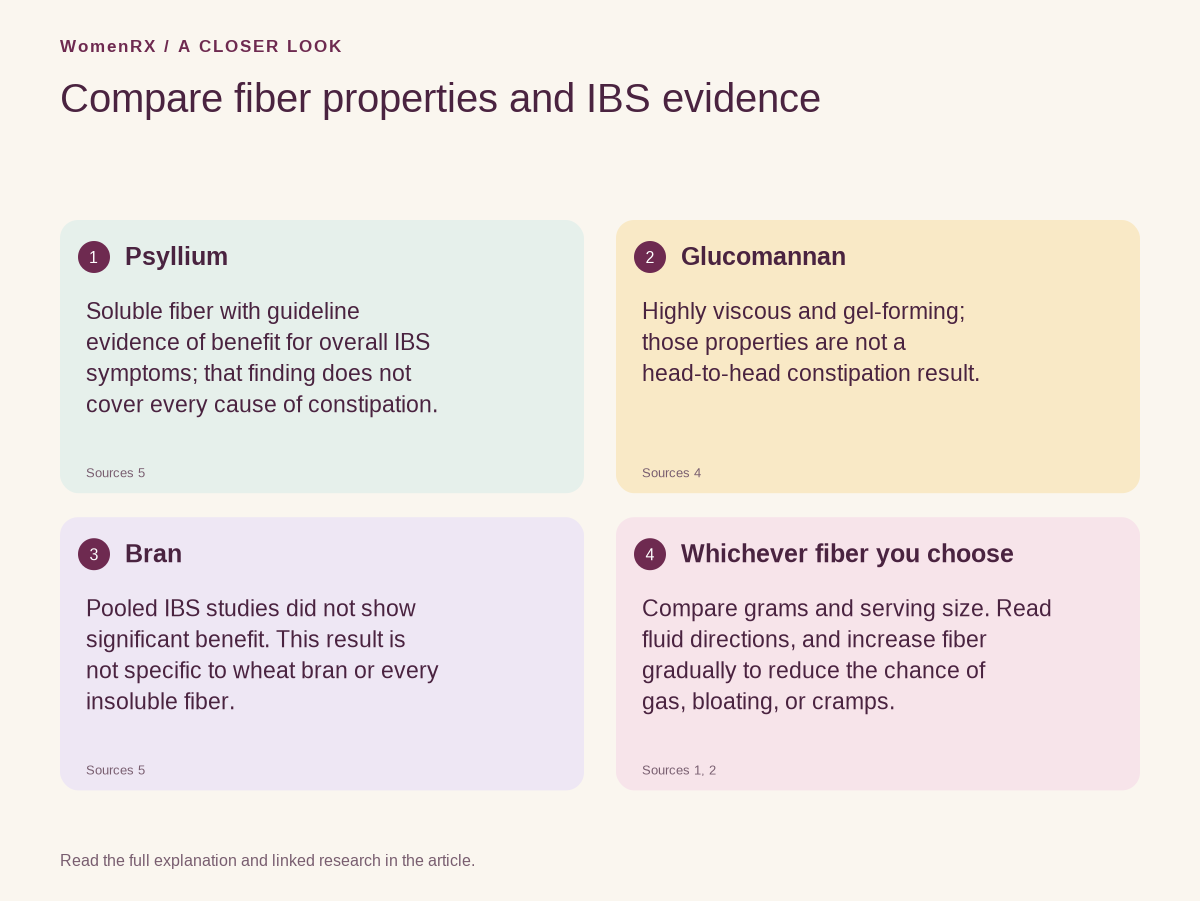
Psyllium: Soluble fiber with guideline evidence of benefit for overall IBS symptoms; that finding does not cover every cause of constipation.5
Glucomannan: Highly viscous and gel-forming; those properties are not a head-to-head constipation result.4
Bran: Pooled IBS studies did not show significant benefit. This result is not specific to wheat bran or every insoluble fiber.5
Whichever fiber you choose: Compare grams and serving size. Read fluid directions, and increase fiber gradually to reduce the chance of gas, bloating, or cramps.12
Read the figure as text
These distinctions separate a fiber’s physical properties from clinical findings. The label check applies whichever ingredient you’re considering.- Psyllium: Soluble fiber with guideline evidence of benefit for overall IBS symptoms; that finding does not cover every cause of constipation.5
- Glucomannan: Highly viscous and gel-forming; those properties are not a head-to-head constipation result.4
- Bran: Pooled IBS studies did not show significant benefit. This result is not specific to wheat bran or every insoluble fiber.5
- Whichever fiber you choose: Compare grams and serving size. Read fluid directions, and increase fiber gradually to reduce the chance of gas, bloating, or cramps.12
More questions, answered
Does psyllium have to be taken every day to help?
The evidence cited here supports psyllium supplementation for IBS symptoms, but it doesn’t establish a universal schedule for every person or product. Follow the specific label directions rather than assuming all psyllium products are used the same way. 5
Is it a problem if I don’t have a bowel movement every day?
Not necessarily. MedlinePlus notes that a daily bowel movement isn’t required; a change in your usual bowel habits is more useful to pay attention to. 2
Sources you can check
- Dietary Fiber: MedlinePlusAccessed 2026-09-25Return to first citation
- Constipation | MedlinePlusAccessed 2026-09-25Return to first citation
- Constipation - NHSAccessed 2026-09-25Return to first citation
- Interaction Between Konjac Glucomannan and Gut Microbiota and Its Impact on Health.Yu Y, Jin S, Yang Y, Han X, Guan R, Zhong H. · Biology · 2025Return to first citation
- Canadian Association of Gastroenterology Clinical Practice Guideline for the Management of Irritable Bowel Syndrome (IBS).Moayyedi P, Andrews CN, MacQueen G, Korownyk C, Marsiglio M, Graff L, Kvern B, Lazarescu A, Liu L, Paterson WG, Sidani S, Vanner S. · Journal of the Canadian Association of Gastroenterology · 2019Return to first citation