Set a Weight Goal That Fits Your Life
Age alone can’t tell you what weight to aim for; your health, strength, daily function, and reason for setting a goal matter too.
There isn’t one ideal weight for each age. Weight is only one part of the picture: it includes muscle, bone, fat, and water, while BMI can miss differences in body composition. Start with the outcome you want, consider your health and daily function, and treat sudden or ongoing unintentional weight change as a reason to look for its cause rather than as a goal. 3 1
Start with the reason, not the number
Before choosing a weight target, name what you hope will change. You might want to feel more comfortable moving, support your overall health, or understand an unexpected shift on the scale. Those are different aims, and they don’t all call for a weight-loss goal.
Try this example: if your main priority is feeling steadier and stronger in everyday activities, define success around strength and function, not just a scale reading. If you’re considering weight change because of a health concern, make that concern part of the conversation rather than assuming a particular number will address it.
Weight can be one useful measure, but it isn’t a full account of health. It includes muscle, bone, fat, and water, and everyday factors can affect it. BMI compares weight with height and can be one risk indicator, but it doesn’t distinguish fat from muscle or bone. It may overestimate body fat in a muscular person and underestimate it in some older adults who have lost muscle. 3
Use a short decision check
1. What outcome matters to you? Choose something concrete and meaningful. Depending on your situation, that could be a health concern you want to address, strength, energy, or how comfortably you manage daily activities. Weight may relate to some health risks, but the scale alone can’t tell you whether you’re making progress on every priority. 3
2. What else is going on with your health? Consider whether a condition, medicine, appetite change, stress, or other life circumstance could affect your weight or what goal makes sense. Unplanned weight change can have many causes, including stress, some medicines, digestive or hormone conditions, and other illnesses. The cause matters because a weight goal won’t answer the question behind an unexpected change. 1 3
3. Would a non-weight measure better match your aim? If your priority is function, focus on function. If you’re concerned about a health issue, keep that issue in view rather than treating weight as a stand-in for every outcome. A clinician can help put weight, BMI, health history, and your priorities together; if weight loss or gain is recommended, a dietitian may provide additional support. 3
4. When will you review the goal? A useful goal should still fit your health and life circumstances as they change. Review whether it is helping with the outcome you chose, and whether it remains realistic and acceptable to you. Don’t treat an age chart as a verdict: available guidance describes weight needs as varying with age, and highlights maintaining muscle and strength in older adults rather than relying on a number alone. 3
Life stage is context, not a target
Pregnancy, recovery after birth, menopause, and older age can change which questions feel relevant, but an age label by itself doesn’t provide a personal target. Pregnancy is a distinct health context, and postpartum recovery can involve physical and emotional changes; it may be more useful to consider recovery and well-being than to measure success against an age-chart number. Postpartum recovery varies, and physical and emotional demands can shape body image and concerns about weight. 2 4
In older age, strength and muscle deserve particular attention. MedlinePlus notes that BMI can underestimate body fat in older adults who have lost muscle, and that keeping muscle and strength is key. A goal focused only on lowering scale weight could miss the outcome that matters most. 3
For menopause, don’t assume that turning a particular age creates a single ideal weight. Use the same questions: What matters to you now? What health or functional issue are you trying to address? What measure would show whether you’re getting there?
Treat unplanned change differently
A goal you choose is different from weight loss you didn’t intend. If you keep losing weight without changing your eating or activity, arrange a check-in with a primary care clinician. Possible causes include stress, appetite or nutrition problems, digestive conditions, hormone conditions, heart conditions, and medicine effects; finding the cause helps determine what to do next. 1
The same principle applies to a sudden, unexpected gain or loss: don’t assume it reflects a successful or failed goal. MedlinePlus advises discussing unexpected changes with a health care provider because they can signal a medical problem. 3
A realistic goal is one that fits the outcome you care about, accounts for your health and life stage, and can be reviewed when circumstances change. Sometimes that will include a weight target. Sometimes the more useful target will be health, strength, or everyday function.
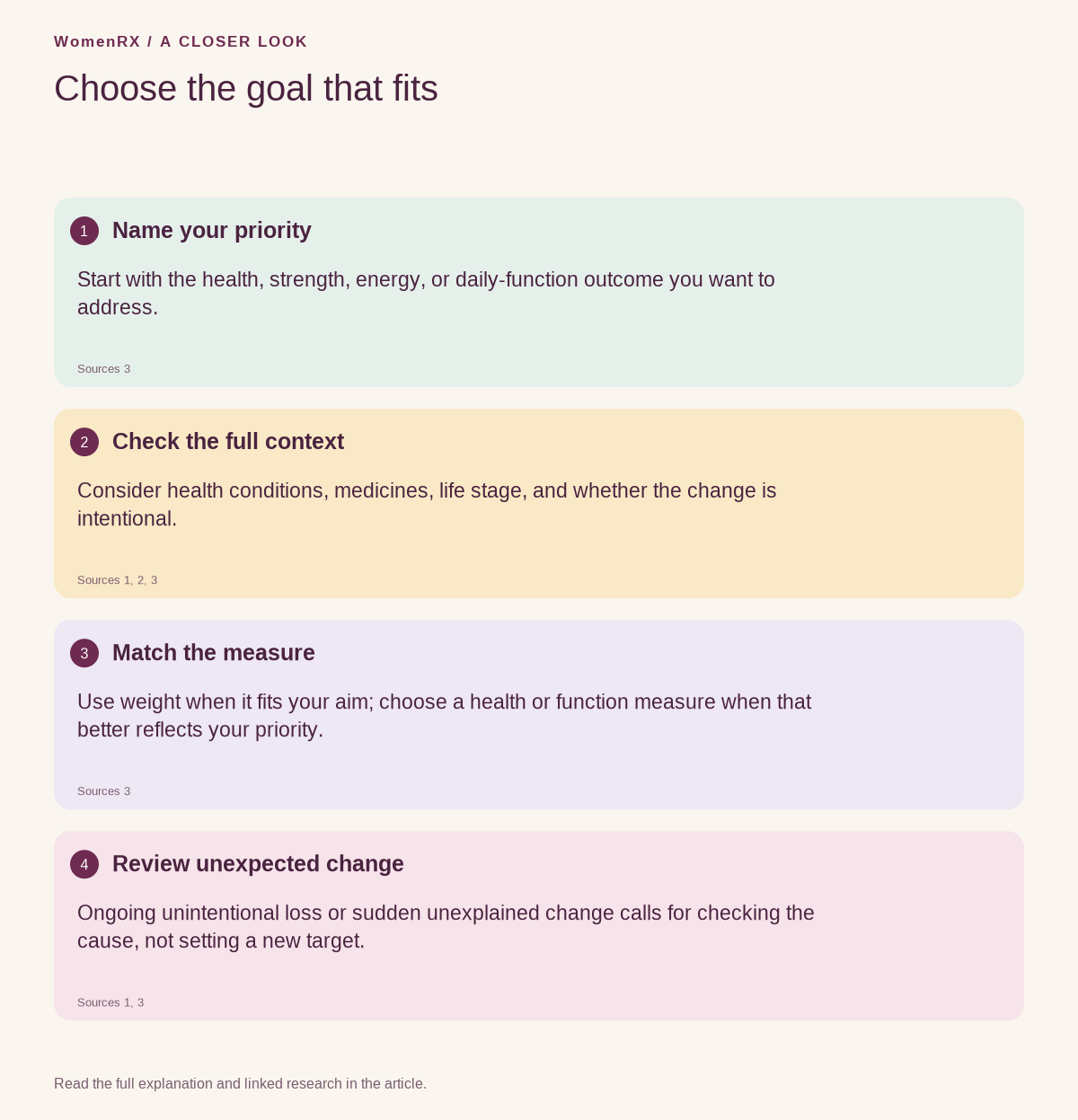
Choose the goal that fits
Name your priority: Start with the health, strength, energy, or daily-function outcome you want to address.3
Check the full context: Consider health conditions, medicines, life stage, and whether the change is intentional.123
Match the measure: Use weight when it fits your aim; choose a health or function measure when that better reflects your priority.3
Review unexpected change: Ongoing unintentional loss or sudden unexplained change calls for checking the cause, not setting a new target.13
Read the figure as text
A simple path from the reason for a goal to the measure that best reflects it, with a separate route for unexpected weight change.- Name your priority: Start with the health, strength, energy, or daily-function outcome you want to address.3
- Check the full context: Consider health conditions, medicines, life stage, and whether the change is intentional.123
- Match the measure: Use weight when it fits your aim; choose a health or function measure when that better reflects your priority.3
- Review unexpected change: Ongoing unintentional loss or sudden unexplained change calls for checking the cause, not setting a new target.13
Sources you can check
- Unintentional weight loss - NHSAccessed 2026-09-25Return to first citation
- Postpartum Care: MedlinePlusAccessed 2026-09-25Return to first citation
- Body Weight: MedlinePlusAccessed 2026-09-25Return to first citation
- Postpartum Women's Body Dissatisfaction: A Systematic Review of Theoretical Models and Regression Analyses.Siqueira MR, Limongi TM, Salzer EB, Bomtempo APD, Meireles JFF, Neves CM. · International journal of environmental research and public health · 2025Return to first citation