How to Choose a Protein Powder That Fits Your Life
The useful comparison is protein per serving, ingredients you can eat, and whether a powder fills a real gap in your day.
Start with what you need the powder to do: make a meal more convenient, help you get enough protein, or support a training routine. Compare grams of protein per labeled serving, identify the protein source, and check everything else in the ingredients. Protein supports muscle, but many Americans get enough from food, and exercise research doesn’t establish a best powder specifically for women. 1 2 4
First, decide what the powder is for
If you’re looking for an easy way to add protein to breakfast or pack a snack after training, a powder may be convenient. It isn’t a requirement for building muscle. Protein comes from everyday foods, including dairy, meat, beans, nuts, and some grains, and most Americans get enough. How much you need depends in part on your age, health, and activity level. 1
Training changes the context, but it doesn’t make the front of a tub a reliable guide. Protein helps build, maintain, and repair muscle; resistance exercise supplies the training stimulus. A powder is one way to add protein if your usual meals aren’t meeting your needs. 2 3
Compare the serving, not just the big number
Find the protein grams and the serving size on the same label. A product advertising more protein may also call for a larger serving. Check how much you’d actually use, then compare products on that basis. A scoop is a manufacturer’s serving, not a protein goal tailored to you.
For perspective, the NIH Office of Dietary Supplements describes a daily protein range of 1.2 to 2.0 grams per kilogram of body weight for athletes. That refers to protein from the whole day’s diet, not an amount to put in one shake or a target for everyone who exercises. 2
More protein after a workout doesn’t guarantee a noticeable recovery benefit. In a randomized study of 27 healthy adults whose usual diets supplied about 0.9 grams of protein per kilogram of body weight daily, adding whey or a whey-like protein for three days after a demanding resistance workout did not improve measured muscle protein synthesis, strength recovery, or soreness compared with a carbohydrate control over the following 72 hours. That short study can’t settle whether a supplement helps someone whose overall intake is too low. 5
Choose a source you can use consistently
Look past words such as “clean” or “made for women” and find the named protein in the ingredients. Whey is dairy-derived, so it won’t fit a dairy-free diet. 5 If you prefer a plant-based powder, you might compare products labeled soy or pea, or a blend. The name of the source alone won’t tell you how much protein the serving provides or what else the powder contains.
Protein quality is worth considering without turning it into a contest between tubs. Animal proteins supply all the amino acids the body can’t make; most plant proteins do not supply them in the same way. MedlinePlus advises eating different plant protein foods across the day to meet amino acid needs. That’s a reason to think about your overall diet, not proof that a plant-based powder can’t support training. 1
If you avoid an ingredient or have a food allergy, read the full ingredient and allergen information on the specific product each time you buy it. A source name on the front won’t tell you everything in a flavored or blended powder. The same goes for added ingredients marketed for energy or performance: multi-ingredient exercise products vary, and findings for one ingredient don’t establish the effects or safety of every combination. 2
Match the training claim to the people studied
A label promising muscle gains may leave out the most useful detail: who was studied? An eight-week trial in 30 untrained male college students found greater improvement in some strength measures with a protein supplement plus resistance training than with training alone. It did not find a significant between-group difference in muscle mass. Because the participants were men, the trial cannot tell you whether women would have the same result. 6
For older adults with sarcopenia, or a high risk of it, a review of 18 trials involving 1,341 participants found that protein or related supplements added to resistance or functional exercise improved pooled measures of grip strength and appendicular muscle mass index, but not timed up-and-go performance. The authors judged the comparative evidence very low certainty and could not identify one definitively superior strategy. Those findings don’t rank retail powders, and the reported results do not establish a separate best choice for women. 4
That distinction matters if your goal changes with age. Supporting strength and day-to-day function is a different question from choosing a convenient shake after a gym session. Muscle-strengthening activity itself helps maintain muscle and strength as people get older. 3
Use a different standard during pregnancy or breastfeeding
Don’t treat a sports-performance claim as evidence that a powder or its added ingredients are a good fit during pregnancy or breastfeeding. The exercise trials described above do not establish suitability for either period. 4 5 6 If food intake is difficult or you’re considering a powder regularly, bring the specific ingredient list to the clinician or dietitian helping with your nutrition so the choice reflects your situation, not a general training claim.
For an everyday purchase, the decision can stay simple: does the serving provide a useful amount of protein for how you eat, does the full ingredient list fit your diet, and will you actually use it? A “for women” label answers none of those questions.
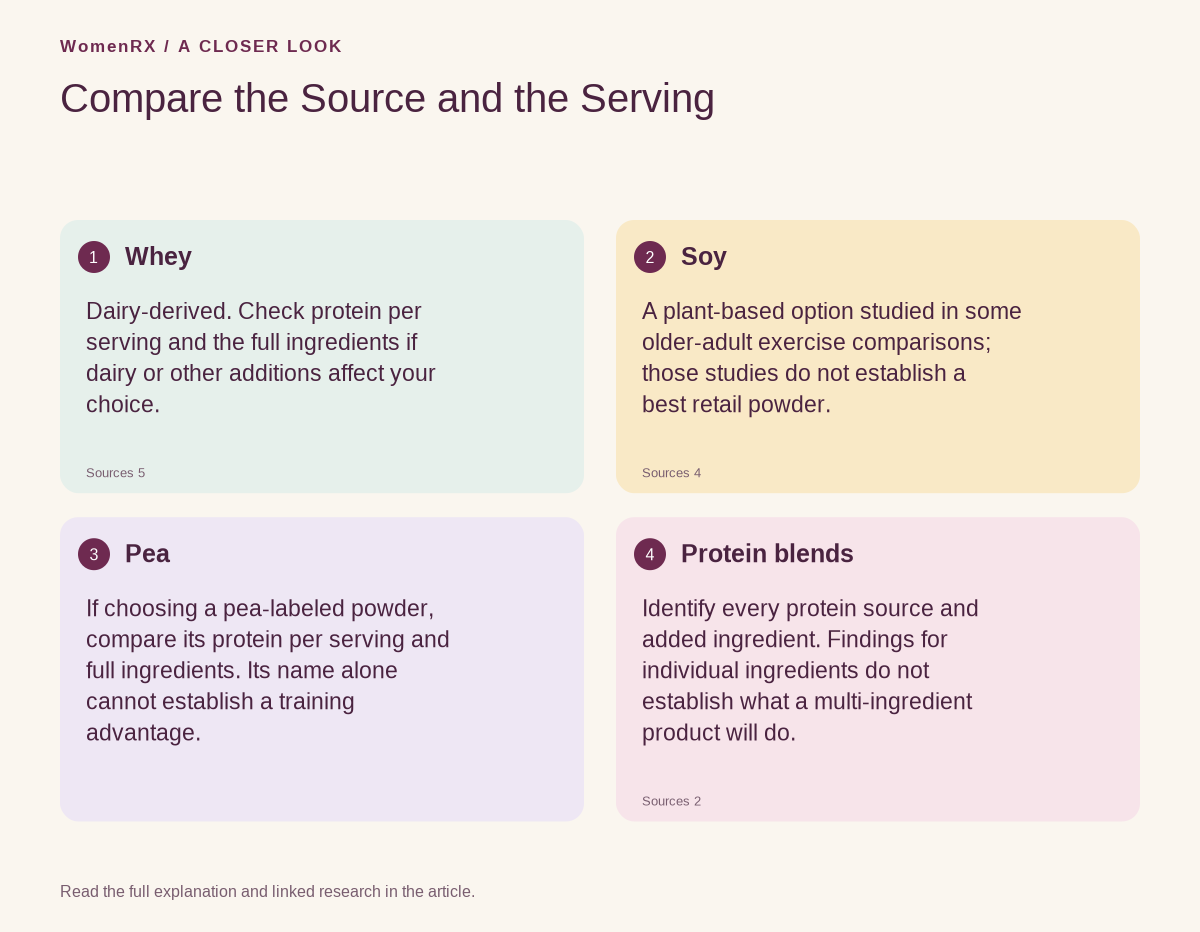
Compare the Source and the Serving
Whey: Dairy-derived. Check protein per serving and the full ingredients if dairy or other additions affect your choice.5
Soy: A plant-based option studied in some older-adult exercise comparisons; those studies do not establish a best retail powder.4
Pea: If choosing a pea-labeled powder, compare its protein per serving and full ingredients. Its name alone cannot establish a training advantage.
Protein blends: Identify every protein source and added ingredient. Findings for individual ingredients do not establish what a multi-ingredient product will do.2
Read the figure as text
Apply the same label checks to different protein sources; none wins on its name alone.- Whey: Dairy-derived. Check protein per serving and the full ingredients if dairy or other additions affect your choice.5
- Soy: A plant-based option studied in some older-adult exercise comparisons; those studies do not establish a best retail powder.4
- Pea: If choosing a pea-labeled powder, compare its protein per serving and full ingredients. Its name alone cannot establish a training advantage.
- Protein blends: Identify every protein source and added ingredient. Findings for individual ingredients do not establish what a multi-ingredient product will do.2
Sources you can check
- Dietary Proteins: MedlinePlusAccessed 2026-09-25Return to first citation
- Dietary Supplements for Exercise and Athletic Performance - Health Professional Fact SheetAccessed 2026-09-25Return to first citation
- Benefits of Exercise: MedlinePlusAccessed 2026-09-25Return to first citation
- Comparative effectiveness of protein or protein-related supplementation combined with resistance or functional exercise for sarcopenia in older adults: a systematic review and network meta-analysis.Yang B, Chen X, Yuan G, Zhang X, Lu D. · Frontiers in nutrition · 2026Return to first citation
- Muscle Recovery and Myofibrillar Protein Synthesis after Damaging Exercise with Recombinant Bovine β-Lactoglobulin, Dairy-Derived Whey or Carbohydrate Supplementation in Young Healthy Adults.Rogers LM, Korzepa M, Belfield AE, Quinlan JI, Wallis GA, Breen L. · The Journal of nutrition · 2026Return to first citation
- Effects of an 8-week liquid protein supplementation on resistance training adaptations in untrained healthy college students.Liu Q, Guo Y, Fan D, Peng B, Wang J, Chen Z, Gu W, Wu J, Niu Z, Wang S, Zhao Y. · PeerJ · 2026Return to first citation