How to Choose a Protein Powder for Training
Protein powder can be convenient, but your diet and the product label matter more than a promise on the tub.
You don’t need a special protein powder because you’re a woman, and you may not need one at all if food meets your needs. Protein needs vary with age, health, and activity level. If a powder would be convenient, compare protein per serving, source, ingredients, testing details, and cost rather than looking for a universal winner. 1 2 3
First, decide what a powder would do for you
Protein comes from foods including meat, dairy, nuts, beans, and some grains. How much you need depends partly on your age, health, and activity level; most Americans get enough from their diets. If food is working for you, a powder isn’t a requirement for strength training. 1
Convenience is a good enough reason to consider one. For example, a shake may be easier to bring along than a meal. The useful question is whether it helps you meet a need in your actual routine, not whether the package says it’s made for women.
Dairy and plant proteins: what the comparison tells you
Whey is an animal-based protein supplement. Animal proteins supply all the amino acids the body can’t make, so whey may be a straightforward choice if it fits your diet. The word whey alone, though, doesn’t tell you how much protein is in a serving or what else the product contains. 1 3
Soy is a plant-based protein described as complete in resistance-training research. In a small trial, 32 postmenopausal women strength trained for 16 weeks and added either soy powder or a placebo powder to milk. The soy group made greater gains on several strength measures, while muscle-mass gains did not differ between groups. Because both groups drank milk, this study doesn’t compare soy with whey or test soy powder on its own. 2 3
Other plant sources may fit if you avoid dairy or prefer plant-based foods. Most plant proteins don’t individually supply all essential amino acids in the amounts needed; eating a variety of plant proteins across the day helps cover them. That doesn’t mean every powder must be a blend. Your overall diet matters, too. 1
There’s no clear winner for every woman who trains. One paper summarizes a meta-analysis in adults under 50 that found modest advantages for animal over plant protein supplements on measures of lean mass, but its summary doesn’t provide a women-specific result. In a separate 10-week trial of peanut protein versus no supplement, researchers found no significant supplement-related differences in training adaptations among the 34 women enrolled. Neither comparison establishes that whey beats every plant powder for women. 3
Read past the front of the package
Start with grams of protein per serving, then check how much powder makes up that serving. Two tubs with similar-sized scoops can provide different amounts of protein. If you avoid an ingredient or have a food allergy, read the full ingredient list rather than relying on a prominent claim on the front.
Next, look at what else you’re buying. A longer ingredient list isn’t automatically a problem, but added ingredients should serve a purpose you want. If a product advertises testing, look for product-specific details about who did the testing and what was tested. A vague testing claim tells you less than those details do.
Finally, compare value using the protein you’d actually get. To calculate cost per 10 grams of protein, divide the package price by the number of servings times the grams of protein per serving, then multiply by 10. This puts different tub and serving sizes on the same footing. Taste and convenience still count: the lowest calculated cost isn’t a bargain if you won’t use the powder.
The training studies above tested particular supplements in particular groups, not the products on a store shelf. They’re useful for understanding the limits of a best protein powder claim, not for ranking brands. 2 3
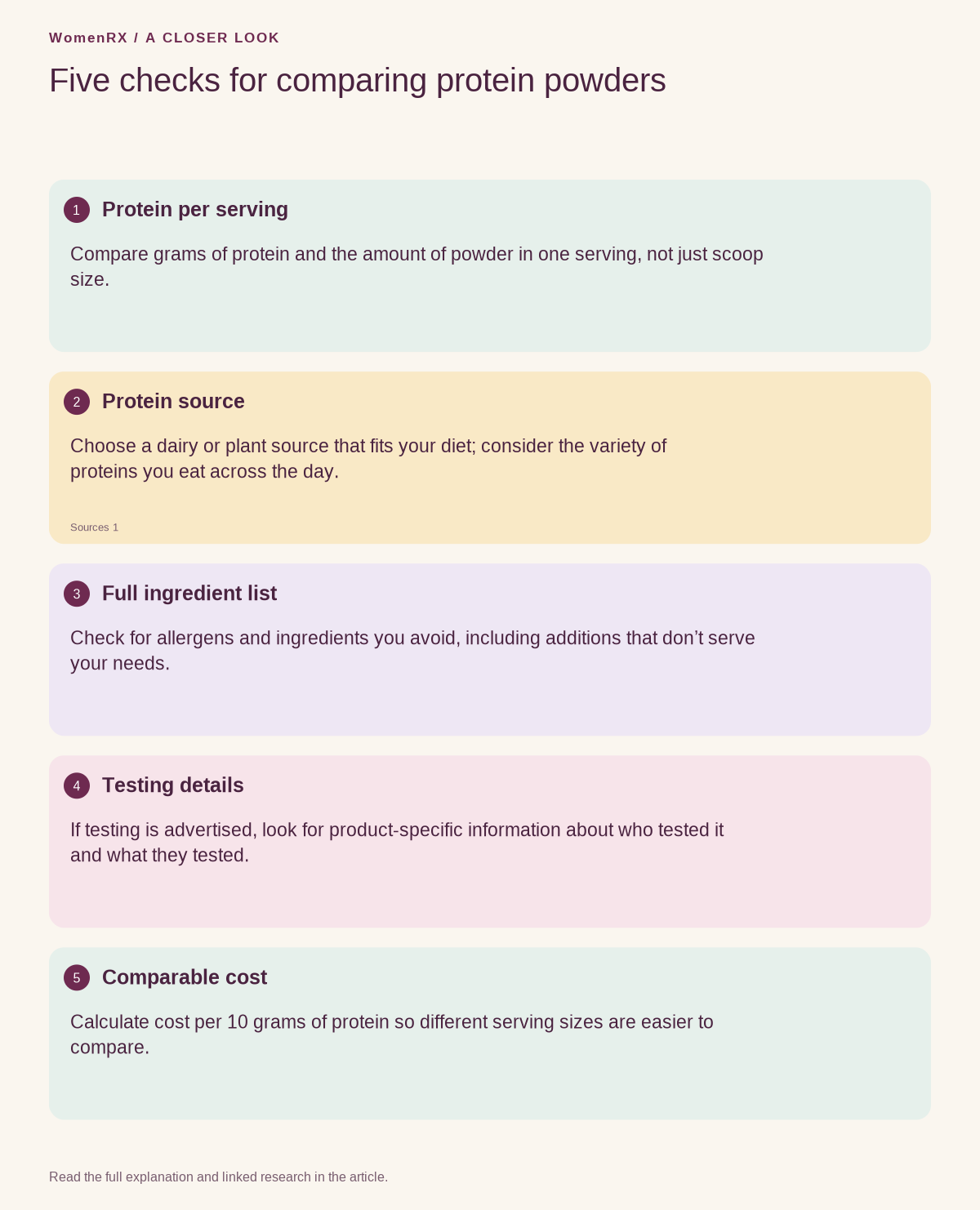
Five checks for comparing protein powders
Protein per serving: Compare grams of protein and the amount of powder in one serving, not just scoop size.
Protein source: Choose a dairy or plant source that fits your diet; consider the variety of proteins you eat across the day.1
Full ingredient list: Check for allergens and ingredients you avoid, including additions that don’t serve your needs.
Testing details: If testing is advertised, look for product-specific information about who tested it and what they tested.
Comparable cost: Calculate cost per 10 grams of protein so different serving sizes are easier to compare.
Read the figure as text
Use these checks to compare what a powder provides, whether it fits your diet, and what it costs.- Protein per serving: Compare grams of protein and the amount of powder in one serving, not just scoop size.
- Protein source: Choose a dairy or plant source that fits your diet; consider the variety of proteins you eat across the day.1
- Full ingredient list: Check for allergens and ingredients you avoid, including additions that don’t serve your needs.
- Testing details: If testing is advertised, look for product-specific information about who tested it and what they tested.
- Comparable cost: Calculate cost per 10 grams of protein so different serving sizes are easier to compare.
More questions, answered
Does a plant-based powder need to contain a blend?
Not necessarily. Eating different types of plant proteins during the day can help you get the amino acids you need; that doesn’t require every powder to combine several sources. 1
Does whey have proven advantages over plant protein for women?
Not on the basis of these comparisons. A paper summarizing a meta-analysis in adults under 50 reports modest advantages for animal protein on some lean-mass measures, but that summary doesn’t provide a women-specific result. The postmenopausal trial added soy or placebo to milk, while the peanut-protein trial compared powder with no supplement. Neither directly compared whey with a plant powder in women. 2 3
Sources you can check
- Dietary Proteins: MedlinePlusAccessed 2026-09-25Return to first citation
- Adding Soy Protein to Milk Enhances the Effect of Resistance Training on Muscle Strength in Postmenopausal Women.Orsatti FL, Maestá N, de Oliveira EP, Nahas Neto J, Burini RC, Nunes PRP, Souza AP, Martins FM, Nahas EP. · Journal of dietary supplements · 2018Return to first citation
- Effects of Peanut Protein Supplementation on Resistance Training Adaptations in Younger Adults.Sexton CL, Smith MA, Smith KS, Osburn SC, Godwin JS, Ruple BA, Hendricks AM, Mobley CB, Goodlett MD, Frugé AD, Young KC, Roberts MD. · Nutrients · 2021Return to first citation