Protein Powder: How to Choose and Whether You Need It
The useful first question isn’t which powder is best. It’s whether your usual meals leave a protein gap.
You may not need protein powder at all: most Americans get enough protein from food, though needs vary with health and activity.1 If a powder would help fill a gap, compare protein per serving, source, allergens, and other ingredients. Ask for details behind any independent-testing claim. Research suggests supplements can add to resistance-training gains, but it doesn’t establish a women-specific advantage.2
Start with the gap, not the tub
Protein helps your body build and maintain muscle, along with bones and skin. You can get it from foods such as dairy, meat, beans, nuts, and grains. How much you need varies with your age, health, and activity level, and most Americans get enough from their usual diet.1
That makes the first decision practical: would a powder supply protein you’re otherwise missing? For example, if breakfast is often just coffee and you want a convenient way to add protein, a powder might suit your routine. If your meals already provide enough, adding a shake isn’t automatically an upgrade. The training research below compares supplements with placebo; it does not establish an added benefit from powder when your diet already supplies enough protein.12
What training research can tell you
A review of 36 randomized trials involving 1,552 adults compared protein supplements with placebo during supervised resistance training lasting at least six weeks. Whey ranked highest for gains in lean body mass in that analysis, with an estimated 1.24 kg greater gain than placebo; the 95% credible interval was 0.61 to 1.87 kg. That’s a result across trial conditions, not a prediction for your body or evidence that whey beats a sufficient diet made from food. Comparisons involving plant proteins were less certain, so the rankings aren’t a sound reason to dismiss soy or pea powder.2
There is research involving women, but it answers a different question. In one eight-week trial, women with overweight ages 40 to 53 who did resistance training while eating a high-protein diet improved muscle and strength measures compared with a non-training control group. Because the study combined training and diet rather than comparing powders, it cannot tell you whether a powder added benefit or whether women need a particular protein source. The supplement review did not establish a different response or protein-source need for women.32
Compare products by the job you want them to do
Protein per serving: Read the grams of protein for the serving you would actually use, not just the size of the scoop or a claim on the front. A larger serving isn’t inherently better; the useful amount depends on what the rest of your eating already provides.
Protein source and allergens: Whey, milk, and casein are dairy-derived options studied in resistance-training trials; soy and pea are plant-based options.2 Check the ingredient statement for any source you’re allergic to or avoid. A broad description such as “plant-based” or “protein blend” isn’t enough to identify every ingredient. Plant-based eating can provide the amino acids you need through a variety of protein foods across the day.1 The review does not establish that everyone should choose dairy protein for training.2
Everything besides protein: A product sold as protein powder may also contain sweeteners, flavors, or other added ingredients. Compare the full ingredient list with what you want from the product. If your goal is simply to add protein to a meal, extra ingredients aren’t automatically useful for that goal. The training review compared protein sources, not the merits of every ingredient in a finished commercial blend.2
Independent quality verification: If a product claims independent testing, look for details that identify the testing organization, the specific product it checked, and what it tested for. A statement on the front of a tub alone doesn’t answer those questions. No particular testing program or certification is evaluated here, so this comparison cannot tell you which seal to trust or what it guarantees. Verification is also a separate question from how much protein a serving contains or whether its ingredients suit you.
Pregnancy and breastfeeding call for a product review
Don’t use resistance-training results in adults to judge a powder for pregnancy or breastfeeding.2 During pregnancy, nutrition decisions involve more than protein alone: NIH guidance addresses several nutrients with pregnancy-specific considerations and urges caution with botanical supplements.4 As a practical precaution, if you’re considering a powder, especially one with added vitamins, minerals, or botanicals, bring its full label and a list of any prenatal supplements you take to your prenatal care clinician. That gives you a way to review the specific ingredients together, rather than treating a training claim as evidence that the product suits pregnancy.
As a practical precaution, if you’re breastfeeding, review a specific powder’s ingredients with your care clinician as well. The resistance-training research cannot establish whether a particular blend is suitable while breastfeeding.23
A sensible choice is the one that fits a real dietary need and your food preferences. Check what a serving supplies, then decide whether a powder would be easier or more appealing than using food to fill the gap.1
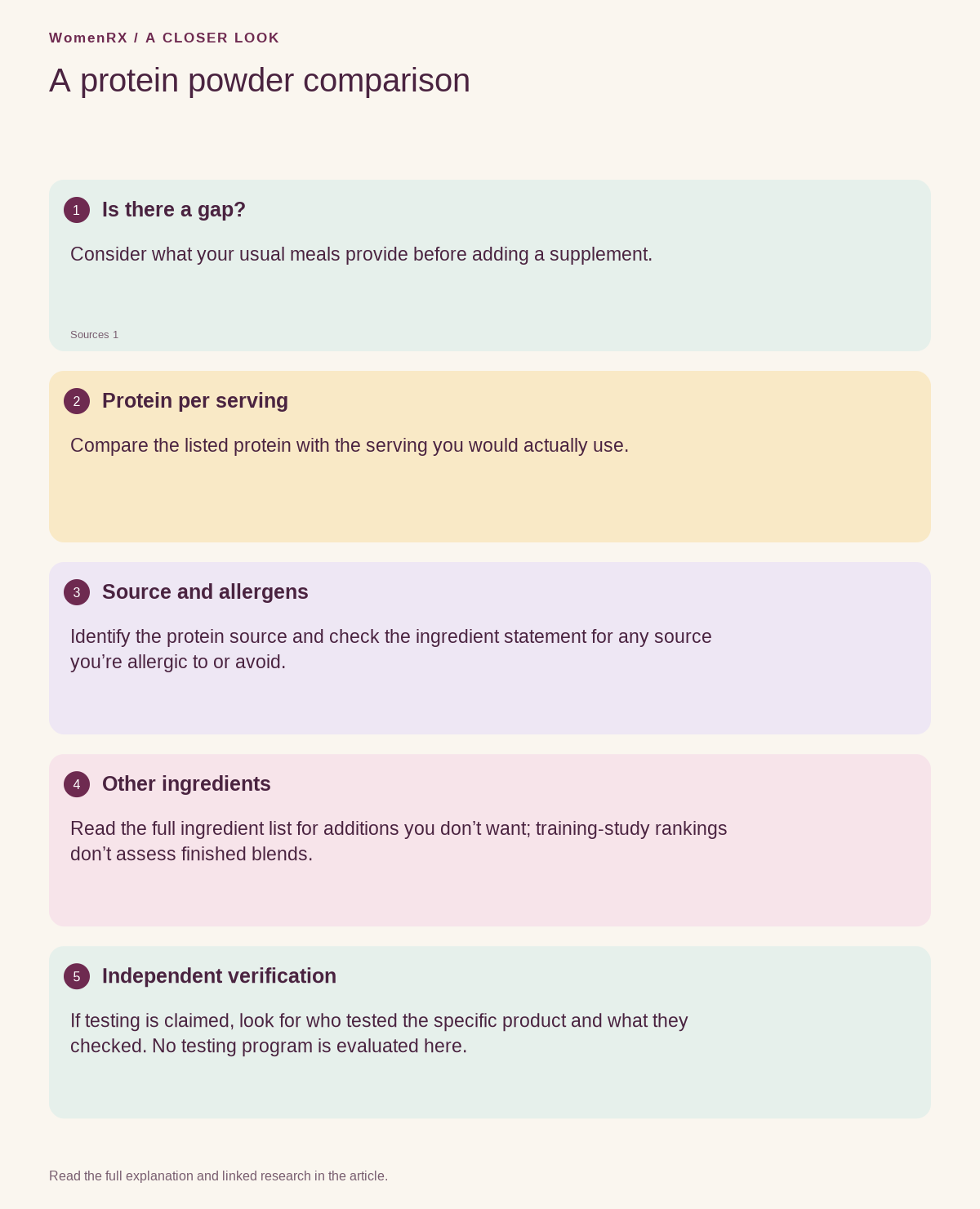
A protein powder comparison
Is there a gap?: Consider what your usual meals provide before adding a supplement.1
Protein per serving: Compare the listed protein with the serving you would actually use.
Source and allergens: Identify the protein source and check the ingredient statement for any source you’re allergic to or avoid.
Other ingredients: Read the full ingredient list for additions you don’t want; training-study rankings don’t assess finished blends.
Independent verification: If testing is claimed, look for who tested the specific product and what they checked. No testing program is evaluated here.
Read the figure as text
Use these questions to decide whether a product fits the protein gap you’re trying to fill. This is a shopping aid, not a score.- Is there a gap?: Consider what your usual meals provide before adding a supplement.1
- Protein per serving: Compare the listed protein with the serving you would actually use.
- Source and allergens: Identify the protein source and check the ingredient statement for any source you’re allergic to or avoid.
- Other ingredients: Read the full ingredient list for additions you don’t want; training-study rankings don’t assess finished blends.
- Independent verification: If testing is claimed, look for who tested the specific product and what they checked. No testing program is evaluated here.
More questions, answered
Is plant protein powder a poor choice for building muscle?
This review does not establish that plant protein is a poor choice. Its estimates for plant-based supplements during resistance training were less certain than those for dairy-derived ones, with wide credible intervals. It did not establish that soy or pea powder cannot help someone meet her protein needs.2
Sources you can check
- Dietary Proteins: MedlinePlusAccessed 2026-09-25Return to first citation
- Dose-structure-population interactions of protein supplementation combined with resistance training on body composition: a Bayesian network meta-analysis with dose-response modeling.Li Y, Qin G, Wang Z, Zhang J. · Frontiers in nutrition · 2026Return to first citation
- Effects of 8 Weeks of Resistance Training Combined with a High-Protein Diet and Omega-3 Supplementation on Body Composition, Muscular Performance, and Muscle-Related Biomarkers in Overweight Women.Radfar B, Bagheri R, Ghobadi H, Hematabadi A, Askari B, Rashidlamir A, Dutheil F. · Nutrients · 2026Return to first citation
- Dietary Supplements and Life Stages: Pregnancy - Health Professional Fact SheetAccessed 2026-09-25Return to first citation