Protein Supplements: How to Choose One When Food Falls Short
A protein powder is a convenience, not a requirement: first work out whether your usual meals leave a gap, then choose a product that fits your diet.
Most Americans get enough protein from food, though needs vary with age, health, and activity. If a supplement would help with a practical eating gap, compare the named protein source, amount per serving, serving size, and other ingredients. Reviews of exercise studies in women do not establish which protein source is best for muscle outcomes. 1 2 3
Start with the gap, not the tub
Protein helps the body build and maintain muscle, bones, and skin. You can get it from foods such as meat, dairy, nuts, grains, and beans. Your needs depend partly on age, health, and physical activity, and most Americans get enough from their diets. So a protein supplement is most useful when it solves a real-life problem, such as regularly missing a protein-containing meal because of schedule, appetite, or food preferences. 1
Think about your usual eating pattern across the day rather than assuming one workout means you need a powder. For example, if you regularly eat protein-containing foods at meals and snacks, a supplement may not fill a meaningful gap. If a shake would make it easier to eat after exercise or on days when a meal is difficult to fit in, convenience may be its main benefit. The label can tell you what is in the product; it can’t tell you whether you need it.
What women’s muscle research can, and can’t, tell you
Research does not support a blanket claim that every woman who exercises will gain muscle by adding a protein supplement. A 2025 meta-analysis of nine randomized trials involving 408 healthy women aged 18 to 73 found that multi-ingredient protein supplements combined with exercise were associated with an average increase in fat-free mass and improvements in measured muscle size and strength. The analysis did not find significant effects on fat mass or physical-function outcomes. These findings apply to the tested combinations and exercise programs, not automatically to every protein powder. 2
A separate 2026 review pooled 14 trials involving 763 women across reproductive stages. It combined studies of whole-protein supplements with studies of amino acids, related compounds, and creatine. Supplementation plus exercise did not significantly improve the pooled measures of muscle mass, though some strength measures improved. Because the review grouped different kinds of supplements, it cannot tell you which particular protein source is best. 3
For older women, the practical takeaway is not “more protein is always better.” In the women’s meta-analysis, some subgroup results suggested greater fat-free-mass gains among older participants, but those results came from a small set of trials. A review focused on postmenopausal women found that strength training consistently improved outcomes, while adding protein showed no significant extra effect on lean mass or strength in the studies reporting a minimum intake of 0.8 g/kg body weight. Taken together, age alone doesn’t establish that you need a supplement; your eating pattern and training context matter. 2 4
Choose a product that fits what you eat
Start with your food preferences and restrictions, then read the product’s stated protein source and full ingredient list. If you’re comparing powders labeled whey, soy, or pea, treat those names as product details to check, not as a ranking of what works best for women’s muscles.
The exercise reviews discussed here do not establish which of those sources produces better muscle outcomes in women. MedlinePlus advises eating different types of plant proteins during the day to get the amino acids you need. That general food guidance does not establish the amino-acid profile of a particular powder or predict its results in training. 1 2 3
Once the source fits your diet, compare the label in this order:
- Protein per serving: Compare the amount listed for the serving you would actually use.
- Serving size: Check how much powder the listed protein amount refers to.
- Protein source: Check what the product says it contains against your preferences or restrictions.
- Other ingredients: Review the ingredient list for anything else you want to avoid or account for.
This is a practical comparison, not a ranking of brands. A particular source, a longer ingredient list, or a product marketed to women doesn’t guarantee better muscle results.
Pregnancy, breastfeeding, and medical needs
The women’s exercise reviews do not establish which protein supplements are appropriate during pregnancy or while breastfeeding. Their findings also cannot determine whether a powder fits a prescribed eating plan. Protein needs vary with health. 1 2 3
If you have questions about a product while pregnant or breastfeeding, or about how it fits a prescribed eating plan, discussing its ingredient list and serving information with a health professional is an option. The exercise findings don’t provide product-specific answers for these situations. 1 2 3
A useful decision is often simpler than choosing a product: first ask whether your regular food pattern leaves a practical gap. If it does, compare a few labels for source, serving size, and protein amount. If it doesn’t, you don’t need to buy a supplement just because you train or because the package is aimed at women.
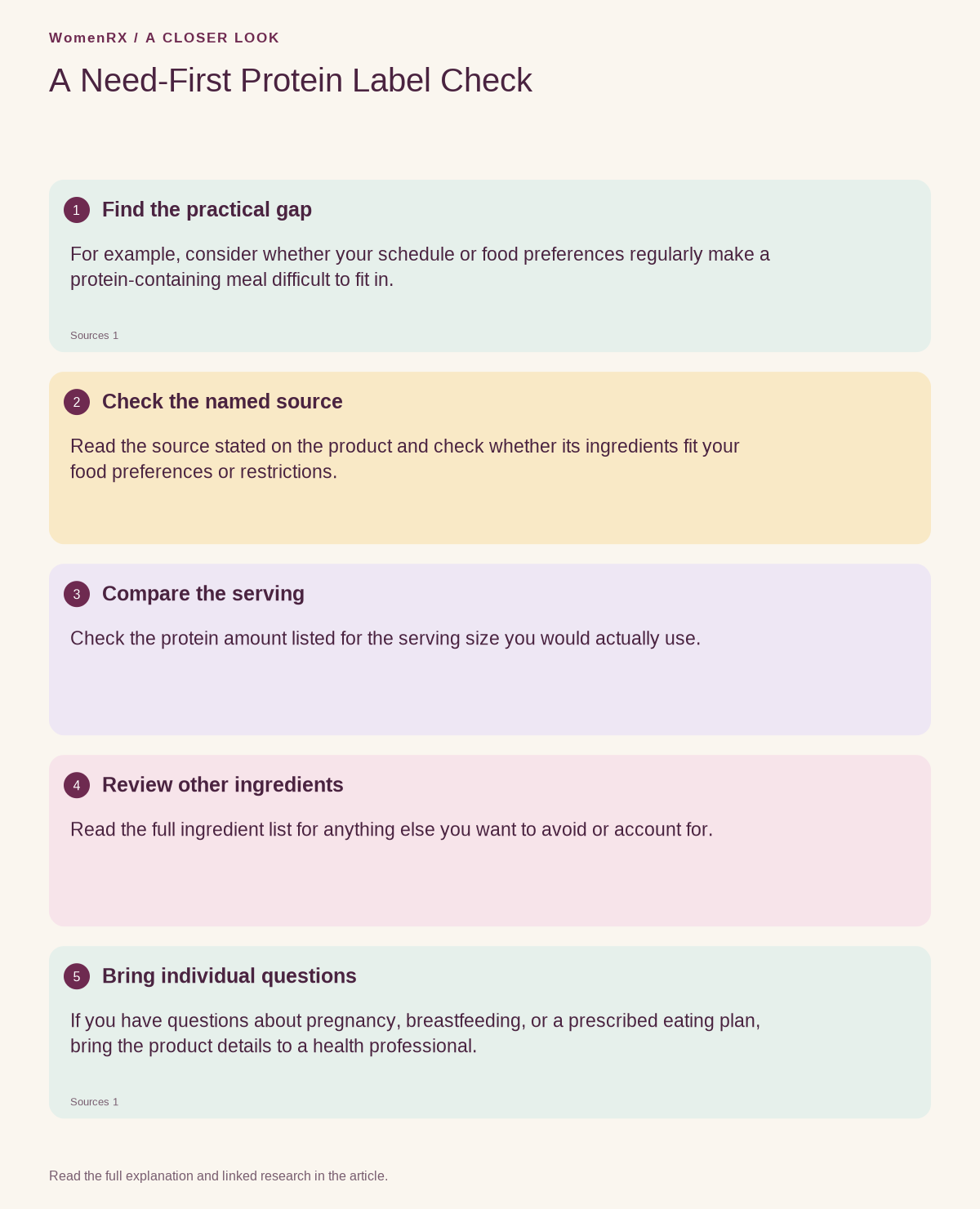
A Need-First Protein Label Check
Find the practical gap: For example, consider whether your schedule or food preferences regularly make a protein-containing meal difficult to fit in.1
Check the named source: Read the source stated on the product and check whether its ingredients fit your food preferences or restrictions.
Compare the serving: Check the protein amount listed for the serving size you would actually use.
Review other ingredients: Read the full ingredient list for anything else you want to avoid or account for.
Bring individual questions: If you have questions about pregnancy, breastfeeding, or a prescribed eating plan, bring the product details to a health professional.1
Read the figure as text
Use this short path to decide whether a powder solves a real eating-pattern gap and compare products without assuming one source works best.- Find the practical gap: For example, consider whether your schedule or food preferences regularly make a protein-containing meal difficult to fit in.1
- Check the named source: Read the source stated on the product and check whether its ingredients fit your food preferences or restrictions.
- Compare the serving: Check the protein amount listed for the serving size you would actually use.
- Review other ingredients: Read the full ingredient list for anything else you want to avoid or account for.
- Bring individual questions: If you have questions about pregnancy, breastfeeding, or a prescribed eating plan, bring the product details to a health professional.1
More questions, answered
Does protein powder work without exercise?
The women’s findings cited here studied supplementation alongside exercise, so they do not establish that protein powder alone improves muscle outcomes in women. 2 3
Is one protein source better for women?
These exercise reviews don’t establish whether whey, soy, or pea protein produces better muscle outcomes in women. Choose based on your eating pattern and preferences, then compare the serving size, protein amount, and other ingredients on the label. 2 3
Sources you can check
- Dietary Proteins: MedlinePlusAccessed 2026-09-25Return to first citation
- Effects of multi-ingredient protein supplementation combined with exercise intervention on body composition and muscle fitness in healthy women: a systematic review with multilevel meta-analysis.Zhou C, Qiu M, Zeng Z, Xie Q, Xu K, Yan H, Wang B, Qiu B, Shi G. · Frontiers in nutrition · 2025Return to first citation
- Nutritional Supplementation Combined with Exercise for Musculoskeletal Health in Women: A Systematic Review and Meta-Analysis Evaluating Proteins, Amino Acids, and Creatine across Reproductive Stages.Chen KH, Yeh TP, Lin SC, Liu PJ, Bai D, Chen IH. · International journal of medical sciences · 2026Return to first citation
- Analysis of the Additive Effects of Nutritional Strategies in Strength Training Interventions on Body Composition, Muscle Strength and Bone Mineral Density in Postmenopausal Women: A Systematic Review.Walter F, Schalla J, Bloch W, Diel P, Geisler S, Isenmann E. · Sports medicine - open · 2026Return to first citation