Can Protein Supplements Cause Weight Gain?
A shake can add calories to your day, but whether it affects your weight depends largely on what it adds or replaces.
Yes, a shake could contribute to weight gain if it regularly adds calories to your usual intake. Check the calories for the amount of powder you actually use, include anything mixed into the drink, and compare it with the food the shake replaces. A scale change alone can’t show whether fat, muscle, bone, or water changed. 1
The shake is part of the whole day
This evidence doesn’t establish what routine protein powder use does to body fat: neither example tested protein powder alone in healthy adults. 2 3 A prepared shake can still add calories to your usual intake, which is a separate question from what changes in body composition. 1 Check the label for the amount of powder you use, and include any ingredients you mix in when you compare the full drink with other foods.
If you have a shake on top of your usual meals and snacks, you’re adding something to your day. If you use it instead of a snack or another food, it may take that food’s place rather than simply adding to your intake. MedlinePlus describes extra calories within a balanced diet as one way to support weight gain, though that general guidance doesn’t tell us exactly what a particular protein shake will do for you. 1
That distinction is more useful than asking whether protein powder is inherently “fattening.” The same powder could be used in different ways, and the rest of your eating pattern matters.
Check the serving, not just the scoop
A label-reading check can help you see what you’re actually adding:
- Find the serving size. Check how much powder the nutrition information describes. A scoop is useful only if it matches the label’s serving.
- Look at calories for that serving. Use the number for the amount you expect to use, not automatically the label’s suggested serving.
- Count what you mix in. If you make a shake with other ingredients, include those too. The powder label won’t describe the full drink you made.
- Compare it with what it replaces. Ask whether the shake is an extra, or whether it takes the place of a snack or another part of a meal.
This won’t predict a precise change in weight. It does show whether the shake is likely to be a meaningful addition to your usual intake.
The scale can’t tell you what changed
Body weight includes muscle, bone, fat, and water. A change on the scale, by itself, can’t tell you which of these changed. 1 That’s one reason weight gain and fat gain aren’t interchangeable terms.
Research on nutritional supplements also doesn’t mean every increase in weight is an increase in fat. In a randomized trial of children with or at risk of undernutrition, adding a complete nutritional drink alongside counseling increased weight and lean mass compared with counseling alone over 240 days; the groups did not differ in fat mass index. The children were young, undernourished or at risk, and received a complete supplement, so those results don’t predict what a protein powder will do for an adult. 2
A separate trial in adults with severe COPD tested individualized nutritional care, which could include supplements, rather than protein powder alone. Intake of energy and protein increased, but the study found no significant between-group difference in body composition over three months. This is a different clinical situation, not a direct test of everyday shakes. 3
What the evidence means for women
These examples don’t establish whether protein shakes cause weight gain in healthy women across adulthood, or whether effects differ during cycling years, pregnancy, lactation, perimenopause, or after menopause. The child trial is not evidence about adult women. The COPD trial involved adults with a serious condition and a broader nutrition program; its reported greater benefits among men don’t tell us what a protein-only supplement would do in women. 2 3
For your own decision, focus first on the label and the role the shake plays in your day. If you want it as an extra, consider whether that addition fits your needs. If it’s replacing something, compare the whole shake with the food it replaces rather than judging by protein grams alone.
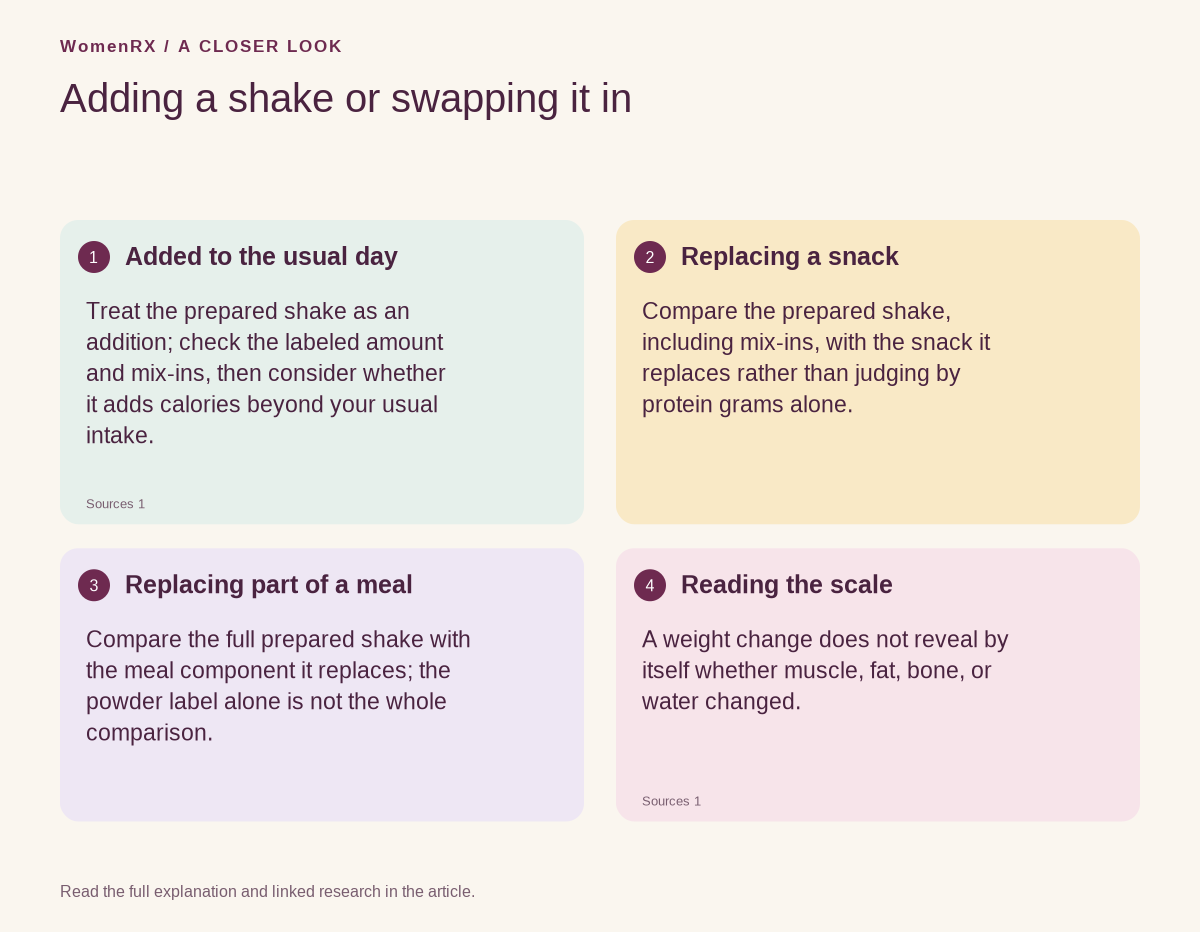
Adding a shake or swapping it in
Added to the usual day: Treat the prepared shake as an addition; check the labeled amount and mix-ins, then consider whether it adds calories beyond your usual intake.1
Replacing a snack: Compare the prepared shake, including mix-ins, with the snack it replaces rather than judging by protein grams alone.
Replacing part of a meal: Compare the full prepared shake with the meal component it replaces; the powder label alone is not the whole comparison.
Reading the scale: A weight change does not reveal by itself whether muscle, fat, bone, or water changed.1
Read the figure as text
The shake’s role in your day changes whether it’s an addition or a replacement. Compare the full prepared drink with the food it takes the place of, if any.- Added to the usual day: Treat the prepared shake as an addition; check the labeled amount and mix-ins, then consider whether it adds calories beyond your usual intake.1
- Replacing a snack: Compare the prepared shake, including mix-ins, with the snack it replaces rather than judging by protein grams alone.
- Replacing part of a meal: Compare the full prepared shake with the meal component it replaces; the powder label alone is not the whole comparison.
- Reading the scale: A weight change does not reveal by itself whether muscle, fat, bone, or water changed.1
More questions, answered
Does gaining weight mean I gained body fat?
Not necessarily. Body weight includes muscle, bone, fat, and water, so the scale alone can’t identify what changed. 1
Do studies show the same effect in women at different life stages?
These studies don’t establish effects for women across adulthood or compare pregnancy, lactation, cycling years, perimenopause, and postmenopause. The examples involve young children or adults receiving broader nutrition care for severe COPD, not healthy women using protein powder alone. 2 3
Sources you can check
- Body Weight: MedlinePlusAccessed 2026-09-25Return to first citation
- Efficacy of long-term oral nutritional supplementation with dietary counseling on growth, body composition and bone mineralization in children with or at risk for undernutrition: a randomized controlled trial.Ow MYL, Tran NT, Berde Y, Nguyen TS, Tran VK, Jablonka MJ, Baggs GE, Huynh DTT. · Nutrition journal · 2025Return to first citation
- Individualized nutritional care including adherence support improves health-related quality of life in individuals with severe chronic obstructive pulmonary disease: a randomized controlled trial.Hegelund MH, Ritz C, Olsen MF, Mølgaard C, Nielsen TL, Jensen AV, Søborg C, Braagaard L, Krogh-Madsen R, Lindegaard B, Faurholt-Jepsen D. · Health and quality of life outcomes · 2026Return to first citation