Weight Gain in Your 40s: Is Perimenopause One Factor?
Changing periods can make perimenopause plausible, but weight gain alone can’t identify its cause.
If you’re in your 40s and your periods have become less predictable, perimenopause could be one part of the picture. But weight change alone can’t confirm it. The scale reflects more than body fat, and midlife changes in body composition don’t mean hormones are the sole cause. Cycle changes, other symptoms, health history, and recent medication changes can help guide what to check next. 1 2 3
If you’re gaining weight in your 40s, perimenopause is a possibility, not a diagnosis. Pay attention to whether your menstrual pattern has changed, whether the change is mainly in your waist or on the scale, and whether you have other symptoms or health changes. Those details can help you and a clinician decide whether to look at menopause, another health condition, or more than one factor.
Start with your cycle, not the scale alone
Periods can become irregular as menopause gets closer. That makes a new cycle change useful context, but it doesn’t prove perimenopause is causing weight gain. Irregular periods can also have other causes, including thyroid problems and polycystic ovary syndrome (PCOS). 1
Consider what has changed: Are your periods arriving at different intervals, lasting longer, or appearing between periods? Have you also noticed tiredness, new facial hair, or changes in your skin? The NHS guidance specifically flags irregular periods alongside weight gain, tiredness, facial hair, or dry or oily skin as a reason to seek an assessment. 1
Ask what kind of change you’re seeing
A number on the scale can’t distinguish fat from muscle, bone, or water. It also can’t show where body fat is distributed. 2 If your main change is a growing waist, mention that separately from any change in overall weight.
Research reviews describe a link between the menopause transition and changes in body composition, including more abdominal fat. But weight gain itself can’t simply be attributed to the menopause transition. 3 In a nine-year observational study of 1,528 women, mean age 46, waist circumference more often predicted later changes in several sex hormones than those hormone measures predicted later waist circumference. The study suggests the relationship can run in both directions, rather than showing that hormone changes are always the starting point. 4
That distinction matters: a changing waist may be worth discussing even if the scale has barely moved, while a scale change by itself doesn’t tell you what has changed in your body.
Look beyond menopause, too
Your cycle pattern and overall health history can point toward other things to discuss. Thyroid problems and PCOS are two conditions that can contribute to irregular periods. 1 If the weight change is sudden or unexpected, it’s also worth getting assessed rather than assuming it’s a normal midlife change. 2
Bring a list of medicines and supplements, including anything recently started, stopped, or changed. You can ask whether any are worth reviewing as part of the picture, without stopping a medicine on your own. Also note when the weight or waist change began and how it relates to any cycle changes. These details help make the conversation specific; they don’t diagnose the cause.
When to make an appointment
Consider making an appointment if your usual period pattern changes, especially if you also have weight gain, tiredness, facial hair, or a noticeable change in your skin. Bleeding between periods or periods lasting longer than 7 days also deserve discussion. 1 An unexpected change in weight is another reason to ask for an assessment. 2
The useful question isn’t simply “Is this hormonal?” It’s “What changed, when did it change, and what else changed alongside it?” That gives you a clearer starting point for sorting out perimenopause from other possible contributors.
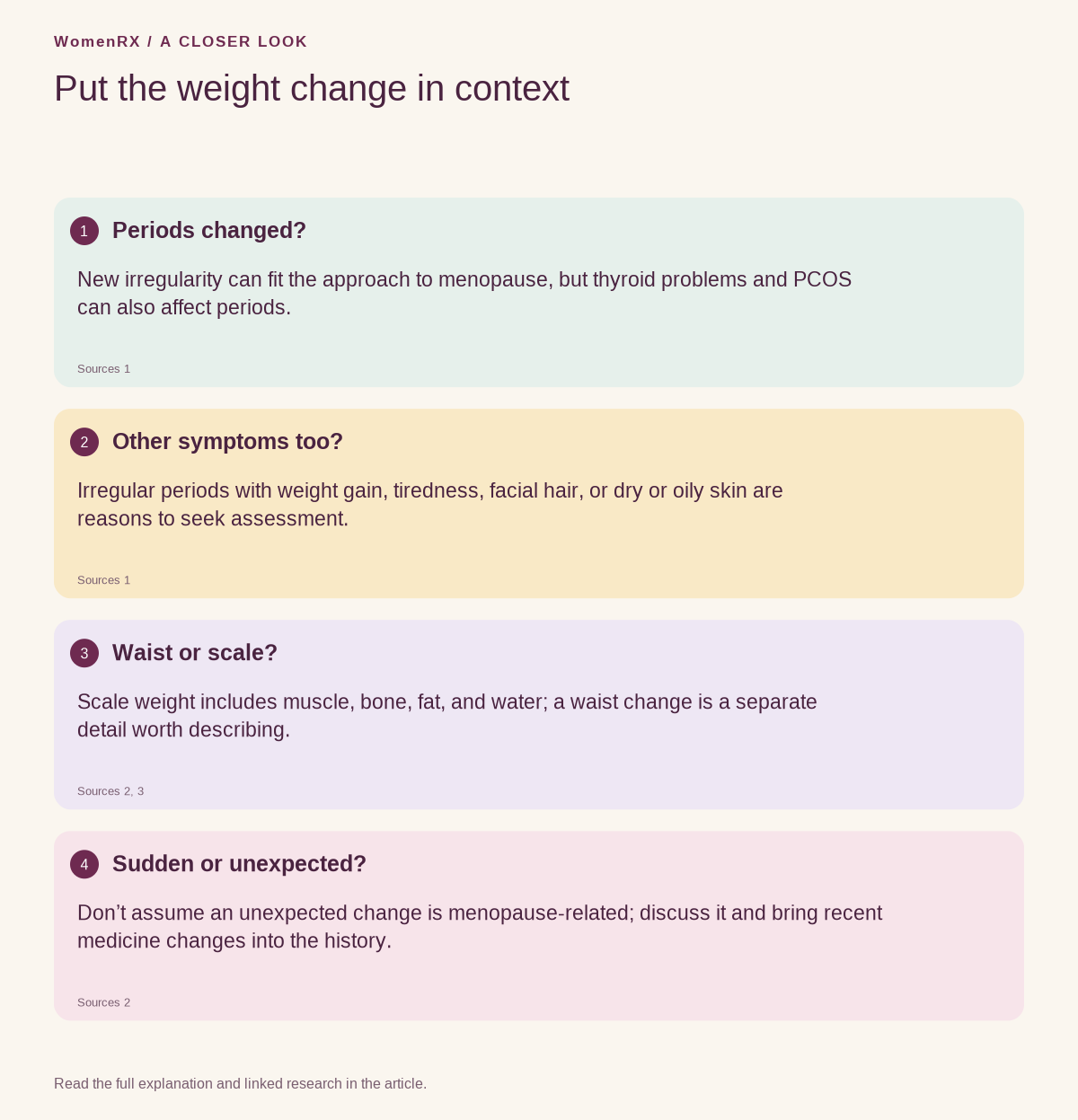
Put the weight change in context
Periods changed?: New irregularity can fit the approach to menopause, but thyroid problems and PCOS can also affect periods.1
Other symptoms too?: Irregular periods with weight gain, tiredness, facial hair, or dry or oily skin are reasons to seek assessment.1
Waist or scale?: Scale weight includes muscle, bone, fat, and water; a waist change is a separate detail worth describing.23
Sudden or unexpected?: Don’t assume an unexpected change is menopause-related; discuss it and bring recent medicine changes into the history.2
Read the figure as text
Use these questions to organize what changed and what to discuss. The flow offers context, not a way to diagnose perimenopause.- Periods changed?: New irregularity can fit the approach to menopause, but thyroid problems and PCOS can also affect periods.1
- Other symptoms too?: Irregular periods with weight gain, tiredness, facial hair, or dry or oily skin are reasons to seek assessment.1
- Waist or scale?: Scale weight includes muscle, bone, fat, and water; a waist change is a separate detail worth describing.23
- Sudden or unexpected?: Don’t assume an unexpected change is menopause-related; discuss it and bring recent medicine changes into the history.2
More questions, answered
Does a growing waist mean I’m in perimenopause?
No. Menopause-related body-composition changes may include more abdominal fat, but waist change alone can’t identify perimenopause or establish that hormones caused it. Cycle changes and the rest of your health picture matter too. 1 3
Sources you can check
- Irregular periods - NHSAccessed 2026-09-25Return to first citation
- Body Weight: MedlinePlusAccessed 2026-09-25Return to first citation
- Understanding weight gain at menopause.Davis SR, Castelo-Branco C, Chedraui P, Lumsden MA, Nappi RE, Shah D, Villaseca P, Writing Group of the International Menopause Society for World Menopause Day 2012. · Climacteric : the journal of the International Menopause Society · 2012Return to first citation
- Do changes in sex steroid hormones precede or follow increases in body weight during the menopause transition? Results from the Study of Women's Health Across the Nation.Wildman RP, Tepper PG, Crawford S, Finkelstein JS, Sutton-Tyrrell K, Thurston RC, Santoro N, Sternfeld B, Greendale GA. · The Journal of clinical endocrinology and metabolism · 2012Return to first citation