Headaches in Your 40s: Could Perimenopause Be One Factor?
Perimenopause may coincide with more frequent migraine, but age alone can’t tell you why your headaches changed.
It’s possible: migraine can be sensitive to menstrual hormone shifts, and an observational study found high-frequency headache was more common among perimenopausal women with migraine than among premenopausal women with migraine. That doesn’t prove hormones caused an individual headache. Look for a repeatable link with changing periods, note the headache pattern and medicine use, and don’t dismiss a sudden or severe new headache as hormonal. 3 5 1
First, sort out what kind of headache you’re having
Migraine is more likely when the pain is moderate to severe, throbbing or pulsing, and comes with nausea, light or sound sensitivity, or worsening pain with movement. Some people also have aura, such as flashing lights or zigzag lines. Headache symptoms vary, so one feature by itself doesn’t establish migraine. 3
A change in your 40s could involve migraine, but it could also be a tension-type headache or another cause. Tension headaches are often linked with tight muscles around the neck, shoulders, scalp, or jaw; stress, poor sleep, missed meals, and alcohol can contribute to headaches too. 1 A change in pattern is worth noticing, not automatically labeling as hormonal.
What would make a menstrual link more plausible?
A useful clue is a pattern that repeats around your period. Migraine attacks just before or during menstruation are described as menstrual migraine, and attacks at those times may be longer or more severe. A headache that appears at unrelated times, without a recurring cycle pattern, is less clearly tied to menstruation. 3 4
Periods can become irregular during perimenopause, and hormone-related migraine changes are discussed in reviews of the menopausal transition. But the evidence doesn’t let you identify the cause of a particular headache from age or a single cycle alone. 6 Track the pattern over several cycles if you can, especially when your periods are changing.
One observational study gives useful context, not a personal prediction. Among 3,664 women aged 35-65 who already met criteria for migraine, 12.2% of perimenopausal women had high-frequency headache, defined as at least 10 headache days per month, compared with 8.0% of premenopausal women. After adjustment for several factors, including medication overuse and preventive medication, the odds were higher in the perimenopausal group. Because the study was cross-sectional, it can show an association, not that perimenopause caused the change. It also studied women with migraine, not everyone with a new headache. 5
Use a short record to spot patterns, not diagnose yourself
For each headache, jot down when it started and ended, where and how it hurt, and whether you had nausea, light or sound sensitivity, or visual symptoms. Note the first day of your period and any changes in cycle timing. Also record medicines taken and how often you use them. A diary can help reveal a recurring pattern and give your clinician a clearer account. 2 3 4
Medicine use matters because taking pain relievers too often can contribute to more headaches, and medication overuse is also recognized as a migraine trigger. If you’re reaching for medicine frequently or your headaches are becoming more common, mention that pattern rather than simply increasing or changing treatment on your own. 1 3 4
The aim is to compare clues: repeated timing around a period may suggest a menstrual connection; migraine features may help describe the headache type; frequent medicine use may be part of the pattern; and sleep, stress, or missed meals may offer other explanations. None of these clues rules out other causes.
Know when not to wait
Get immediate medical attention for a sudden, extremely painful headache, or a headache with confusion, fainting or loss of consciousness, a stiff neck and fever, seizure, weakness on one side, trouble speaking, or vision loss. A headache after a blow to the head also needs prompt attention. These warning signs should not be put down to perimenopause. 1 4
Arrange a medical assessment if headaches are recurring, worsening, hard to control, or changing in a way that concerns you. Bring your notes on cycle timing, symptoms, and medicine use. A clear record can help separate a possible menstrual pattern from migraine, medication-related headache, or other causes without assuming the answer in advance. 2 4
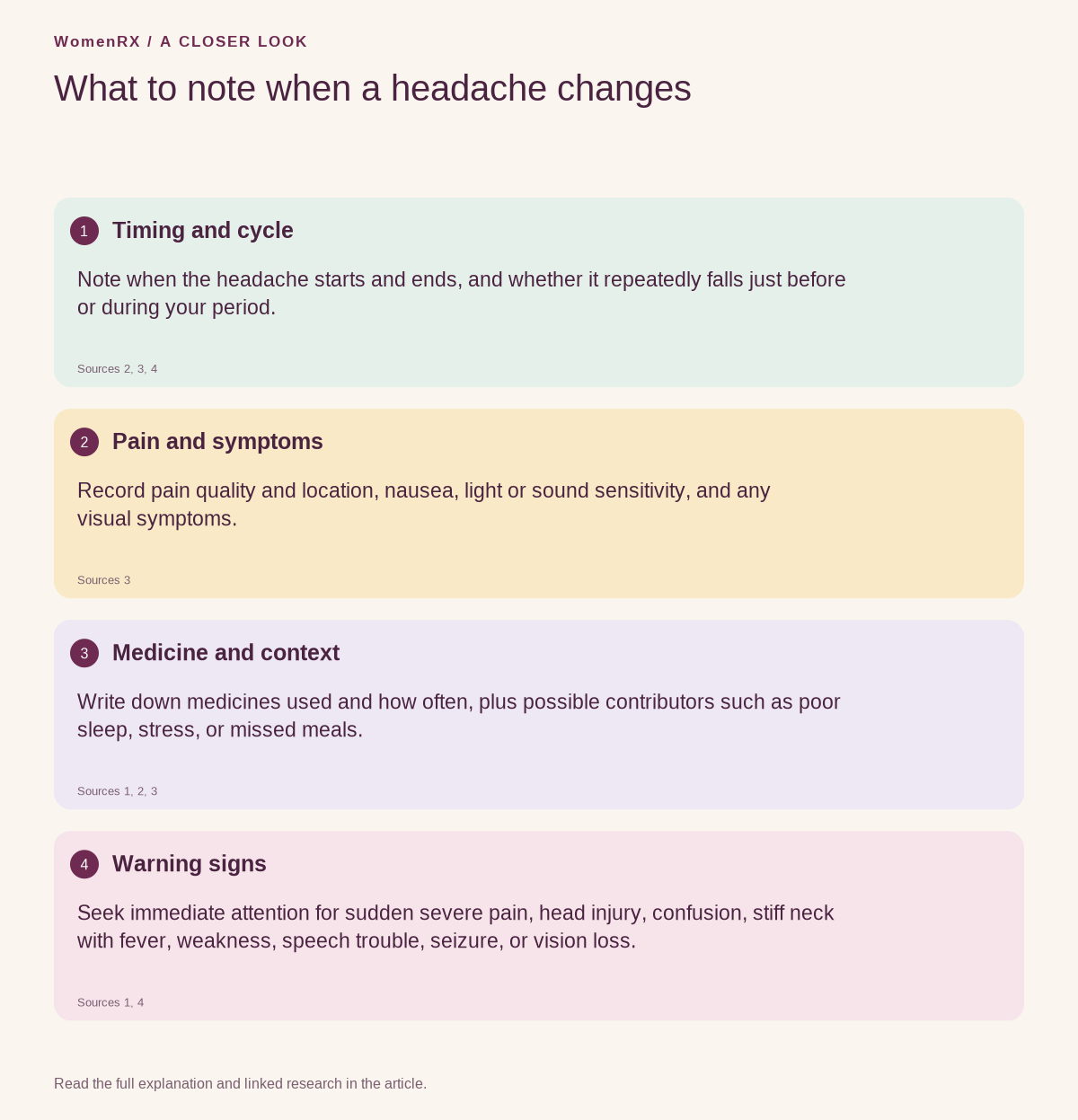
What to note when a headache changes
Timing and cycle: Note when the headache starts and ends, and whether it repeatedly falls just before or during your period.234
Pain and symptoms: Record pain quality and location, nausea, light or sound sensitivity, and any visual symptoms.3
Medicine and context: Write down medicines used and how often, plus possible contributors such as poor sleep, stress, or missed meals.123
Warning signs: Seek immediate attention for sudden severe pain, head injury, confusion, stiff neck with fever, weakness, speech trouble, seizure, or vision loss.14
Read the figure as text
Use these observations to compare possible menstrual timing, migraine features, medicine use, and warning signs. The checklist helps describe a pattern; it does not diagnose the cause.- Timing and cycle: Note when the headache starts and ends, and whether it repeatedly falls just before or during your period.234
- Pain and symptoms: Record pain quality and location, nausea, light or sound sensitivity, and any visual symptoms.3
- Medicine and context: Write down medicines used and how often, plus possible contributors such as poor sleep, stress, or missed meals.123
- Warning signs: Seek immediate attention for sudden severe pain, head injury, confusion, stiff neck with fever, weakness, speech trouble, seizure, or vision loss.14
More questions, answered
Does a headache in your 40s mean you’re in perimenopause?
No. Age by itself doesn’t establish perimenopause or explain a headache. Changing periods may be one relevant clue, but headache features, timing, medicine use, and other causes also matter. 5 6
What should I write down in a headache diary?
Record when the headache starts and ends, its features and related symptoms, period timing or cycle changes, and medicines used. The purpose is to spot patterns and describe them clearly, not to diagnose the cause yourself. 2 3
Sources you can check
- Headache | MedlinePlusAccessed 2026-09-25Return to first citation
- Headaches - NHSAccessed 2026-09-25Return to first citation
- Migraine | MedlinePlusAccessed 2026-09-25Return to first citation
- Migraine - NHSAccessed 2026-09-25Return to first citation
- Perimenopause and Menopause Are Associated With High Frequency Headache in Women With Migraine: Results of the American Migraine Prevalence and Prevention Study.Martin VT, Pavlovic J, Fanning KM, Buse DC, Reed ML, Lipton RB. · Headache · 2016Return to first citation
- Migraine headache in perimenopausal and menopausal women.MacGregor EA. · Current pain and headache reports · 2009Return to first citation