Brain Fog in Your 40s: Could Perimenopause Be One Factor?
Changing periods can make perimenopause part of the picture, but focus or memory changes alone can’t identify the cause.
Yes. Perimenopause can coincide with memory and concentration concerns, especially as menstrual patterns change, but brain fog by itself doesn’t show that hormones are responsible. Research finds some differences in cognition between perimenopausal and premenopausal groups, with results depending on how researchers defined the stages. Sleep, stress, health conditions and other factors also belong in the conversation. 3 4
Start with the pattern, not your age
Forgetting why you walked into a room, losing your train of thought, or taking longer to recall a name can feel unsettling. In your 40s, perimenopause may be one possible context, particularly if your menstrual pattern is changing. But age and brain fog alone don’t establish that you’re in perimenopause or explain what’s causing the change.
A 2026 systematic review and meta-analysis included 26 studies and 9,428 participants. It found poorer cognitive outcomes for perimenopausal than premenopausal participants overall, but that result appeared only in studies using standardized STRAW+10 criteria to define reproductive stages. Findings also differed depending on whether researchers measured people’s own cognitive complaints or performance on tests. That makes perimenopause a reasonable possibility to consider, not a stand-alone explanation for an individual’s symptoms. 3
Look for what changes alongside the fog
A useful clue is whether the focus or memory change appears alongside other changes. Note whether your periods have become irregular or different from your usual pattern, and whether hot flashes or night sweats are interrupting sleep. Perimenopause can involve changes in menstrual cycles, sleep, mood and cognition, though these can occur together without proving which one is driving your experience. 4 6
Sleep is worth recording in its own right. A study of 2,097 postmenopausal women found an association between retrospectively reported perimenopausal sleep disturbance and lower cognitive scores later in life, especially among women often woken by menopausal symptoms. Because participants recalled earlier sleep and the study assessed cognition decades later, it doesn’t show that poor sleep causes today’s brain fog. It does support treating sleep disruption as relevant context to discuss, not as a diagnosis. 5
Stress can also be part of the picture. Jot down whether difficult or ongoing demands are present, but treat that as context rather than proof that stress explains your symptoms. MedlinePlus describes long-term stress as a sustained response to pressures such as work, family needs or money problems. 2
It’s also reasonable to include health changes and medicines in the discussion. Write down what you take, including over-the-counter products, and anything recently started or changed. That’s a prompt for review, not evidence that a particular medicine is responsible. Some health problems can be relevant when memory difficulties are more serious; MedlinePlus lists thyroid, kidney and liver problems among possible causes of significant memory problems. 1
Make a short record you can actually use
A brief daily note can help you see whether symptoms cluster around certain circumstances. Record:
- Periods: bleeding dates and changes from your usual pattern.
- Sleep: whether you slept poorly or woke with hot flashes or night sweats.
- Focus and mood: what felt harder, and whether your mood seemed different.
- Stress and care context: notable pressures, health changes, and medicines or supplements, including recent changes.
Use specific examples, such as “lost my place twice during a familiar work task,” rather than only “bad brain fog.” The point isn’t to score yourself or prove a hormone connection. It’s to bring a clearer picture of when the problem began and what else was happening.
When not to write it off as menopause
Occasional forgetfulness happens. But trouble using a familiar phone or finding your way home is different from misplacing your keys; MedlinePlus identifies those kinds of difficulties as possible signs of a more serious problem. Don’t assume a major or worsening change is perimenopause. 1
If the change is interfering with everyday life, bring your notes and medicine list to a medical appointment. You can ask whether the timing of your menstrual changes fits the perimenopause transition, what else might contribute, and whether any further assessment is appropriate. Your record won’t diagnose the cause, but it can make that conversation more concrete.
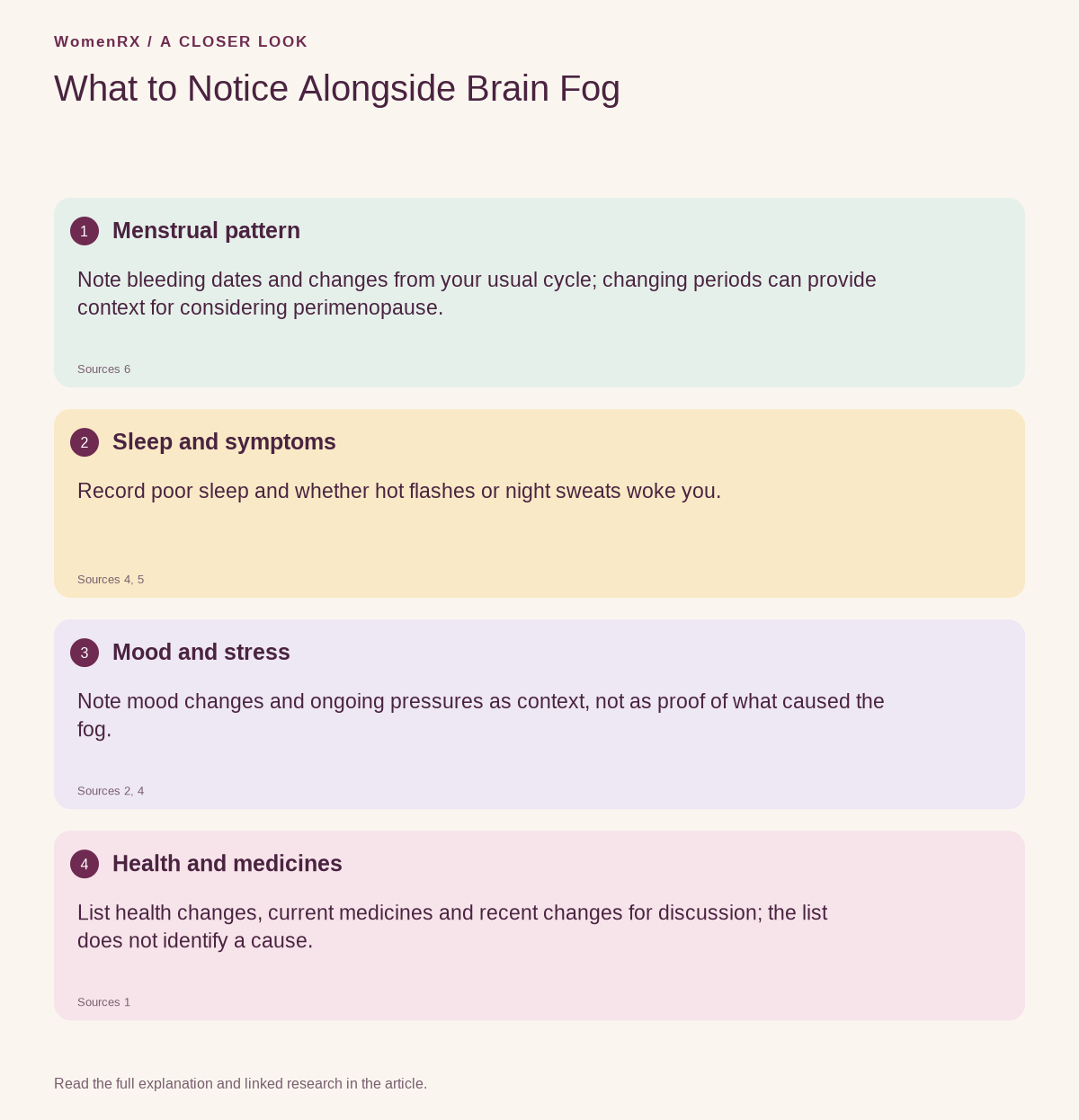
What to Notice Alongside Brain Fog
Menstrual pattern: Note bleeding dates and changes from your usual cycle; changing periods can provide context for considering perimenopause.6
Sleep and symptoms: Record poor sleep and whether hot flashes or night sweats woke you.45
Mood and stress: Note mood changes and ongoing pressures as context, not as proof of what caused the fog.24
Health and medicines: List health changes, current medicines and recent changes for discussion; the list does not identify a cause.1
Read the figure as text
A short record can help separate the symptom from the context around it. These prompts organize observations; they do not diagnose perimenopause.- Menstrual pattern: Note bleeding dates and changes from your usual cycle; changing periods can provide context for considering perimenopause.6
- Sleep and symptoms: Record poor sleep and whether hot flashes or night sweats woke you.45
- Mood and stress: Note mood changes and ongoing pressures as context, not as proof of what caused the fog.24
- Health and medicines: List health changes, current medicines and recent changes for discussion; the list does not identify a cause.1
More questions, answered
Does brain fog mean I’m in perimenopause?
No. Brain fog alone can’t establish perimenopause. Changing menstrual patterns can provide useful context, and research on cognition during this stage has mixed results depending on how researchers define the stage and measure cognition. 3 6
What memory changes should I take seriously?
Occasional lapses are common, but difficulty using a familiar phone or finding your way home is different from forgetting a name or misplacing keys. MedlinePlus describes those more significant changes as possible signs of a serious problem. 1
Sources you can check
- Memory | MedlinePlusAccessed 2026-09-25Return to first citation
- Stress: MedlinePlusAccessed 2026-09-25Return to first citation
- Cognitive functioning in perimenopause: An updated systematic review and meta-analysis.Bangle A, Williams D, Walters J, Nguyen L. · Psychology and aging · 2026Return to first citation
- Perimenopause and Lifestyle Medicine: A Window of Opportunity.Pangalangan JML, Tollefson M. · American journal of lifestyle medicine · 2026Return to first citation
- Sleep disturbances during perimenopause and later-life cognitive function.Hu B, Lin JJ, Qiu X, McAlaine K, Mahalingaiah S, Weisskopf M. · Menopause (New York, N.Y.) · 2026Return to first citation
- Women's health care during the perimenopause.Frackiewicz EJ, Cutler NR. · Journal of the American Pharmaceutical Association (Washington, D.C. : 1996) · 2000Return to first citation