Can Supplements Help With Perimenopause Weight Gain?
Weight gain can happen during perimenopause, but a supplement’s weight-loss claim needs closer scrutiny than its label may invite.
There isn’t a well-supported “best” supplement for weight gain during perimenopause. Weight-loss supplement studies often have limits, and research on menopause-related supplements has focused much more on postmenopause than perimenopause. Before buying a product, check whether people like you were studied, whether body weight was measured, and whether the research tested the finished product rather than one ingredient. Review the label and any medicines you take, too. 341
First, put the weight change in context
Weight gain during perimenopause is common, and some women notice more of it around the stomach and upper body. That timing is worth paying attention to, but it doesn’t tell you on its own why your weight changed or whether a supplement would help. A number on the scale includes muscle, bone, fat, and water. Waist circumference can add context because carrying more fat around the abdomen is associated with higher risks of heart disease and type 2 diabetes. 52
Consider the difference between a gradual change you’ve noticed over a few years and a sudden gain you can’t explain. The second deserves a health assessment rather than an experiment with a weight-loss product: an unexpected change in weight can be a sign of a medical problem. 2
What would count as evidence for your question?
A convincing study would test a clearly identified supplement against a comparison, measure body weight over a stated period, and include women in perimenopause. Those details matter because “supports metabolism,” a change in a blood marker, and a measured change in body weight are different outcomes.
Research on dietary supplements around menopause doesn’t neatly answer that question. An analysis of US-linked publications found that most focused on postmenopause, with perimenopause notably underrepresented. That analysis mapped what researchers studied; it did not establish which supplements cause weight loss. 3
One example shows why life stage matters. An NIH review describes a study in postmenopausal women in which calcium plus vitamin D slightly reduced weight gain compared with placebo, especially among women whose calcium intake was lower at the start. That finding isn’t a test of a perimenopause weight-loss product, and “less weight gain” isn’t the same as weight loss. It doesn’t make calcium and vitamin D a general recommendation for this purpose. 4
Read past the front of the bottle
Start with the Supplement Facts label and the product’s specific claim. Then ask:
- Was body weight actually measured? A study of menopausal symptoms, liver markers, or another health outcome can’t establish weight loss simply because the product is marketed for menopause. 4
- Who was studied? Findings in postmenopausal women, or in a general adult group without a reported perimenopause result, may not answer your question. 34
- Was it this finished product? Many weight-loss supplements combine ingredients. Research on one ingredient doesn’t show what the combination will do, and ingredient amounts can differ across products and studies. 4
- How strong was the comparison? Small, short, or poor-quality studies make a promising claim less reliable. Laboratory or animal findings aren’t proof of weight loss in people. 4
This is more useful than treating a long ingredient list as a sign of stronger evidence. It can also save you from paying for a combination whose weight effect has never been clearly separated from its individual ingredients. 4
Give safety its own decision
Supplements don’t go through the same testing as drugs before they’re sold. A familiar vitamin, herb, or “natural” ingredient still deserves a safety check, particularly when you’re taking medicines or other supplements. Tell the person managing your care what you use, read reliable information about the ingredients, and don’t exceed the label’s recommended amount. If you’re having surgery, review your supplements with your care team beforehand. 1
The useful next move depends on what’s happening. For a product you’re considering, compare its exact ingredients and claim with the research, then check how it fits with your medicines and health needs. For sudden or unexplained weight change, start with the change itself rather than assuming perimenopause is the cause. 42
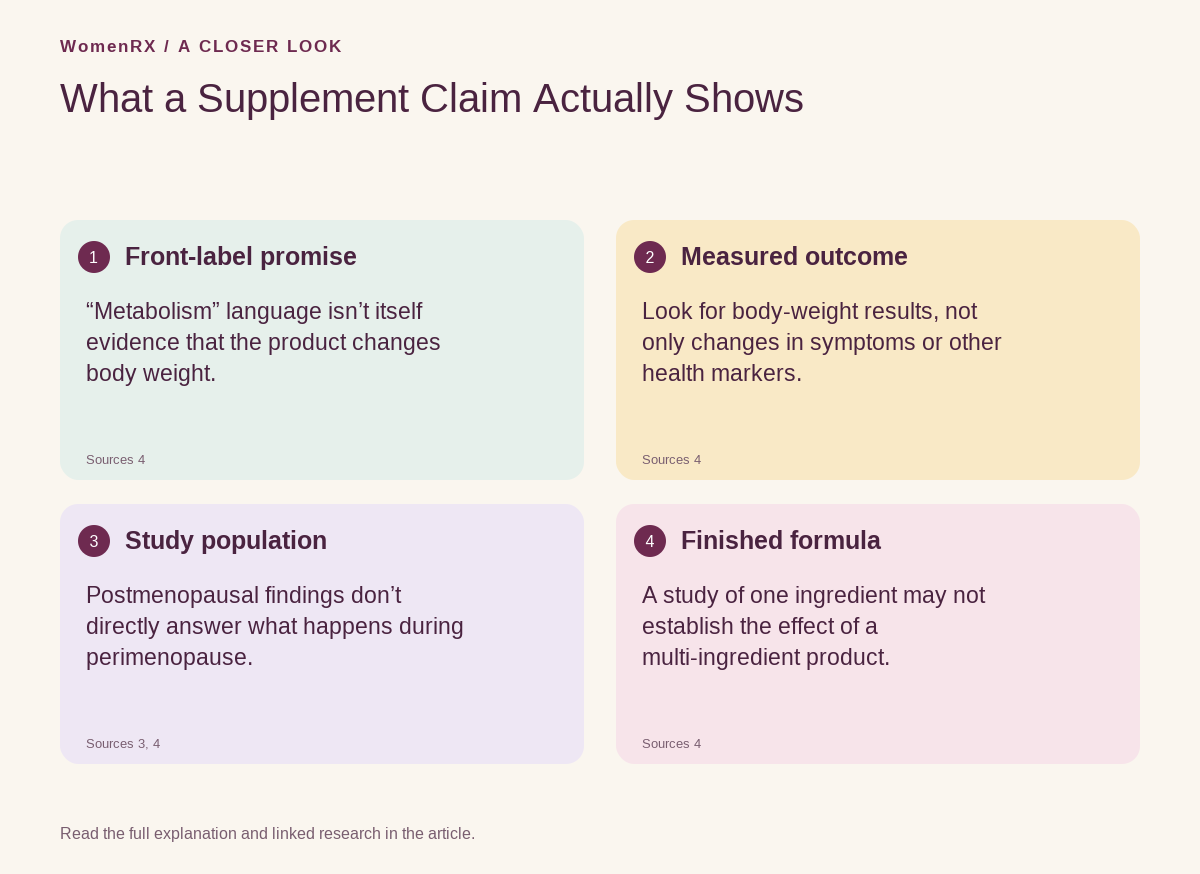
What a Supplement Claim Actually Shows
Front-label promise: “Metabolism” language isn’t itself evidence that the product changes body weight.4
Measured outcome: Look for body-weight results, not only changes in symptoms or other health markers.4
Study population: Postmenopausal findings don’t directly answer what happens during perimenopause.34
Finished formula: A study of one ingredient may not establish the effect of a multi-ingredient product.4
Read the figure as text
Four distinctions to use when a product promises help with perimenopause weight gain.- Front-label promise: “Metabolism” language isn’t itself evidence that the product changes body weight.4
- Measured outcome: Look for body-weight results, not only changes in symptoms or other health markers.4
- Study population: Postmenopausal findings don’t directly answer what happens during perimenopause.34
- Finished formula: A study of one ingredient may not establish the effect of a multi-ingredient product.4
More questions, answered
Does a supplement study in postmenopausal women apply to perimenopause?
Not automatically. Postmenopause and perimenopause are different stages, and perimenopause was underrepresented in an analysis of menopause supplement research. Check the study population and the outcome measured before applying its findings to a weight-loss claim. 34
Sources you can check
- Dietary Supplements: MedlinePlusAccessed 2026-09-25Return to first citation
- Body Weight: MedlinePlusAccessed 2026-09-25Return to first citation
- Dietary supplements for menopausal symptoms and health: a bibliometric analysis of US research (2000-2024).Canino MC, Cohen B, Byrd C, Gahche JJ. · Menopause (New York, N.Y.) · 2026Return to first citation
- Dietary Supplements for Weight Loss - Health Professional Fact SheetAccessed 2026-09-25Return to first citation
- Symptoms of menopause and perimenopause - NHSAccessed 2026-09-25Return to first citation