Tirzepatide and Menopause Weight Gain: What We Know
Tirzepatide may be considered for weight management based on a person’s health and weight-related criteria, but that is not the same as evidence that it specifically treats menopause-related weight gain.
Zepbound research is relevant to some adults in perimenopause or after menopause if they meet weight-management criteria, but it doesn’t establish a menopause-specific benefit. A trial described in US prescribing information included women, yet its summary doesn’t report menopausal status or outcomes by menopause subgroup. A 2026 expert statement says tirzepatide needs menopause-specific evaluation. Ask your prescriber how your overall health and goals fit the broader evidence. 1 4
The distinction that matters
There are two different questions here: whether tirzepatide can be considered for weight management in an adult who is in perimenopause or postmenopause, and whether it has been shown to treat weight gain caused by menopause. Evidence for the first does not answer the second. The available expert review describes tirzepatide as promising in broader clinical contexts, while concluding that it still needs menopause-specific evaluation. 4
That means menopause doesn’t automatically rule out considering weight-management treatment, but it also shouldn’t be treated as proof that tirzepatide will work differently, or better, because of menopause. The evidence does not establish that it treats menopause itself or reverses weight changes specifically attributed to the transition.
What the trial details do, and don’t, tell us
One trial described in US prescribing information enrolled adults with obesity, or overweight plus at least one weight-related health condition. The randomized group had a mean age of 46, ranged from 18 to 77, and was 63% female. But the trial description doesn’t report how many participants were perimenopausal or postmenopausal, or results separated by menopausal status. So the presence of women, including people in a midlife age range, isn’t the same as evidence about menopause-related weight change. 1
There’s another limitation when applying that trial to a treatment decision. Participants first completed an intensive lifestyle period, and only those who lost at least 5% of their weight during that period entered the randomized phase. That design describes a selected group, not everyone who might consider starting treatment. 1
A 2026 expert position statement on incretin-based therapies in peri- and postmenopausal women says that direct menopause-specific evidence is limited overall, and that semaglutide currently has more such evidence than tirzepatide. It characterizes that semaglutide evidence as largely observational, too. The statement calls for menopause-specific evaluation of tirzepatide rather than claiming that broader trial findings settle the question. 4
How to make the decision personal
A prescriber can help separate your reason for considering treatment from the question of menopause. For example, you might be concerned about a change in weight during perimenopause, but the treatment decision may also depend on your overall health, weight-related conditions, and goals. General obesity guidance describes treatment plans as depending on overall weight and other health conditions, and includes medication among possible options. 2
Useful questions to bring include:
- Do my weight and health history fit the criteria you use when considering weight-management medication?
- What health or day-to-day goals should we track besides the number on the scale?
- How will we consider body composition, muscle health, and physical function as part of the plan?
- What would make us continue, adjust, or reconsider treatment?
The last two questions reflect a key point in the menopause-specific expert statement: it recommends considering body composition, musculoskeletal health, and functional outcomes, not weight alone. 4
Menopause hormone therapy is a separate decision. The same expert statement says it should not be started solely to increase weight loss. If you’re considering hormone therapy for menopause symptoms, that deserves its own discussion of benefits, risks, and goals. 3 4
The practical bottom line
Think of tirzepatide as a potential weight-management option to discuss on the basis of your health and eligibility, not as a proven treatment for menopause-related weight gain. The key evidence gap is specific: research needs to report menopausal status and outcomes for those subgroups before we can say whether the treatment’s effects differ during perimenopause or after menopause. 4
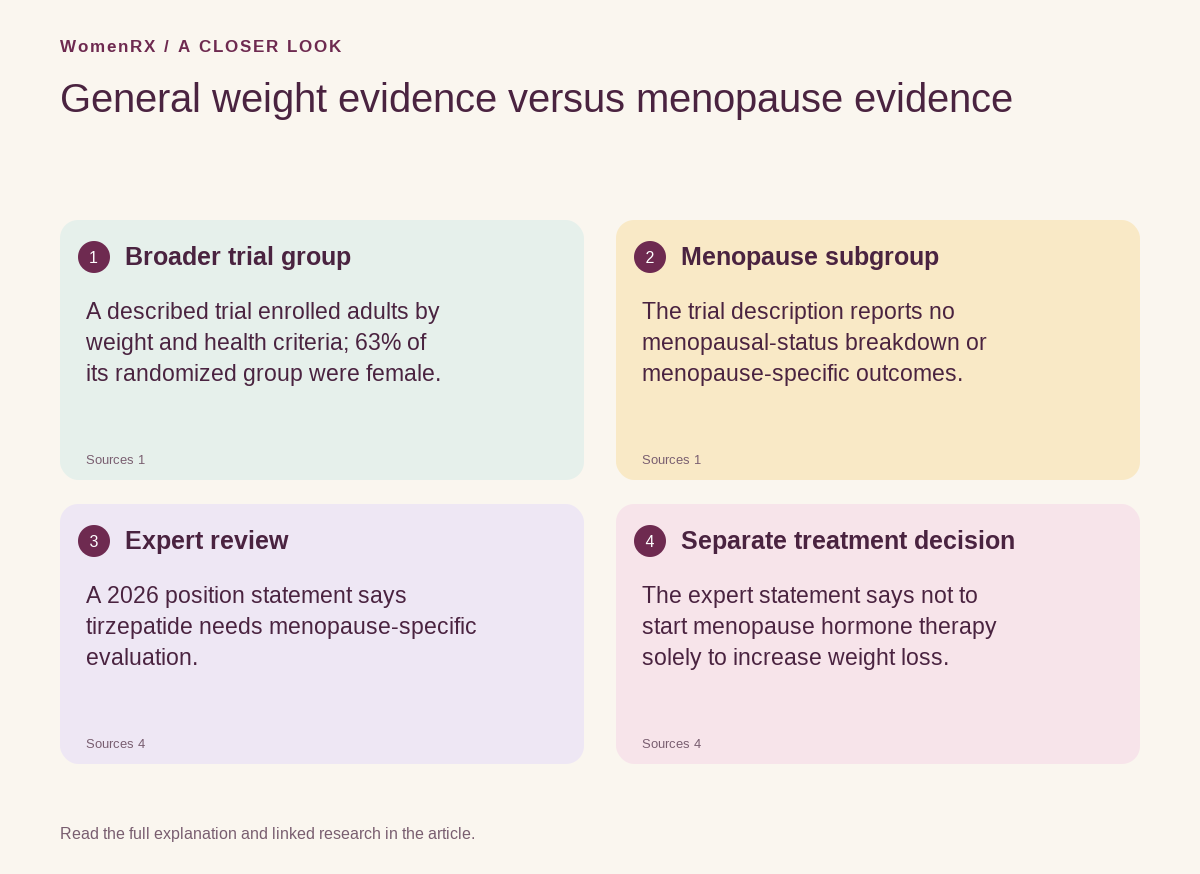
General weight evidence versus menopause evidence
Broader trial group: A described trial enrolled adults by weight and health criteria; 63% of its randomized group were female.1
Menopause subgroup: The trial description reports no menopausal-status breakdown or menopause-specific outcomes.1
Expert review: A 2026 position statement says tirzepatide needs menopause-specific evaluation.4
Separate treatment decision: The expert statement says not to start menopause hormone therapy solely to increase weight loss.4
Read the figure as text
This comparison shows why a trial that includes women does not, by itself, answer whether tirzepatide works differently for menopause-related weight change.- Broader trial group: A described trial enrolled adults by weight and health criteria; 63% of its randomized group were female.1
- Menopause subgroup: The trial description reports no menopausal-status breakdown or menopause-specific outcomes.1
- Expert review: A 2026 position statement says tirzepatide needs menopause-specific evaluation.4
- Separate treatment decision: The expert statement says not to start menopause hormone therapy solely to increase weight loss.4
More questions, answered
Does tirzepatide treat menopause?
This evidence does not establish tirzepatide as a treatment for menopause or for menopause symptoms. Its possible role is weight management, considered separately from menopause care. 4
Should hormone therapy be started to improve weight loss?
No. A 2026 expert position statement says hormone therapy shouldn’t be initiated solely to augment weight loss. Decisions about hormone therapy should be made for their own indications, not as a weight-loss add-on. 4
Sources you can check
- ZEPBOUND (TIRZEPATIDE) INJECTION, SOLUTION ZEPBOUND (TIRZEPATIDE) INJECTION, SOLUTION ZEPBOUND KWIKPEN (TIRZEPATIDE) INJECTION, SOLUTION [ELI LILLY AND COMPANY] | US prescribing information and patient instructionsAccessed 2026-09-25Return to first citation
- Obesity: MedlinePlusAccessed 2026-09-25Return to first citation
- The 2022 hormone therapy position statement of The North American Menopause Society.“The 2022 Hormone Therapy Position Statement of The North American Menopause Society” Advisory Panel. · Menopause (New York, N.Y.) · 2022Return to first citation
- Incretin-based therapies in peri- and postmenopausal women with obesity: an expert position statement from the Spanish Menopause Society.Sánchez-Prieto M, Romero-Domínguez M, Orozco R, Lilue M, Lubián-López DM, González SP, Nieto A, Coronado P, Sánchez-Borrego R, Cano A, Castelo-Branco C, Palacios S, Young Investiga... · Maturitas · 2026Return to first citation