Menopause and Weight Gain: What Eating Patterns Can Change
Eating habits can support weight management, but weight, waist size, and body composition tell different stories around menopause.
A balanced eating pattern may help influence weight and waist size, especially when paired with regular activity, but menopause-specific evidence is limited. One trial in women in the menopause transition and early postmenopause tested diet advice and aerobic activity together, so it can’t tell us how much change came from food alone. Weight, waist size, and body composition are different outcomes, and results for one don’t guarantee changes in the others. 514
What food can, and can’t, change
If your weight or waist is changing around menopause, it’s reasonable to look at your eating habits. Nutrition studies in women around menopause measure different outcomes and sometimes test food changes alongside other strategies. A useful goal is a pattern you can maintain that supports your overall health, not a restrictive plan built around one ingredient.
Weight is only one measure. It includes fat, muscle, bone, and water, so a change on the scale doesn’t reveal what changed. Waist size offers a different measure. In research, fat mass and lean mass may also be reported separately, as they were in a trial of postmenopausal women. These measures can move differently. 14
That distinction matters when interpreting menopause nutrition research. A study might find a difference in body weight without reporting a clear difference in waist size or lean mass. Those aren’t interchangeable results.
What menopause studies have actually tested
A randomized trial followed 100 women in China who were in the menopause transition or early postmenopause. The intervention combined advice on healthy eating with encouragement to do moderate aerobic activity. At three months, the intervention group’s weight changed by an average of −0.28 kg, compared with a 0.68 kg increase in the usual-care group. Waist circumference changed by −0.28 cm in the intervention group and increased by 1.43 cm in usual care. These are group averages from one combined program, not a prediction for an individual, and the study can’t separate the contribution of food from activity. 5
The researchers also assessed body composition. The weight and waist findings alone, though, can’t tell you whether the program changed fat mass or preserved muscle. 15
A separate trial offers a closer look at body composition, but in a different group: 101 women with obesity who were at least five years past menopause. Over 12 months, the group assigned to a more intensive energy-restriction program lost more weight and fat mass than the group assigned to moderate restriction. It also lost more lean mass and hip bone density. The lean-mass loss was proportional to the greater total weight loss, and handgrip strength didn’t differ between groups. This study illustrates a tradeoff, not a reason to choose an intensive diet: it involved postmenopausal women with obesity, and its findings don’t automatically apply to women in perimenopause or to less restrictive eating changes. 4
A review of dietary patterns in postmenopausal women describes promising links with health and body composition, but much of the evidence is observational. That can show an association, not prove that a particular diet caused a change. 6
A manageable way to shape your meals
Rather than searching for a menopause-specific “best food,” start with changes that make meals filling and workable in your everyday life:
- Add fiber-rich foods you like. Beans, fruit, vegetables, and whole grains provide dietary fiber. Fiber adds bulk and can help you feel full sooner, though that doesn’t mean it guarantees weight loss. If you’re eating little fiber now, increase it gradually; adding too much too quickly can cause gas, bloating, or cramps. 2
- Include a protein food. Protein helps build and maintain muscle. Options include meat, dairy, nuts, beans, and some grains. These are useful building blocks for meals, not a special menopause weight-loss treatment. 3
- Choose a pattern you can repeat. For example, a lunch with beans or another protein food, vegetables, and a whole grain may be more satisfying than a meal that leaves you hungry soon afterward. Treat this as an adaptable example, not a prescribed menu.
- Consider the rest of your routine, too. Diet is one contributor to body weight. Sleep habits, stress, activity, and family history can also play a part, so a change in weight doesn’t automatically mean you’ve chosen the wrong foods. 1
These ideas support nourishment and satiety; they don’t guarantee a particular number on the scale. If your goal includes losing weight, a registered dietitian can help tailor a realistic pattern to your health, preferences, and daily life. MedlinePlus notes that a dietitian may be part of weight-management support when weight loss is recommended. 1
Read the outcome, not just the headline
When you hear that a menopause diet “worked,” ask what changed: weight, waist circumference, fat mass, or lean mass? Was the program food advice alone, or did it also include activity? And were participants in perimenopause, early postmenopause, or several years past menopause?
Those questions help keep the promise in proportion. Current examples include a combined diet-and-activity trial in women in the transition and early postmenopause, and a more intensive weight-loss trial in women at least five years past menopause. The first can’t isolate diet’s effects; the second doesn’t test an everyday eating pattern for preventing weight gain during the transition. 54
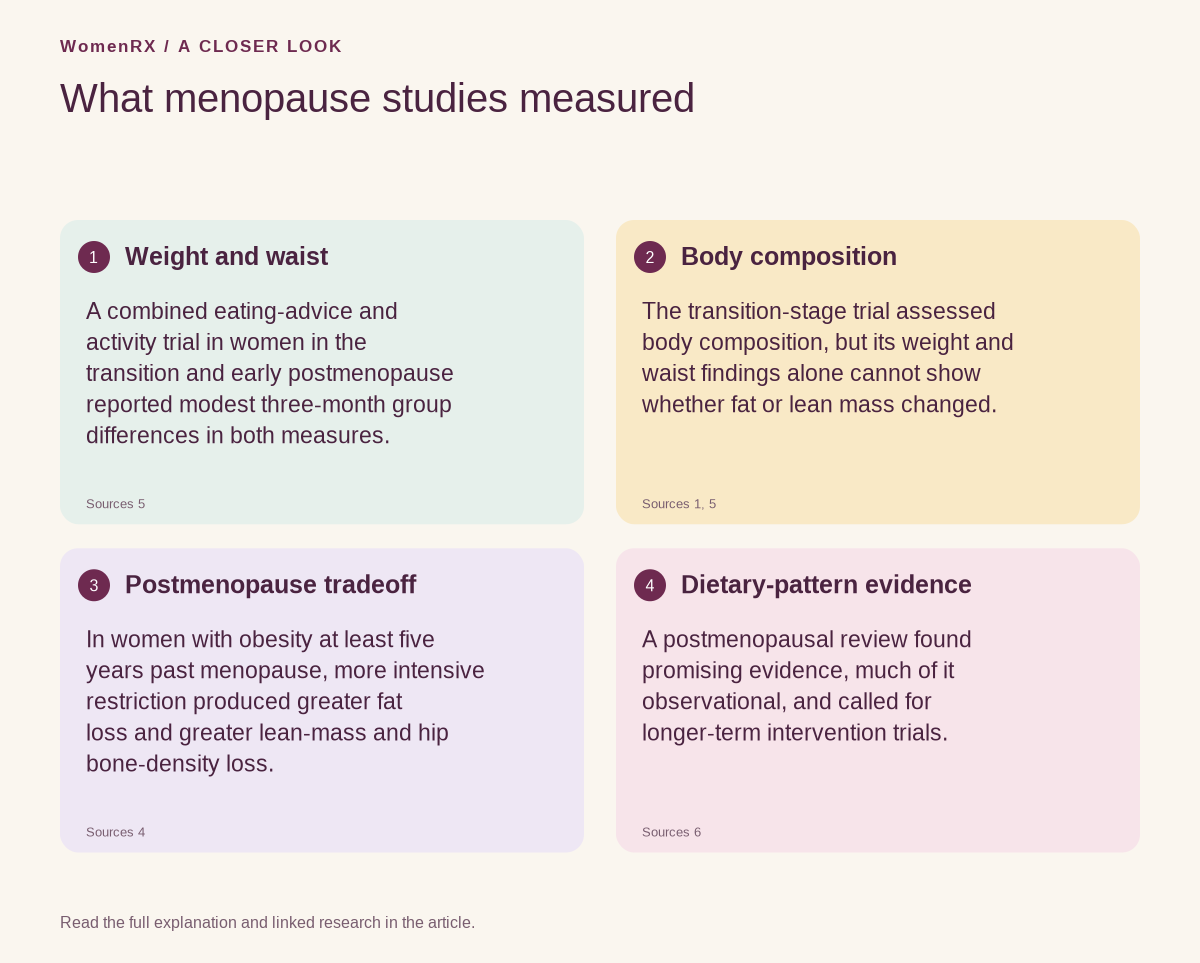
What menopause studies measured
Weight and waist: A combined eating-advice and activity trial in women in the transition and early postmenopause reported modest three-month group differences in both measures.5
Body composition: The transition-stage trial assessed body composition, but its weight and waist findings alone cannot show whether fat or lean mass changed.15
Postmenopause tradeoff: In women with obesity at least five years past menopause, more intensive restriction produced greater fat loss and greater lean-mass and hip bone-density loss.4
Dietary-pattern evidence: A postmenopausal review found promising evidence, much of it observational, and called for longer-term intervention trials.6
Read the figure as text
Weight, waist size, and body composition answer different questions. These study examples show which outcomes were reported and where the evidence has limits.- Weight and waist: A combined eating-advice and activity trial in women in the transition and early postmenopause reported modest three-month group differences in both measures.5
- Body composition: The transition-stage trial assessed body composition, but its weight and waist findings alone cannot show whether fat or lean mass changed.15
- Postmenopause tradeoff: In women with obesity at least five years past menopause, more intensive restriction produced greater fat loss and greater lean-mass and hip bone-density loss.4
- Dietary-pattern evidence: A postmenopausal review found promising evidence, much of it observational, and called for longer-term intervention trials.6
More questions, answered
Does eating more fiber cause weight loss during menopause?
Fiber-rich foods can add bulk and help you feel full sooner, but that’s not proof they cause weight loss during menopause. Increasing fiber gradually may help avoid gas, bloating, or cramps. 2
Can the scale show whether I’m losing fat or muscle?
No. Body weight includes muscle, fat, bone, and water. Waist circumference is another measure, and research may report fat mass and lean mass separately, as one postmenopausal trial did. The scale alone can’t identify what changed. 14
Sources you can check
- Body Weight: MedlinePlusAccessed 2026-09-25Return to first citation
- Dietary Fiber: MedlinePlusAccessed 2026-09-25Return to first citation
- Dietary Proteins: MedlinePlusAccessed 2026-09-25Return to first citation
- Effect of Weight Loss via Severe vs Moderate Energy Restriction on Lean Mass and Body Composition Among Postmenopausal Women With Obesity: The TEMPO Diet Randomized Clinical Trial.Seimon RV, Wild-Taylor AL, Keating SE, McClintock S, Harper C, Gibson AA, Johnson NA, Fernando HA, Markovic TP, Center JR, Franklin J, Liu PY, Grieve SM, Lagopoulos J, Caterson ID,... · JAMA network open · 2019Return to first citation
- Effects of lifestyle intervention improve cardiovascular disease risk factors in community-based menopausal transition and early postmenopausal women in China.Wu L, Chen R, Ma D, Zhang S, Walton-Moss B, He Z. · Menopause (New York, N.Y.) · 2014Return to first citation
- Dietary patterns and their associations with body composition, cardiometabolic and bone health in postmenopausal women.Best N. · Post reproductive health · 2025Return to first citation