Eating Patterns That Make Weight Management More Livable
A flexible eating pattern built around nourishing foods has a better case than any single “weight-loss food,” and it has to fit your life.
The evidence behind these choices doesn’t establish one best diet. A consistent pattern of healthy eating is a sounder starting point than chasing a particular food or supplement. Fiber-rich foods can help you feel full, while a five-year study in women linked improving overall diet quality with less BMI gain. Neither finding promises weight loss for an individual. 124
Start with the pattern, not a food list
If you want meals that support weight management without turning eating into a rigid set of rules, look at what you can repeat. A healthy dietary pattern, an appropriate overall energy intake, and physical activity are the foundation of long-term weight-loss approaches, according to the NIH Office of Dietary Supplements. That description doesn’t require one named diet or a ban on foods you enjoy. 1
The distinction matters because feeling full after a meal and changing weight over time are different outcomes. Fiber can add bulk to food and help you feel full sooner. Whole grains, fruits, and vegetables are familiar sources. But fullness alone doesn’t tell us what will happen to your weight over months or years. 2 In trials summarized by NIH, several isolated fiber ingredients proposed as weight-loss aids had little or no effect on body weight. That’s a reason not to treat a fiber supplement as a shortcut to the benefits of an eating pattern. 1
What the longer view in women shows
One study followed 1,242 women living in socioeconomically disadvantaged neighborhoods in Victoria, Australia, using self-reported diet and BMI at three points over five years. Women whose diet quality improved tended to have less BMI gain. The researchers adjusted their analyses for factors including age, physical activity, and menopausal status. This was an observational study, though: it cannot show that changing diet quality caused the difference, and it doesn’t establish a best diet for every woman. 4
That gives you two useful lenses for choosing food. Fullness can help you judge whether a meal works for your day. Overall dietary quality asks whether the foods you eat regularly add up to a nourishing pattern. The evidence for the second lens is about a pattern over time, not a claim that one fruit, grain, or meal will produce a particular weight result. 24
A flexible way to build a meal
Try using these as choices rather than requirements:
- Pick a plant food you like and can get regularly. Fruit, vegetables, and whole grains provide dietary fiber. For example, an apple alongside breakfast or vegetables added to dinner may be more realistic than rebuilding every meal at once. 2
- Give the meal substance. Beans or lentils are examples of foods that provide both fiber and protein. They can be a starting point for a meal rather than an ingredient added solely for its supposed effect on weight. 5
- Notice whether the meal holds you comfortably until you next want to eat. Fiber may help with fullness, but your appetite and schedule matter when deciding whether a combination works for you. 2
- Make changes at a pace your gut tolerates. Adding fiber too quickly can cause gas, bloating, or cramps, so a gradual change is more practical than abruptly overhauling everything you eat. 2
For example, you might build lunch around a bean-and-vegetable soup with a whole-grain side, if those foods are affordable and appealing to you. The example combines fiber sources; it isn’t a prescribed meal or a promise of weight loss. A different combination may fit your tastes, culture, budget, and access better. 25
What the scale cannot tell you
Weight alone doesn’t describe your health: it includes muscle, bone, fat, and water. Health history matters when interpreting it, and for older adults, so do muscle and strength. 3 The five-year study adjusted for menopausal status but did not report whether the association between diet quality and BMI differed by menopausal status. It therefore cannot identify a menopause-specific eating pattern or tell you how a change on the scale relates to muscle. 34
When a weight-loss goal may not fit
During pregnancy, eating well is still useful, but intentional weight loss is a different goal. It isn’t recommended by the pregnancy guidance discussed in research on women’s experiences of weight management. If weight change concerns you, make it part of your prenatal care conversation rather than using a general weight-loss plan. 7
If you’re breastfeeding, these meal ideas may still appeal to you, but the general weight-management findings here don’t establish whether intentional weight loss is appropriate while breastfeeding. They cannot tell you whether to set a weight-loss target.
In perimenopause or after menopause, the question isn’t simply which foods might move the scale. A balanced diet, calcium-rich foods, and strength-building activity also matter for bone health. Nothing in the diet-quality study identifies a special weight-loss diet for this stage. 64
If you’ve had disordered eating, you can use the meal ideas without making weight loss the goal. Research on adult weight-management programs suggests many participants’ eating-disorder symptoms improve, but a smaller group may experience worsening symptoms; it has not established which program components account for those differences or which approach suits someone with a past history. 8
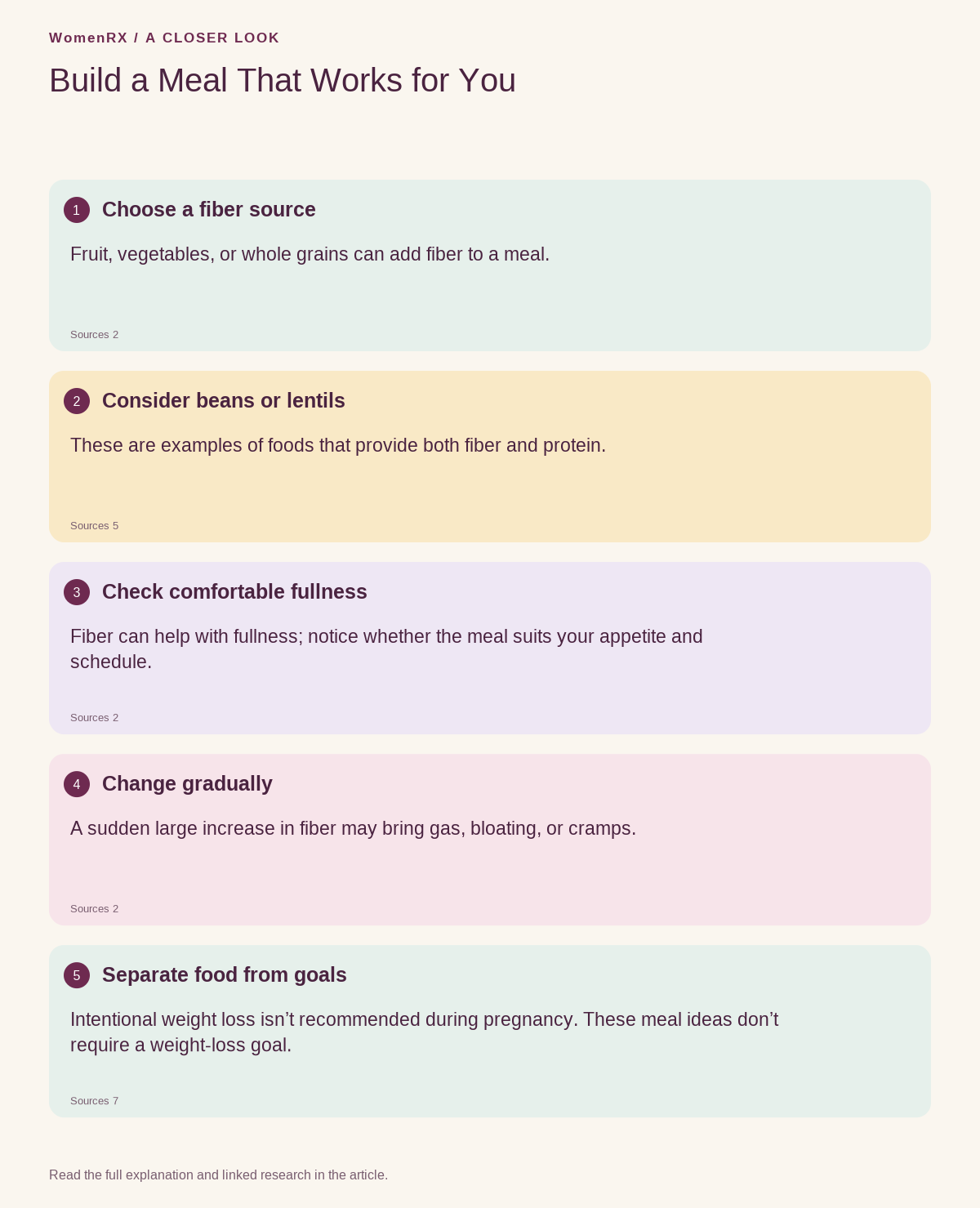
Build a Meal That Works for You
Choose a fiber source: Fruit, vegetables, or whole grains can add fiber to a meal.2
Consider beans or lentils: These are examples of foods that provide both fiber and protein.5
Check comfortable fullness: Fiber can help with fullness; notice whether the meal suits your appetite and schedule.2
Change gradually: A sudden large increase in fiber may bring gas, bloating, or cramps.2
Separate food from goals: Intentional weight loss isn’t recommended during pregnancy. These meal ideas don’t require a weight-loss goal.7
Read the figure as text
Use these optional prompts to assemble a meal. The final prompt separates meal choices from the decision to pursue weight loss; this isn’t a diagnostic checklist.- Choose a fiber source: Fruit, vegetables, or whole grains can add fiber to a meal.2
- Consider beans or lentils: These are examples of foods that provide both fiber and protein.5
- Check comfortable fullness: Fiber can help with fullness; notice whether the meal suits your appetite and schedule.2
- Change gradually: A sudden large increase in fiber may bring gas, bloating, or cramps.2
- Separate food from goals: Intentional weight loss isn’t recommended during pregnancy. These meal ideas don’t require a weight-loss goal.7
More questions, answered
Would a fiber supplement work as well as adding fiber-rich foods?
Don’t assume so. Fiber-rich foods can contribute to fullness and an overall eating pattern, while trials of several isolated fiber ingredients summarized by NIH found little or no weight benefit. The studies do not establish that a supplement reproduces the effect of changing your meals. 12
Sources you can check
- Dietary Supplements for Weight Loss - Health Professional Fact SheetAccessed 2026-09-25Return to first citation
- Dietary Fiber: MedlinePlusAccessed 2026-09-25Return to first citation
- Body Weight: MedlinePlusAccessed 2026-09-25Return to first citation
- Prospective associations between diet quality and body mass index in disadvantaged women: the Resilience for Eating and Activity Despite Inequality (READI) study.Olstad DL, Lamb KE, Thornton LE, McNaughton SA, Crawford DA, Minaker LM, Ball K. · International journal of epidemiology · 2017Return to first citation
- Investigating the physicochemical characteristics and importance of insoluble dietary fiber extracted from legumes: An in-depth study on its biological functions.Liu T, Zhen X, Lei H, Li J, Wang Y, Gou D, Zhao J. · Food chemistry: X · 2024Return to first citation
- Things you can do to help menopause and perimenopause symptoms - NHSAccessed 2026-09-25Return to first citation
- I know i'm not meant to 'diet' but is it ok to lose a few pounds while pregnant?: a qualitative analysis of Mumsnet discussion forum posts to understand women's experiences of and views on weight and weight management while living with excess weight during and after pregnancy.Fong M, Kelly E, Gregory S, Talbot CV, Aquino MRJ. · BMC pregnancy and childbirth · 2025Return to first citation
- Unpacking weight management interventions measuring eating disorder risk in adults: coding of components of interventions in a systematic review.Lister NB, Khalid R, Jardine IR, Pryde S, Melville H, Seidler AL, Hunter KE, Ahern AL, Baur LA, Braet C, Garnett SP, Hill AJ, Maguire S, Nicholls D, Paxton SJ, Piya MK, Sainsbury A... · Journal of eating disorders · 2026Return to first citation