What a Gut-Supportive Eating Pattern Can Look Like
Start with fiber-rich foods you enjoy, add them gradually, and let your symptoms help shape the plan.
A realistic starting point is to include fiber-containing foods such as fruit, vegetables, oats, or whole grains in ways that suit your meals and your tolerance. Increase fiber gradually: a sudden jump can cause gas, bloating, or cramps. These are practical food choices, not a proven microbiome makeover, and persistent digestive symptoms may call for a more tailored approach. 1 3
Start with foods, not a microbiome score
This is general fiber guidance, not a uniquely female diet. A useful everyday starting point is fiber from plant foods: MedlinePlus names whole grains, fruits, and vegetables as sources. Oats and linseed are also mentioned as soluble-fiber options for constipation-related bloating. Think of these as choices to try, not a required menu or a promise to change your microbiome in a particular way. 1 3
A practical example: add fruit to a breakfast you already eat, choose whole-grain bread when it works for you, or include a vegetable with a familiar lunch. You don’t need to overhaul every meal at once. The aim is to find repeatable options you tolerate, rather than follow a rigid food checklist.
Increase fiber at a pace your gut can handle
More fiber isn’t always more comfortable if you add it quickly. Increasing dietary fiber too fast can lead to gas, bloating, and cramps, so add one change at a time and give yourself a chance to see how it feels. 1
If constipation is part of the picture, fluids matter too: MedlinePlus recommends drinking plenty of water and other liquids alongside eating more fruits, vegetables, and grains. Having a bowel movement every day isn’t necessary for everyone, but a change in your usual bowel habits is worth discussing with a provider. 2
If a food reliably brings on symptoms, you don’t have to force it in the name of “diversity.” Bloating can have several causes, including constipation, food intolerance, celiac disease, and irritable bowel syndrome (IBS). 3 Consider whether a different source or smaller addition feels more manageable; if symptoms keep recurring, the cause may need attention beyond simply adding fiber.
A microbiome shift isn’t the same as feeling better
Research can measure changes in the microbes found in the gut, but that measurement is not automatically a meaningful health improvement. For example, a review of human polyphenol interventions found a change in the abundance of Bifidobacterium, but reported substantial variation between studies and noted short intervention periods and inconsistent methods. That supports interest in the finding, not a guarantee that a particular food will improve symptoms or health for everyone. 4
This distinction is useful when you see claims that a food “balances” or “resets” the microbiome. A measured microbial change and a person’s symptoms are different outcomes; a promising microbiome result alone doesn’t establish that you’ll feel better. 4
When a more tailored plan makes sense
Some digestive conditions call for more specific advice than a general fiber-first approach. In a 2026 review of five clinical reports on women with endometriosis, low-FODMAP approaches showed potential for gastrointestinal symptoms, but the evidence was limited and varied in design. The review describes this as an option for selected patients, with dietitian guidance, a time-limited restriction phase, and reintroduction when symptoms improve. It is not a reason to start cutting out many foods on your own. 5
For recurring or disruptive symptoms, the useful next move is figuring out what may be driving them, rather than assuming every symptom means you need a stricter diet. Persistent bloating, for example, can relate to several digestive issues, and guidance recommends getting it checked when it happens often or doesn’t go away. 3
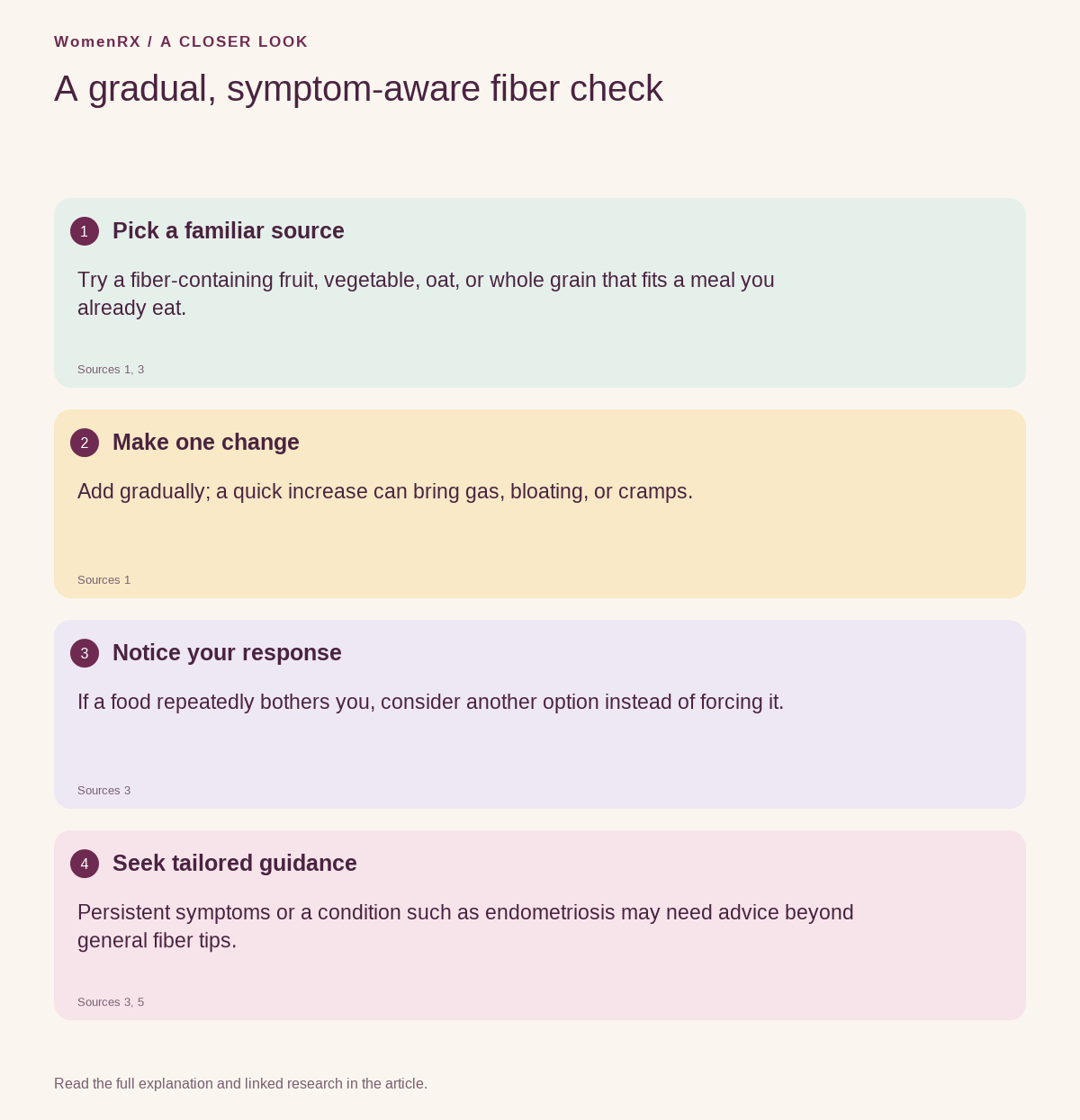
A gradual, symptom-aware fiber check
Pick a familiar source: Try a fiber-containing fruit, vegetable, oat, or whole grain that fits a meal you already eat.13
Make one change: Add gradually; a quick increase can bring gas, bloating, or cramps.1
Notice your response: If a food repeatedly bothers you, consider another option instead of forcing it.3
Seek tailored guidance: Persistent symptoms or a condition such as endometriosis may need advice beyond general fiber tips.35
Read the figure as text
Use this as a practical sequence for trying fiber-rich foods without treating variety as a score or ignoring digestive symptoms.- Pick a familiar source: Try a fiber-containing fruit, vegetable, oat, or whole grain that fits a meal you already eat.13
- Make one change: Add gradually; a quick increase can bring gas, bloating, or cramps.1
- Notice your response: If a food repeatedly bothers you, consider another option instead of forcing it.3
- Seek tailored guidance: Persistent symptoms or a condition such as endometriosis may need advice beyond general fiber tips.35
More questions, answered
Should I keep eating a food that makes me bloated?
You don’t need to force a food that repeatedly causes discomfort. Bloating can have different causes, including constipation and food intolerance, so recurring symptoms may need a tailored explanation rather than a bigger fiber target. 3
Does a change in gut bacteria prove a food is helping?
Not by itself. A measured change in a microbial group is a microbiome finding; it doesn’t automatically show that symptoms or health have improved. Human polyphenol studies also varied considerably in methods and findings. 4
Sources you can check
- Dietary Fiber: MedlinePlusAccessed 2026-09-25Return to first citation
- Constipation | MedlinePlusAccessed 2026-09-25Return to first citation
- Bloating - NHSAccessed 2026-09-25Return to first citation
- Dietary Polyphenols as Modulators of Bifidobacterium in the Human Gut Microbiota.Toderescu CD, Parveen M, Trifunschi S, Oancea A, Jurj GCC, Cresneac IG, Munteanu MF, Ciopanoiu I, Boru C, Pogurschi EN, Ionite C, Stefanache A, Lungu II. · Nutrients · 2026Return to first citation
- Low-FODMAP Diet for Gastrointestinal Symptoms in Endometriosis: A Systematic Review.Watrowski R, Kostov S, Schäfer SD, Juhasz-Böss I, Palumbo M, Sparić R, Mereu L, Vitale SG, Alkatout I. · Nutrients · 2026Return to first citation