How to Build a Satisfying Plate for Weight Loss
Build a meal from familiar foods, then adjust one portion at a time without relying on a fixed plate ratio.
Start with vegetables or fruit, an anchor such as beans or lentils, and a grain or other starch. Serve an amount that looks like a meal you’d normally eat. If you want to try a smaller portion, change one part, such as having one scoop of rice where you’d usually have two, while keeping the beans and vegetables. Portion control can help manage intake; no single plate arrangement guarantees weight loss. 2
A plate can make meal planning simpler, but it doesn't need to look the same at every meal. For weight loss, portion control can be one way to manage how much you eat. The broader aim is to take in less energy than you use over time; the plate itself doesn’t guarantee that. 2
Think of the plate as a prompt: What produce sounds good? What food will anchor this meal? What grain or other starch would round it out? Then use what you’d normally serve as a reference for the amounts. If you want to try a smaller meal, change one component rather than shrinking everything. A scoop is a comparison with your usual serving, not a prescribed serving size.
Build the meal from foods you’ll actually use
Start with produce. Add vegetables, fruit, or both. Fresh, frozen, canned, and prepared choices can all make a meal easier to assemble. MedlinePlus lists fruits and vegetables among foods that may be included in a healthy weight-loss diet. 2 Choose produce that works for your meal rather than treating a particular vegetable or plate share as a rule.
Choose a meal anchor that fits your preferences. For a plant-based meal, beans or lentils are familiar ingredients to build around. They can sit beside rice and vegetables, fill a tortilla, or make soup feel like the main dish. Lupin is another legume option, and a review describes it as a source of plant protein. 3
What about feeling full? In a review of controlled lupin studies in adults, most studies that measured satiety reported a beneficial change, and findings for whole lupin were more consistent than those for lupin protein or fiber on its own. The studies were few and varied. That finding doesn't tell us whether a serving of beans or lentils will have the same effect, or how much of any ingredient you need to feel satisfied. 3
Add a grain or other starch. Rice, oats, potatoes, tortillas, and whole-grain bread are examples to build around. Whole grains are among the foods listed in general weight-loss guidance. You don't need to eliminate starch to use a portion-aware approach. 2
Make a portion change you can see
Look at the meal you were about to serve. If you usually put two scoops of rice next to beans and vegetables, try one scoop of rice while leaving the other foods as planned. If you usually have two pieces of toast with lentil soup, try one with the same bowl of soup. Those are examples of a relative change, not advice to use a particular scoop, bowl, or number of servings.
Eat the meal and notice whether it was enough for you. If a smaller version leaves you looking for more food soon afterward, you can make the next meal more substantial rather than assuming you have to put up with being hungry. If it works for you, it’s a change you can repeat. MedlinePlus identifies portion control as one way to manage intake, but weight loss depends on the overall pattern of eating, not the appearance of one plate. 2
Three meals that bend with your day
These examples show different ways to put a meal together and adjust it without treating any one amount as a rule:
- Beans, rice, and vegetables: Combine canned or cooked beans, rice, and frozen vegetables; season to taste. If your usual plate has two scoops of rice, try one with the same beans and vegetables. If that meal isn't enough, make the next one more substantial with more rice or beans.
- Egg, potato, and vegetables: Put an egg, a potato, and vegetables together as a meal. If you want a more substantial plate, add more potato or another egg rather than following a fixed plate ratio.
- Yogurt, oats, and fruit: For a day when your appetite is limited, start with a smaller bowl of the combination you’d usually make and keep the rest for later. On a hungrier day, make the bowl more substantial. A meal doesn’t have to start at the same size every time.
These choices let you compare portions without counting or forcing every food into a set fraction of the plate. They aren't a test you have to pass: the useful question is whether the meal fits your goal and feels like enough to eat.
Make the approach fit your day
Short on time? Use ready-to-eat or quick-cooking components, such as canned beans, microwaveable grains, and pre-cut or frozen vegetables. A meal doesn't have to be cooked from scratch to follow the same basic structure.
Working with a tight budget? Build around foods you can use in more than one meal, such as dry or canned legumes, grains, and frozen produce. Pick combinations based on what is affordable and available to you rather than chasing a specific “weight-loss” food.
Eating plant-based? Beans and lentils can be meal ingredients alongside a grain and vegetables or fruit. Lupin is another option, not a necessary or proven superior choice for weight loss. 3
A plate is only one part of weight management. MedlinePlus describes healthy eating patterns and physical activity as components of lifestyle changes that can support weight loss. 1
Pregnancy and breastfeeding
General weight-loss advice about portion control and findings from adult lupin studies do not establish whether reducing portions or pursuing weight loss is appropriate during pregnancy or breastfeeding. 2 3 The meals above illustrate combinations of familiar foods, but the evidence presented here does not establish weight-loss portion adjustments for either life stage.
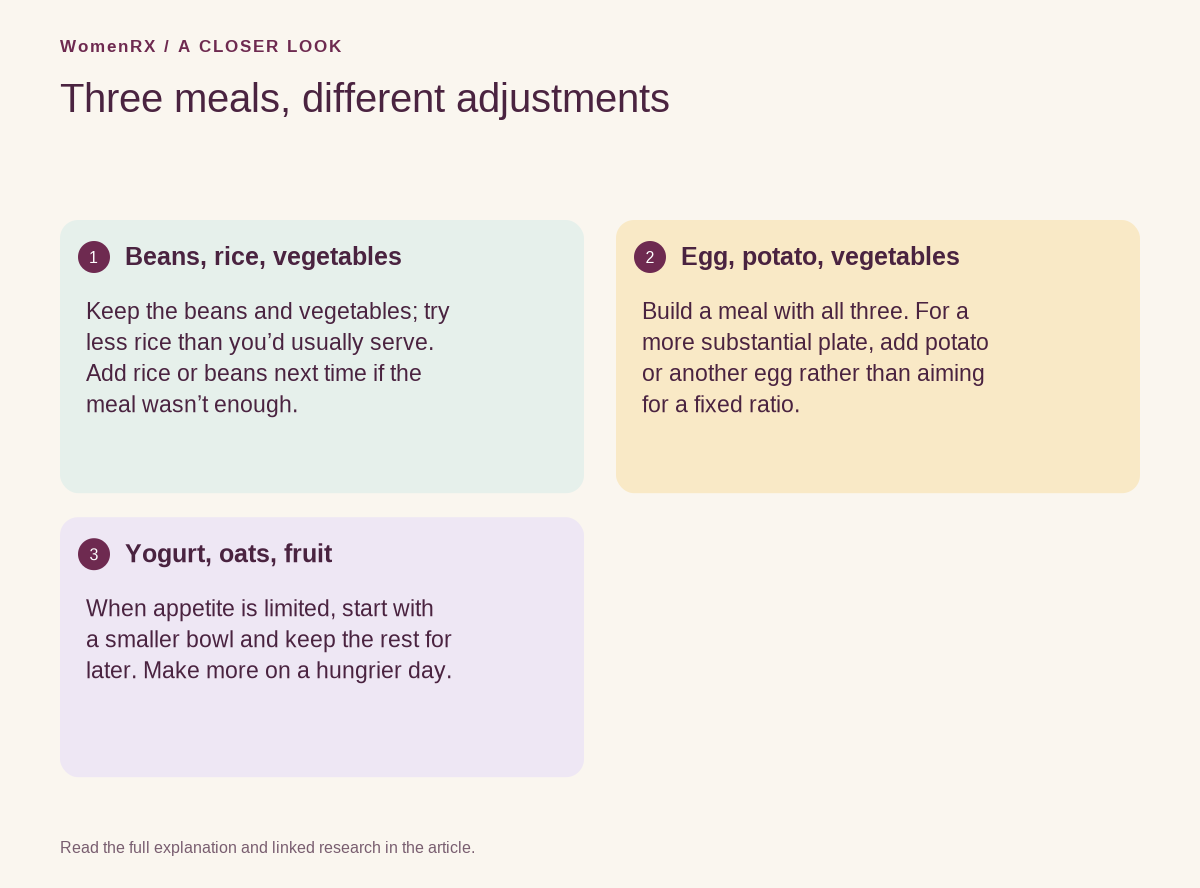
Three meals, different adjustments
Beans, rice, vegetables: Keep the beans and vegetables; try less rice than you’d usually serve. Add rice or beans next time if the meal wasn’t enough.
Egg, potato, vegetables: Build a meal with all three. For a more substantial plate, add potato or another egg rather than aiming for a fixed ratio.
Yogurt, oats, fruit: When appetite is limited, start with a smaller bowl and keep the rest for later. Make more on a hungrier day.
Read the figure as text
These illustrative combinations show that adjusting a meal can mean changing a starch, adding to a plate, or saving part for later.- Beans, rice, vegetables: Keep the beans and vegetables; try less rice than you’d usually serve. Add rice or beans next time if the meal wasn’t enough.
- Egg, potato, vegetables: Build a meal with all three. For a more substantial plate, add potato or another egg rather than aiming for a fixed ratio.
- Yogurt, oats, fruit: When appetite is limited, start with a smaller bowl and keep the rest for later. Make more on a hungrier day.
Sources you can check
- Weight Control: MedlinePlusAccessed 2026-09-25Return to first citation
- Weight-Loss Diets | Diets | MedlinePlusAccessed 2026-09-25Return to first citation
- Lupins and Health Outcomes: A Systematic Literature Review.Bryant L, Rangan A, Grafenauer S. · Nutrients · 2022Return to first citation