How to Build a Meal With Spinach
Spinach can give a meal more vegetable presence, but whether that meal is lower in energy depends on what else goes on the plate.
Yes, spinach can help you build a filling meal, especially when you use it to make room for more vegetables alongside foods that provide protein and other nutrients. Vegetables contribute fiber, which can help with fullness. 12 But adding spinach doesn’t automatically lower a meal’s energy, and a review’s appetite finding for spinach does not establish that eating spinach causes weight loss. 5
Give spinach a job in the meal
Spinach is most useful here as an ingredient, not a weight-loss strategy on its own. Its leaves can take up a noticeable part of a salad or sandwich, or wilt into a warm dish. As a vegetable, it contributes plant fiber; fiber adds bulk to what you eat and can help you feel full sooner. That’s one reason to include vegetables in a meal, though it doesn’t tell us how filling a particular spinach dish will be. 1
Try thinking about what the spinach will sit beside. For example, a spinach salad with beans, chicken, or another protein-containing food makes a more complete meal than a bowl of leaves alone. In a sandwich, a generous layer of fresh spinach can add vegetables without asking you to give up the filling you enjoy. A varied eating pattern includes vegetables and protein-containing foods. 2
Fresh, cooked, or prepared: choose for the dish
Fresh leaves are handy when you want them to remain visible and distinct: in a salad, sandwich, or wrap. Cooked spinach wilts, so it fits differently into a meal. You can stir it into a soup or add it to eggs, beans, or a grain dish when you want vegetables throughout rather than a separate pile on the plate.
Prepared spinach dishes call for one more look. Spinach in a creamy dip, for example, is part of a different recipe from plain leaves in a salad. Neither dish needs to be off-limits. If your goal is a lower-energy meal, compare the whole dish, including its dressing, sauce, and other ingredients, rather than assuming the word “spinach” settles the question. Healthy eating can include a variety of foods and should fit your preferences. 2
Adding spinach and changing a meal aren’t the same thing
Picture a familiar lunch: a sandwich and a side. Adding spinach inside the sandwich gives you more vegetables, but it doesn’t remove anything from that lunch. Choosing a spinach-based side instead of another side changes the meal’s makeup. Whether it lowers total energy still depends on the ingredients and portions in both versions. Long-term weight management rests on an overall eating pattern and energy intake, not on one vegetable. 3
Research doesn’t offer a spinach-specific weight-loss promise for women. A review of clinical trials of plant-derived products reported an appetite finding for spinach, but its abstract doesn’t establish that ordinary servings of fresh or cooked spinach reduce body weight, or give a separate result for women at different life stages. A rat study of spinach-derived thylakoids tested an isolated leaf component, not a spinach meal. 54
So pick the form you’ll enjoy and use it to make a meal you actually want to eat. Fresh leaves may suit a substantial sandwich or salad; wilted spinach may suit a warm, mixed dish. The useful question is what spinach adds to your plate, and whether the finished meal still has enough variety to satisfy you.
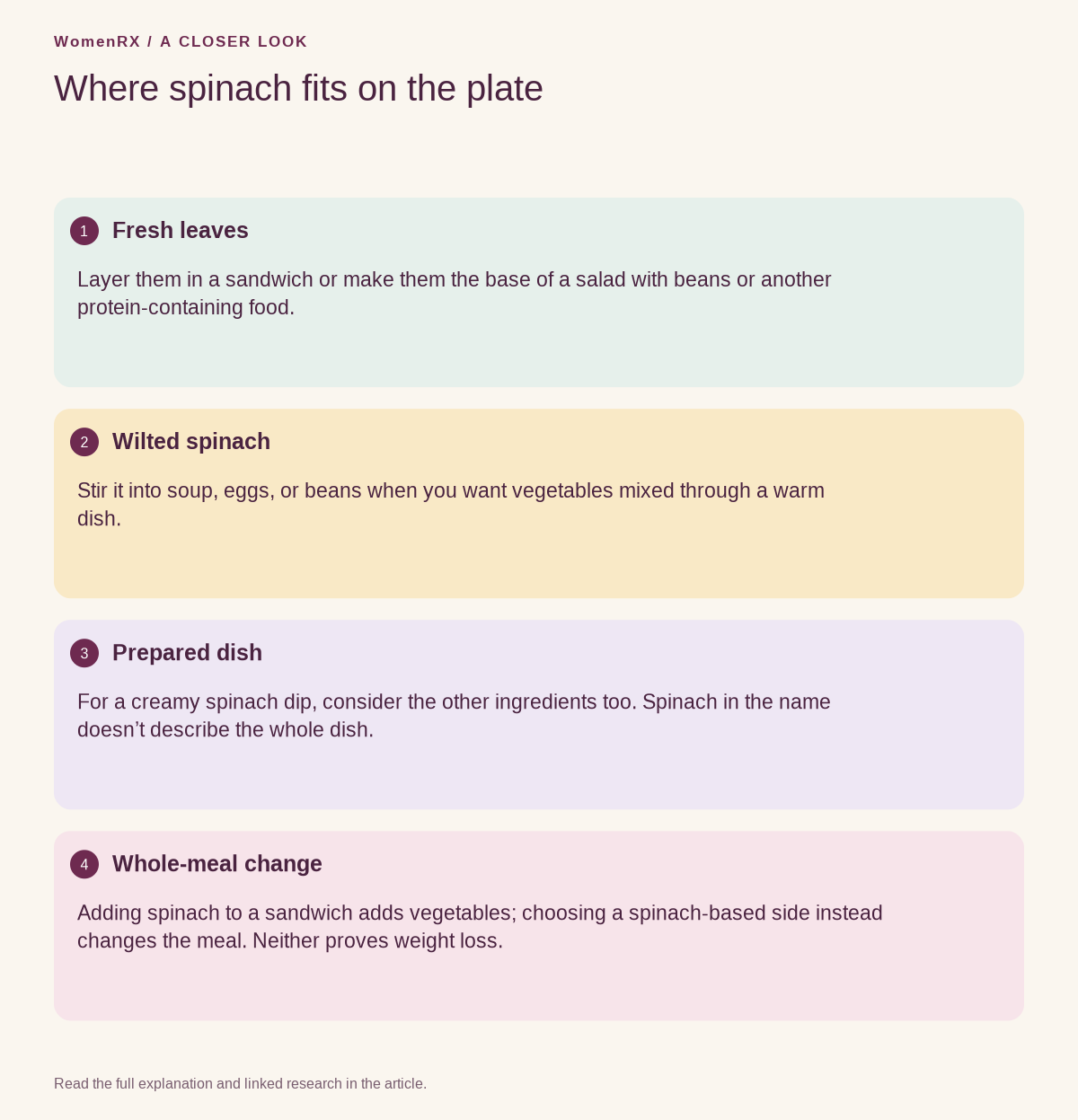
Where spinach fits on the plate
Fresh leaves: Layer them in a sandwich or make them the base of a salad with beans or another protein-containing food.
Wilted spinach: Stir it into soup, eggs, or beans when you want vegetables mixed through a warm dish.
Prepared dish: For a creamy spinach dip, consider the other ingredients too. Spinach in the name doesn’t describe the whole dish.
Whole-meal change: Adding spinach to a sandwich adds vegetables; choosing a spinach-based side instead changes the meal. Neither proves weight loss.
Read the figure as text
The form changes how spinach fits into a meal; the rest of the recipe matters too.- Fresh leaves: Layer them in a sandwich or make them the base of a salad with beans or another protein-containing food.
- Wilted spinach: Stir it into soup, eggs, or beans when you want vegetables mixed through a warm dish.
- Prepared dish: For a creamy spinach dip, consider the other ingredients too. Spinach in the name doesn’t describe the whole dish.
- Whole-meal change: Adding spinach to a sandwich adds vegetables; choosing a spinach-based side instead changes the meal. Neither proves weight loss.
Sources you can check
- Dietary Fiber: MedlinePlusAccessed 2026-09-25Return to first citation
- Nutrition: MedlinePlusAccessed 2026-09-25Return to first citation
- Dietary Supplements for Weight Loss - Health Professional Fact SheetAccessed 2026-09-25Return to first citation
- Feeding spinach thylakoids to rats modulates the gut microbiota, decreases food intake and affects the insulin response.Montelius C, Osman N, Weström B, Ahrné S, Molin G, Albertsson PÅ, Erlanson-Albertsson C. · Journal of nutritional science · 2013Return to first citation
- Effect of the herbal medicines in obesity and metabolic syndrome: A systematic review and meta-analysis of clinical trials.Payab M, Hasani-Ranjbar S, Shahbal N, Qorbani M, Aletaha A, Haghi-Aminjan H, Soltani A, Khatami F, Nikfar S, Hassani S, Abdollahi M, Larijani B. · Phytotherapy research : PTR · 2020Return to first citation