Can Brussels Sprouts Fit Into a Weight-Loss Meal?
Brussels sprouts can be a useful vegetable side, but the oil, cheese, and dressing you add can change the meal more than the sprouts themselves.
Yes. A generous serving of Brussels sprouts can add vegetable volume and make a plate feel more substantial, though the cited research doesn’t establish that Brussels sprouts specifically increase fullness. Plain or simply seasoned sprouts keep the side straightforward; oil, butter, cheese, or creamy dressing add energy. Broad food studies suggest lower-energy-density meals can reduce daily energy intake, but they don’t show that sprouts cause weight loss or work differently for women. 2
The sprouts aren’t the whole story
Brussels sprouts can fit comfortably into a weight-loss meal as a vegetable side. A generous serving adds food volume to the plate, which can make the meal feel more substantial. But the energy-density studies discussed here examined varied foods and meals, not whether Brussels sprouts specifically increase fullness. The useful distinction is how they’re prepared and what they replace: a lightly seasoned portion is different from sprouts coated with oil and finished with cheese or a rich dressing. 2
Food energy density means the amount of energy in a given weight of food. In experiments with adults and children, serving lower-energy-density foods was associated with lower total daily energy intake. But the review included many kinds of food, not a Brussels-sprout weight-loss trial. In the five studies that examined body weight, lower-energy-density foods tended to be linked with more weight loss, but the difference wasn’t statistically significant. The pooled findings cited don’t show whether the effect differs for women. 2
So, Brussels sprouts may help make a meal more vegetable-forward, but the evidence doesn’t establish that eating them leads to weight loss or whether the broader energy-density effect differs for women. A food’s place in the overall eating pattern matters more than labeling it a “weight-loss” food. 12
Compare the preparation, not just the vegetable
Plain, steamed, or boiled: These are straightforward options when you want a vegetable side without a rich sauce. A laboratory study found that cooking Brussels sprouts changes their dietary-fiber fractions; it did not study appetite or body weight, so it can’t tell us which cooking method is best for weight loss. 3
Roasted with little or no added fat: Roasting can be a flavorful option. The cooking method itself doesn’t guarantee a lighter meal, though. Consider what goes on the sprouts and whether the finished dish still works as the vegetable side you intended.
Roasted or served with generous toppings: Oil, butter, cheese, nuts, bacon, and creamy dressing can make the side more energy-dense. Fat contains more energy per gram than protein or carbohydrate, so fat-rich additions can change the meal even when the sprouts remain the main ingredient. 2
That doesn’t make toppings off-limits. It just helps to treat them as part of the meal rather than as invisible seasoning. If you want their flavor, try using a lighter coating, choosing one or two toppings you enjoy, or serving a rich dressing on the side.
A practical way to build the plate
Start with Brussels sprouts prepared in a way you like enough to eat regularly. Then decide whether the meal needs a richer addition for taste or texture. For example, you might roast the sprouts with seasoning and finish them with a small amount of cheese, rather than combining oil, cheese, and a creamy dressing. That’s a practical comparison, not a measured calorie prescription.
If you’re choosing between two versions, ask: Which one gives me the vegetable side I want, and which additions are worth having? That keeps the decision focused on the meal you’ll actually enjoy, without expecting one vegetable to produce weight loss on its own.
A broader weight-loss plan involves the eating pattern and total energy intake, not a single ingredient. 1
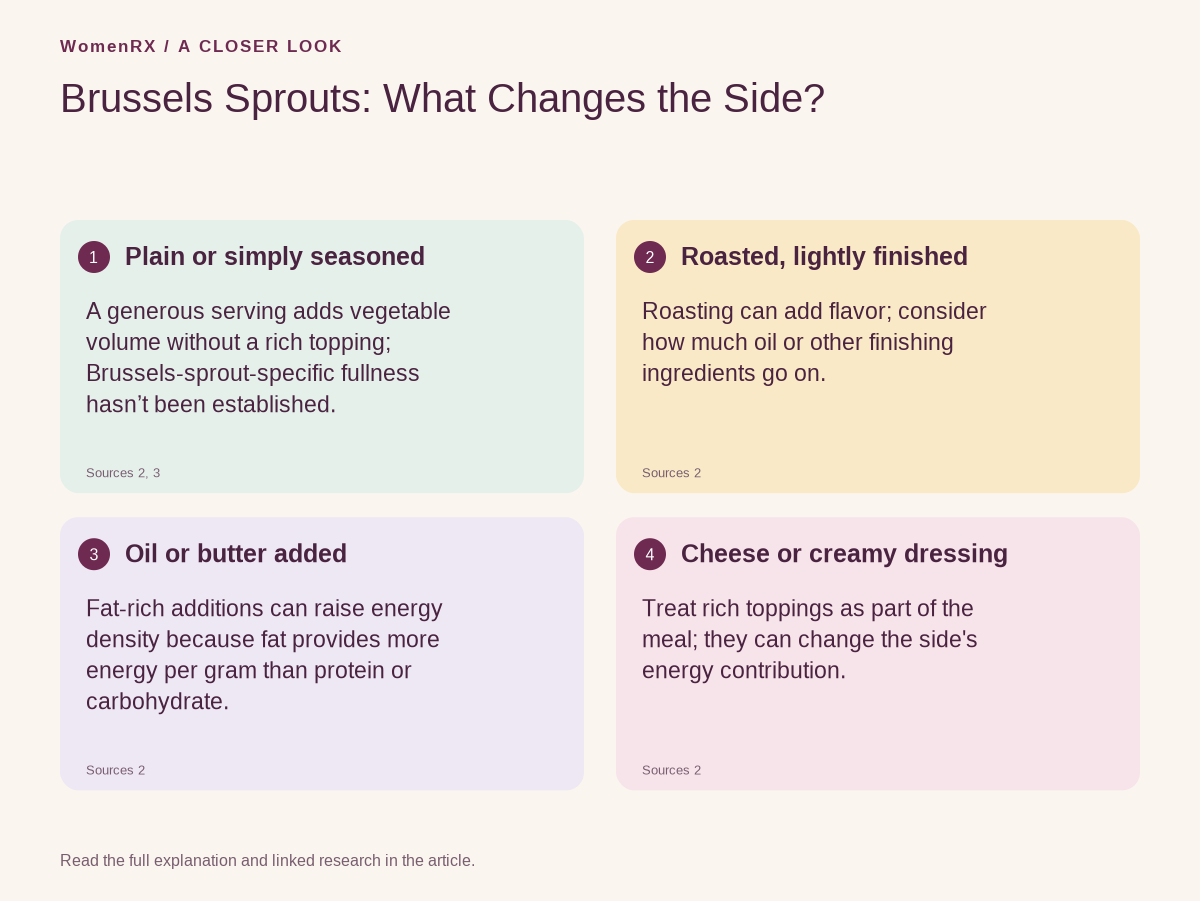
Brussels Sprouts: What Changes the Side?
Plain or simply seasoned: A generous serving adds vegetable volume without a rich topping; Brussels-sprout-specific fullness hasn’t been established.23
Roasted, lightly finished: Roasting can add flavor; consider how much oil or other finishing ingredients go on.2
Oil or butter added: Fat-rich additions can raise energy density because fat provides more energy per gram than protein or carbohydrate.2
Cheese or creamy dressing: Treat rich toppings as part of the meal; they can change the side's energy contribution.2
Read the figure as text
Compare simple preparations with richer finishes. A larger serving adds vegetable volume, but the comparison is about the meal’s ingredients, not a proven fullness or weight-loss effect of Brussels sprouts.- Plain or simply seasoned: A generous serving adds vegetable volume without a rich topping; Brussels-sprout-specific fullness hasn’t been established.23
- Roasted, lightly finished: Roasting can add flavor; consider how much oil or other finishing ingredients go on.2
- Oil or butter added: Fat-rich additions can raise energy density because fat provides more energy per gram than protein or carbohydrate.2
- Cheese or creamy dressing: Treat rich toppings as part of the meal; they can change the side's energy contribution.2
More questions, answered
Does roasting Brussels sprouts make them less useful for weight loss?
Roasting by itself doesn’t determine whether a meal supports weight loss. What matters for this comparison is also what gets added: oil, butter, cheese, and creamy dressing can increase the meal’s energy density. Human studies on energy density are about foods and meals broadly, not roasted Brussels sprouts specifically. 2
Are Brussels sprouts especially effective for women?
The pooled energy-density findings cited don’t show whether the effect differs for women, and they aren’t a trial of Brussels sprouts. That doesn’t establish that the effect is the same or different for women; it means these findings can’t answer that question. 2
Sources you can check
- Dietary Supplements for Weight Loss - Health Professional Fact SheetAccessed 2026-09-25Return to first citation
- Calorie reformulation: a systematic review and meta-analysis examining the effect of manipulating food energy density on daily energy intake.Robinson E, Khuttan M, McFarland-Lesser I, Patel Z, Jones A. · The international journal of behavioral nutrition and physical activity · 2022Return to first citation
- Impact of Cooking Techniques on the Dietary Fiber Profile in Selected Cruciferous Vegetables.Nowak K, Rohn S, Halagarda M. · Molecules (Basel, Switzerland) · 2025Return to first citation