Can Lower-Energy-Density Meals Help You Feel Full?
Adding water-rich foods can make a meal larger by weight without adding energy in the same proportion, but fullness and weight change aren’t guaranteed.
Often, yes. Lowering a meal’s energy density can let you eat a similar amount of food with less energy, and a small trial in young women found a larger broccoli portion improved fullness ratings compared with the smallest portion. It isn’t a guarantee of weight loss or a license for unlimited portions; keeping protein and preferred foods in the meal can make the approach more livable. 234
What energy density means at the table
Energy density is the energy in a given weight of food, usually expressed as calories per gram. Water adds weight without adding calories, so water-rich foods such as vegetables and fruit generally have lower energy density. Fat has more calories per gram than protein or carbohydrate, which is why adding oil can raise a meal’s energy density quickly. 4
That’s different from judging a meal by its size alone. A lower-energy-density meal may weigh about as much as a higher-energy-density one while providing less energy. In a meta-analysis of 38 controlled studies comparing meals, the lower-energy-density conditions led to about 223 fewer calories consumed on average; the studies varied, and they measured intake under controlled conditions. 3
What the women-specific trial actually tested
A randomized crossover trial gave 40 young Japanese women lunches built around the same rice and hamburger, with broccoli portions ranging from 80 to 280 grams. Fullness ratings were lower after the 80-gram portion than after 200 or 280 grams at some of the measured time points. The study also compared those meals with versions that added oil. 2
The researchers concluded that, in a 500-calorie meal with relatively little fat, at least 200 grams of vegetables could provide fullness and satisfaction similar to a higher-fat meal. That’s a result from one specific meal and a small group of young women, not a universal serving target. It also doesn’t show that vegetables must replace the rest of your meal: the rice and hamburger stayed in the tested meals. 2
This is a practical place to start: keep a protein food and the parts of the meal you enjoy, then try adding vegetables such as broccoli. The trial supports that particular meal comparison; it didn’t test every food combination or show that protein independently caused fullness. 2
A useful tool, not a promise of weight loss
Feeling full during a meal and losing weight over time are related questions, but they aren’t the same outcome. A review of controlled studies found that lower-energy-density meals reduced energy intake, while the amount of food eaten stayed similar. In a separate review of experiments lasting at least a day, lower-energy-density foods also reduced daily energy intake, but results for weight change across five studies weren’t statistically conclusive. 34
So it’s reasonable to use energy density as one way to shape meals, but not to expect it to guarantee weight loss. Portion size and the rest of your eating pattern still matter. A food being lower in energy per gram doesn’t make it calorie-free or unlimited. 34
You also don’t have to ban foods that are more energy-dense. In a six-month behavioral weight-loss trial with adults, a walnut-enriched reduced-energy diet produced weight loss and self-reported satiety similar to a standard reduced-energy-density diet. That single trial doesn’t establish that every richer food will have the same effect, but it shows that a weight-management approach can include a preferred, energy-dense food rather than treating it as off-limits. 5
Make the idea fit your appetite and routine
Try the approach with a meal you already like rather than rebuilding your whole diet. For example, if you make rice and a protein food, you could add a more generous portion of broccoli or another vegetable. Keep the ingredients that make the meal satisfying, and be aware that oil or other higher-energy ingredients can change the meal’s energy density without changing its volume much. These are meal-building ideas, not a fixed portion prescription. 24
The approach may suit you if you like vegetables and want a generous-looking meal. It may be less appealing if you dislike the foods you’d be adding, or if a larger volume of food feels uncomfortable. Energy density is one flexible lever, not a rule that every meal must be bulky or low in fat. 34
Most of the larger evidence summaries include adults, sometimes alongside children, and don’t report a women-only effect. The women-specific meal trial involved young Japanese women, so it doesn’t answer whether appetite or energy needs make the approach different for women at other ages. The reported findings don’t provide pregnancy- or breastfeeding-specific results, so these examples aren’t tailored to those periods. In later life, body-weight needs can differ, and maintaining muscle and strength matters alongside the number on the scale. 1234
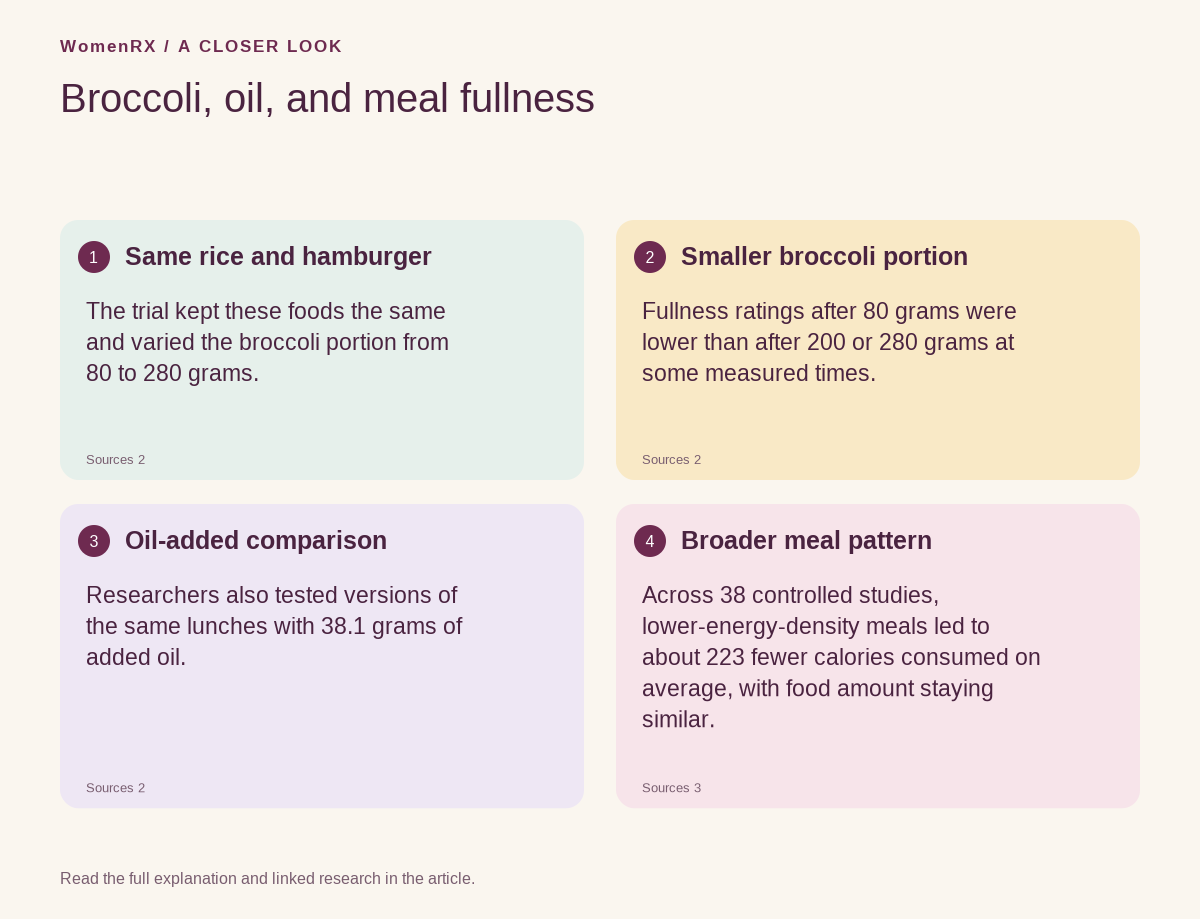
Broccoli, oil, and meal fullness
Same rice and hamburger: The trial kept these foods the same and varied the broccoli portion from 80 to 280 grams.2
Smaller broccoli portion: Fullness ratings after 80 grams were lower than after 200 or 280 grams at some measured times.2
Oil-added comparison: Researchers also tested versions of the same lunches with 38.1 grams of added oil.2
Broader meal pattern: Across 38 controlled studies, lower-energy-density meals led to about 223 fewer calories consumed on average, with food amount staying similar.3
Read the figure as text
A small trial in young women compared versions of the same lunch. These findings illustrate one meal comparison, not a universal portion guide.- Same rice and hamburger: The trial kept these foods the same and varied the broccoli portion from 80 to 280 grams.2
- Smaller broccoli portion: Fullness ratings after 80 grams were lower than after 200 or 280 grams at some measured times.2
- Oil-added comparison: Researchers also tested versions of the same lunches with 38.1 grams of added oil.2
- Broader meal pattern: Across 38 controlled studies, lower-energy-density meals led to about 223 fewer calories consumed on average, with food amount staying similar.3
More questions, answered
Does lower energy density mean cutting out fat?
No. Fat contains more energy per gram than protein or carbohydrate, so adding oil can raise a meal’s energy density. But a six-month behavioral trial found similar weight loss and self-reported satiety with a walnut-enriched reduced-energy diet and a standard reduced-energy-density diet. The practical choice is about how a meal works for you, not banning every higher-energy food. 45
Is 200 grams of vegetables the right amount for every meal?
No. That amount came from one lunch study in 40 young Japanese women, using a specific meal and testing several broccoli portions. It offers an example of how meal composition can affect fullness, not a universal portion target. 2
Sources you can check
- Body Weight: MedlinePlusAccessed 2026-09-25Return to first citation
- Single vegetable meal content equivalence as an alternative to fat for satiety: a randomised trial in Japanese women.Adachi C, Yamanaka-Okumura H, Katayama T, Taketani Y, Takeda E. · Asia Pacific journal of clinical nutrition · 2016Return to first citation
- Impact of energy density on energy intake in children and adults: a systematic review and meta-analysis of randomized controlled trials.Klos B, Cook J, Crepaz L, Weiland A, Zipfel S, Mack I. · European journal of nutrition · 2023Return to first citation
- Calorie reformulation: a systematic review and meta-analysis examining the effect of manipulating food energy density on daily energy intake.Robinson E, Khuttan M, McFarland-Lesser I, Patel Z, Jones A. · The international journal of behavioral nutrition and physical activity · 2022Return to first citation
- Walnut consumption in a weight reduction intervention: effects on body weight, biological measures, blood pressure and satiety.Rock CL, Flatt SW, Barkai HS, Pakiz B, Heath DD. · Nutrition journal · 2017Return to first citation