Can Progesterone Make You Feel Tired?
Oral micronized progesterone can cause drowsiness, but a timing pattern can help you tell medication-related sleepiness from fatigue that needs a broader look.
Yes. Oral micronized progesterone has been linked with drowsiness and dizziness in research involving postmenopausal women, so feeling sleepy after taking it is plausible. But tiredness alone doesn’t prove progesterone is the cause. Note when you take it and when symptoms appear, and bring persistent or worsening fatigue to your prescriber rather than changing the medicine yourself. 24
Sleepy, poorly rested, or drained?
“Tired” can mean different things. You might feel like you could nod off, feel unrefreshed after sleep, or feel persistently low on energy without being sleepy. These experiences can overlap, but separating them in your notes gives your prescriber a clearer starting point. It doesn’t diagnose the cause.
Oral micronized progesterone can make some people feel drowsy. In a randomized study of postmenopausal women using sequential combined hormone therapy, drowsiness and dizziness were more frequent with micronized progesterone than with chlormadinone acetate. The study compared two treatment regimens, so it doesn’t show how often progesterone causes tiredness compared with taking no progesterone. 2
A 2024 review of oral micronized progesterone also describes drowsiness and dizziness as recognized effects. These findings are about oral micronized progesterone; they shouldn’t automatically be applied to every progestogen, route, or treatment plan. 4
Look for a timing pattern, not proof
If you take oral progesterone, note when you take it and when you notice sleepiness or fatigue. A repeated pattern after taking it may be useful to discuss, but it can’t establish the cause on its own. The timing, formulation, and full hormone-therapy regimen matter, and symptoms can have more than one explanation.
Progesterone and some of its metabolites can affect GABA-A receptors, which play a role in brain processes including sleep. This offers a possible explanation for drowsiness, but a mechanism doesn’t prove that progesterone explains any one person’s symptoms. 4
A small single-dose study offers only limited timing context: it included 10 healthy volunteers, nine men and one woman, and found increased sedation ratings one to two hours after doses of extended-release progesterone. Because the study was not a trial of menopause treatment in women, it can’t tell you when you’ll feel sleepy on your own regimen. 3
Make a short, useful log
For a week or two, if it’s practical, jot down:
- When you take progesterone, and the formulation listed on the package or prescription.
- When you feel sleepy, unrefreshed, or low on energy, noting which description fits best.
- Whether the feeling eases, persists, or interferes with your usual activities.
Keep taking your medicine as prescribed while you collect notes. Don’t skip, stop, or change the timing or amount on your own. Instead, ask the prescriber whether the pattern could relate to your particular treatment plan and what options are appropriate for you.
When to look beyond a hormone explanation
If fatigue continues, gets worse, or makes everyday activities difficult, raise it with your prescriber even if it seems to follow a dose. If there’s no clear timing pattern, that’s another reason not to assume progesterone is responsible. A hormone review may be part of the conversation, but it shouldn’t be the only possible explanation considered.
Hormone therapy decisions are individualized and should be reviewed periodically with attention to benefits and risks. Bring your notes and ask what else might account for the fatigue, as well as whether any change to your plan makes sense. 1
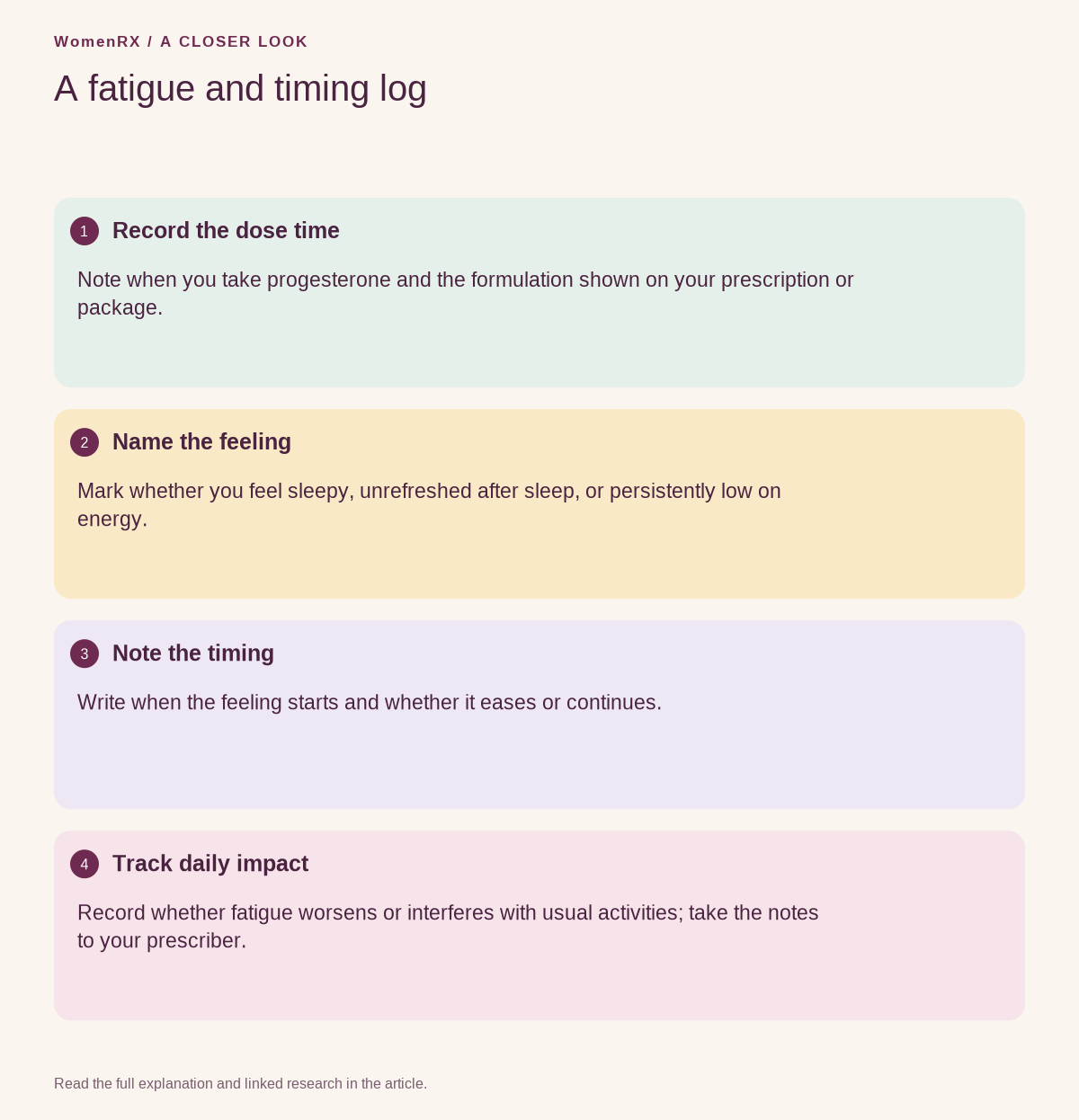
A fatigue and timing log
Record the dose time: Note when you take progesterone and the formulation shown on your prescription or package.
Name the feeling: Mark whether you feel sleepy, unrefreshed after sleep, or persistently low on energy.
Note the timing: Write when the feeling starts and whether it eases or continues.
Track daily impact: Record whether fatigue worsens or interferes with usual activities; take the notes to your prescriber.
Read the figure as text
Separate the kind of tiredness you notice from its timing, so a conversation about possible progesterone effects doesn’t mistake a pattern for proof.- Record the dose time: Note when you take progesterone and the formulation shown on your prescription or package.
- Name the feeling: Mark whether you feel sleepy, unrefreshed after sleep, or persistently low on energy.
- Note the timing: Write when the feeling starts and whether it eases or continues.
- Track daily impact: Record whether fatigue worsens or interferes with usual activities; take the notes to your prescriber.
More questions, answered
Does feeling tired mean I should stop progesterone?
No. A timing pattern can be useful information, but it doesn’t establish the cause or show that stopping is the right choice. Keep taking it as prescribed and discuss the symptoms and your treatment plan with the prescriber.
Does research on oral micronized progesterone apply to every form of progesterone?
Not necessarily. The menopause study and review cited here concern oral micronized progesterone; they don’t establish the same effects for every progestogen, route, or regimen. 24
Sources you can check
- The 2022 hormone therapy position statement of The North American Menopause Society.“The 2022 Hormone Therapy Position Statement of The North American Menopause Society” Advisory Panel. · Menopause (New York, N.Y.) · 2022Return to first citation
- Chlormadinone acetate versus micronized progesterone in the sequential combined hormone replacement therapy of the menopause.Pélissier C, Maroni M, Yaneva H, Brin S, Peltier-Pujol F, Jondet M. · Maturitas · 2001Return to first citation
- Allopregnanolone Concentrations After Ascending Single Dose Administration of Progesterone to Healthy Volunteers.Hughes-Medlicott NJ, Nguyen H, Glue P, Barak Y. · Human psychopharmacology · 2025Return to first citation
- Diagnostic and therapeutic use of oral micronized progesterone in endocrinology.Memi E, Pavli P, Papagianni M, Vrachnis N, Mastorakos G. · Reviews in endocrine & metabolic disorders · 2024Return to first citation