Can progesterone worsen sleep during menopause hormone therapy?
Progesterone is often associated with drowsiness, but insomnia can still occur during hormone therapy, and the timing alone can’t prove which hormone is responsible.
It’s possible for insomnia to occur while you’re taking progesterone, but current evidence doesn’t show that progesterone, or a higher dose, is necessarily the cause. Oral micronized progesterone can cause drowsiness, while one small study found mixed sleep changes after women switched formulations. Estrogen effects, menopause symptoms, other medicines, and common causes of insomnia also matter. Don’t change your dose on your own. 1 2 3 5
Sleepiness and insomnia aren’t the same thing
Feeling drowsy after taking progesterone is different from having insomnia. Insomnia means difficulty falling asleep, waking during the night or too early, or waking without feeling rested. Oral micronized progesterone product information warns that some people may experience drowsiness or dizziness. That doesn’t mean it will improve sleep for everyone, or that daytime sleepiness explains new trouble falling or staying asleep. 1 3
There’s also a product-label signal worth knowing about: the prescribing information for Bijuva, a capsule combining estradiol with micronized progesterone, lists insomnia and sleep disorder. Because the medicine contains both hormones, that listing can’t show whether progesterone, estradiol, their combination, or another factor was responsible. It also doesn’t tell us how often insomnia occurs with progesterone on its own. 2
What studies say about sleep and progesterone
A small retrospective study followed 36 women receiving estrogen-progestogen therapy after they switched from synthetic progestins to micronized progesterone; 22 completed a year of follow-up. At three months, measures of falling asleep and nighttime awakenings improved, but the overall insomnia score didn’t significantly change. At one year, the earlier improvements weren’t seen. Among 11 women who had few sleep symptoms at the start, overall scores worsened. These mixed results suggest that people’s responses can differ, but the study can’t establish that progesterone caused either improvement or worsening. 5
A separate randomized study of 727 recently postmenopausal women compared two estrogen regimens, each paired with micronized progesterone, with placebo. Insomnia decreased in all groups; the active regimens showed an intermittent advantage over placebo. Since progesterone was part of the active regimens, this study can’t tell us what progesterone alone did. It also suggests that improvement in menopause-related symptoms and sleep may not follow a simple, consistent pattern. 6
Taken together, these findings don’t establish that a higher progesterone dose causes insomnia. They also don’t rule out an individual reaction. The evidence is limited: a product label reports insomnia for a combined product, and studies of sleep include progesterone alongside other hormones or compare formulations rather than testing progesterone alone. 2 5 6
Look at the whole change, not just the dose
If sleep changed after starting or adjusting hormone therapy, the timing is useful information, but it isn’t proof of cause. Night sweats or hot flashes may be part of the sleep disruption, and other causes can overlap. Insomnia can also be associated with stress, medical conditions, other medicines, caffeine, tobacco, alcohol, or another sleep disorder. 1 6
For a useful discussion with your prescriber, jot down:
- The product name and formulation, the prescribed dose, and when you take it.
- When you started it or last changed it, and when the sleep change began.
- Whether the problem is falling asleep, waking during the night, waking too early, or daytime drowsiness.
- Whether it changes on different days of a cyclic regimen, if that applies to you.
- Night sweats, hot flashes, other new symptoms, and any medicine or supplement changes around the same time.
This record can help distinguish a recurring pattern from a one-off bad night. Don’t stop, skip, or change progesterone without discussing it with the prescriber, particularly when it’s part of a hormone therapy plan. Menopause hormone therapy should be individualized and periodically reevaluated. 4
If trouble sleeping continues, it deserves attention even if the hormone timing seems persuasive. Insomnia can have more than one contributor, and treating an underlying cause may matter as much as reviewing the hormone regimen. 1
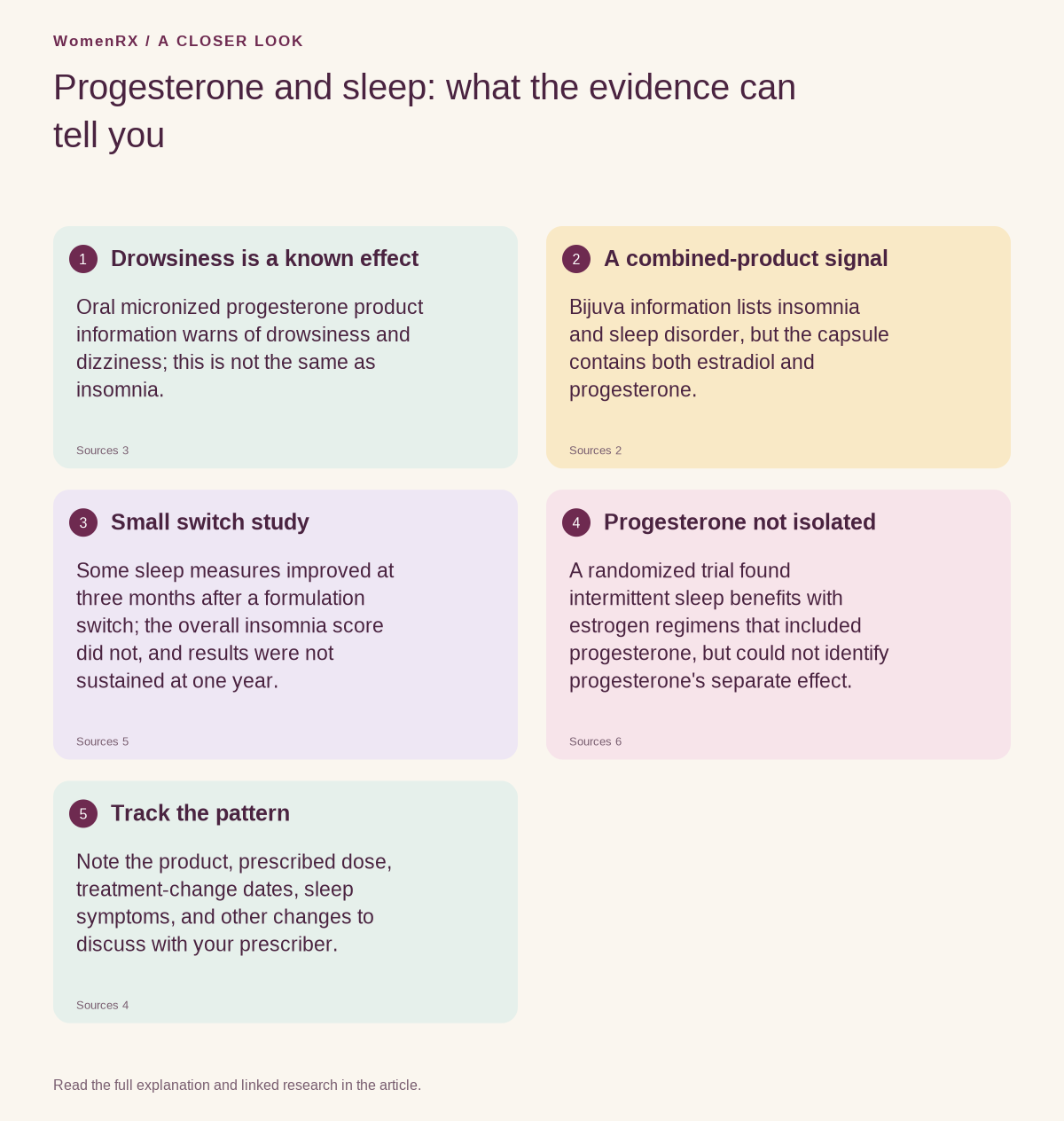
Progesterone and sleep: what the evidence can tell you
Drowsiness is a known effect: Oral micronized progesterone product information warns of drowsiness and dizziness; this is not the same as insomnia.3
A combined-product signal: Bijuva information lists insomnia and sleep disorder, but the capsule contains both estradiol and progesterone.2
Small switch study: Some sleep measures improved at three months after a formulation switch; the overall insomnia score did not, and results were not sustained at one year.5
Progesterone not isolated: A randomized trial found intermittent sleep benefits with estrogen regimens that included progesterone, but could not identify progesterone's separate effect.6
Track the pattern: Note the product, prescribed dose, treatment-change dates, sleep symptoms, and other changes to discuss with your prescriber.4
Read the figure as text
Sleepiness, insomnia, and study results are different kinds of evidence; none alone proves progesterone caused a change in your sleep.- Drowsiness is a known effect: Oral micronized progesterone product information warns of drowsiness and dizziness; this is not the same as insomnia.3
- A combined-product signal: Bijuva information lists insomnia and sleep disorder, but the capsule contains both estradiol and progesterone.2
- Small switch study: Some sleep measures improved at three months after a formulation switch; the overall insomnia score did not, and results were not sustained at one year.5
- Progesterone not isolated: A randomized trial found intermittent sleep benefits with estrogen regimens that included progesterone, but could not identify progesterone's separate effect.6
- Track the pattern: Note the product, prescribed dose, treatment-change dates, sleep symptoms, and other changes to discuss with your prescriber.4
More questions, answered
Does feeling sleepy mean progesterone is helping my sleep?
Not necessarily. Drowsiness is a known effect of oral micronized progesterone, but it isn’t the same as better-quality sleep or fewer nighttime awakenings. Track the difference between daytime sleepiness and insomnia symptoms. 1 3
Should I lower or stop progesterone if my sleep gets worse?
Don’t change it on your own. Record when the sleep problem began and the exact product and prescribed dose, then discuss the pattern with your prescriber. The available studies don’t establish that a particular dose causes insomnia. 4 5 6
Sources you can check
- Insomnia | MedlinePlusAccessed 2026-09-25Return to first citation
- BIJUVA (ESTRADIOL AND PROGESTERONE) CAPSULE [MAYNE PHARMA] | US prescribing information and patient instructionsAccessed 2026-09-25Return to first citation
- PROMETRIUM (PROGESTERONE) CAPSULE [ACERTIS PHARMACEUTICALS, LLC] | US prescribing information and patient instructionsAccessed 2026-09-25Return to first citation
- The 2022 hormone therapy position statement of The North American Menopause Society.“The 2022 Hormone Therapy Position Statement of The North American Menopause Society” Advisory Panel. · Menopause (New York, N.Y.) · 2022Return to first citation
- Effects of Micronized Progesterone in Menopausal Hormone Replacement Therapy on Sleep.Hirose A, Terauchi M, Hirata M, Matsuoka K, Umayahara K, Sakamoto M, Miyasaka N. · The journal of obstetrics and gynaecology research · 2026Return to first citation
- Longitudinal changes in menopausal symptoms comparing women randomized to low-dose oral conjugated estrogens or transdermal estradiol plus micronized progesterone versus placebo: the Kronos Early Estrogen Prevention Study.Santoro N, Allshouse A, Neal-Perry G, Pal L, Lobo RA, Naftolin F, Black DM, Brinton EA, Budoff MJ, Cedars MI, Dowling NM, Dunn M, Gleason CE, Hodis HN, Isaac B, Magnani M, Manson J... · Menopause (New York, N.Y.) · 2017Return to first citation