What Oral Progesterone Does in Menopause Hormone Therapy
If you use systemic estrogen and still have a uterus, progesterone may be part of the plan to protect the uterine lining, but the medicine and route matter.
Oral micronized progesterone is often used with systemic estrogen in menopause hormone therapy when you have a uterus, because estrogen can stimulate the uterine lining and a progestogen helps protect it. It’s not the only kind of progestogen, and an oral capsule isn’t interchangeable with vaginal progesterone or a skin product. Ask which medicine you’re taking, what it’s meant to do, and how its schedule fits your estrogen. 1 2
The reason progesterone may accompany estrogen
Systemic estrogen can stimulate the lining of the uterus. For a postmenopausal woman with an intact uterus who uses estrogen therapy, a progestogen is generally used to help protect that lining from overgrowth. The intended role is endometrial protection, not simply adding another menopause symptom treatment. 2
The plan can be different after hysterectomy. A review of hormone therapy in women without a uterus says estrogen alone is usually sufficient for menopause symptoms; it describes some exceptions, including a history of endometriosis or endometrial neoplasia. 1
“Progesterone” can mean different medicines
Oral micronized progesterone is one specific form. Other medicines used as progestogens include synthetic progestins, such as medroxyprogesterone acetate and drospirenone. These are related medicines, but they are not the same product. A review comparing these options discusses them as distinct treatments, so the name, formulation, and route on your prescription matter. 6
There are also combination capsules that contain both estradiol and progesterone. In a review of a studied oral combination, the two higher doses reduced moderate-to-severe hot-flash frequency and severity compared with placebo at four and twelve weeks. That evidence concerns the combined product, not progesterone alone. 5
The route and schedule are part of the treatment
Evidence about one route shouldn’t be assumed to apply to another. A systematic review concluded that oral micronized progesterone can provide endometrial protection in a specific sequential regimen; it also found that transdermal micronized progesterone does not provide that protection. The review noted that international guidance did not specify one progestogen type, route, dose, or duration for everyone. 2
Vaginal progesterone is another distinct route. In a randomized-trial sub-analysis, postmenopausal participants using oral estradiol with vaginal progesterone for 10 days each month had more endometrial thickening and hyperplasia than the placebo group. The researchers concluded that this particular vaginal schedule did not fully oppose the effect of the oral estradiol studied. That result is a reason not to assume vaginal and oral schedules are interchangeable. 4
So, if your prescription or a product you’re considering uses a different route or formulation from the one discussed in a study, ask whether there is evidence for that exact combination. Don’t substitute a cream, vaginal product, or another progestogen on the assumption that it will protect the uterine lining in the same way.
What to ask about your own prescription
A useful conversation can start with the exact label, not just the word “progesterone.” Ask:
- Is this oral micronized progesterone, a synthetic progestin, or a capsule that also contains estrogen?
- Is the goal to protect my uterine lining, treat hot flashes with a combined product, or both?
- Does the schedule match the estrogen and the specific progesterone or progestin I’m using?
- If I’ve had a hysterectomy, is there a particular reason to include a progestogen?
- What bleeding pattern should I expect with this regimen, and what change should prompt me to get in touch?
These questions help clarify the purpose and fit of the plan without treating all progesterone pills as equivalent.
Include duration in the risk discussion
Breast-risk findings depend on which hormones are combined and for how long. A systematic review of menopausal therapy containing micronized progesterone found no increased breast cancer risk in the reviewed evidence for combined estrogen and progesterone use up to five years, but described limited evidence of increased risk with combined treatment beyond five years. The review recommended discussing breast cancer risk regardless of which progestogen is chosen. These findings concern combined hormone therapy, not progesterone taken alone. 3
That’s a reason to ask how duration affects the balance of benefits and risks for your specific treatment, rather than assuming that one type of progestogen removes the need for that discussion.
Oral Progesterone: Match the Medicine to Its Role
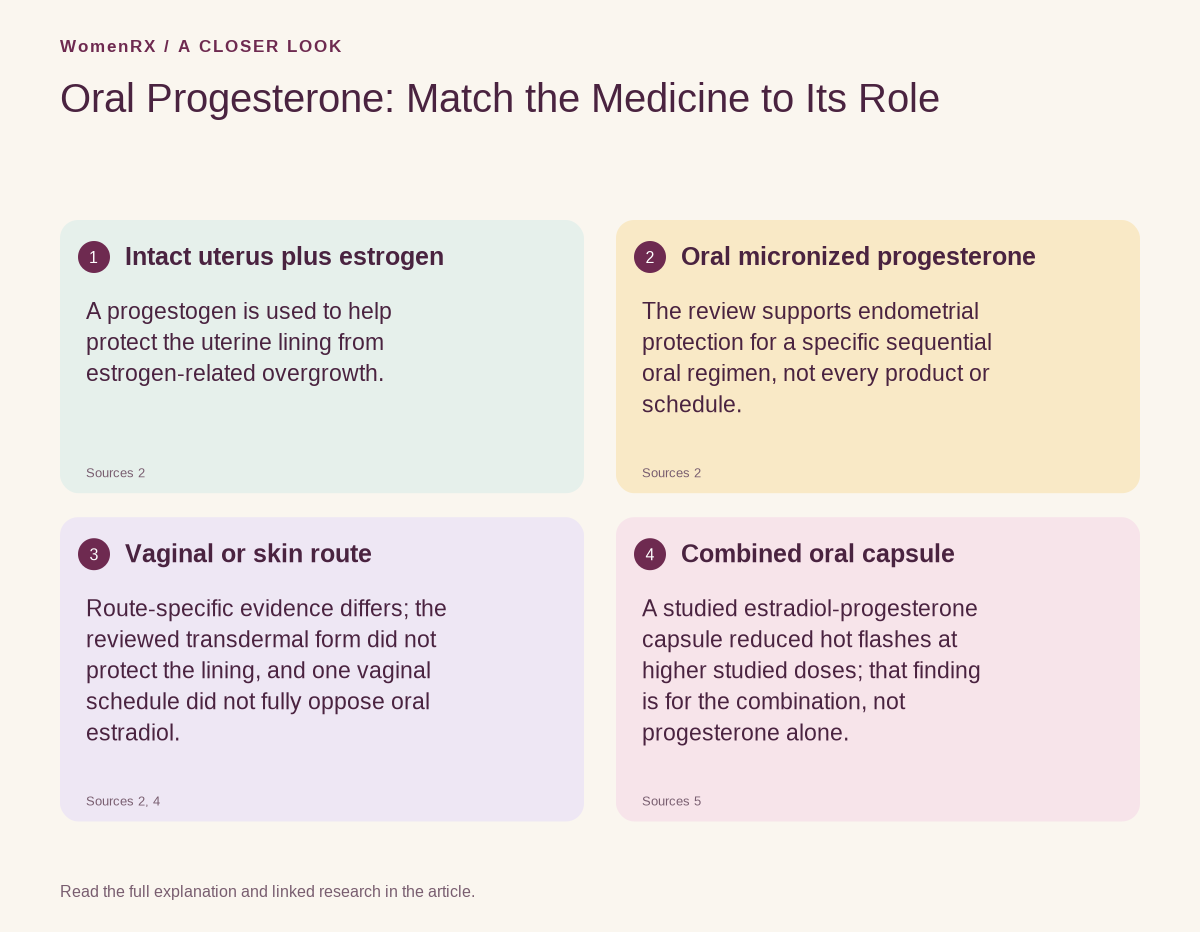
Intact uterus plus estrogen: A progestogen is used to help protect the uterine lining from estrogen-related overgrowth.2
Oral micronized progesterone: The review supports endometrial protection for a specific sequential oral regimen, not every product or schedule.2
Vaginal or skin route: Route-specific evidence differs; the reviewed transdermal form did not protect the lining, and one vaginal schedule did not fully oppose oral estradiol.24
Combined oral capsule: A studied estradiol-progesterone capsule reduced hot flashes at higher studied doses; that finding is for the combination, not progesterone alone.5
Read the figure as text
These distinctions explain why a prescription’s ingredients, route, and purpose matter when progesterone is part of menopause hormone therapy.- Intact uterus plus estrogen: A progestogen is used to help protect the uterine lining from estrogen-related overgrowth.2
- Oral micronized progesterone: The review supports endometrial protection for a specific sequential oral regimen, not every product or schedule.2
- Vaginal or skin route: Route-specific evidence differs; the reviewed transdermal form did not protect the lining, and one vaginal schedule did not fully oppose oral estradiol.24
- Combined oral capsule: A studied estradiol-progesterone capsule reduced hot flashes at higher studied doses; that finding is for the combination, not progesterone alone.5
More questions, answered
Does progesterone alone treat hot flashes?
A studied oral estradiol-and-progesterone combination reduced moderate-to-severe hot flashes; that finding does not establish that progesterone alone has the same effect. 5
Can I use a progesterone cream instead of an oral pill?
Don’t assume the routes are interchangeable. A systematic review found transdermal micronized progesterone did not provide endometrial protection, while the evidence for oral use applied to a specific regimen. Ask whether the exact product and route protect the uterine lining with your estrogen. 2
Sources you can check
- Options for hormone therapy in women who have had a hysterectomy.Haney AF, Wild RA. · Menopause (New York, N.Y.) · 2007Return to first citation
- The impact of micronized progesterone on the endometrium: a systematic review.Stute P, Neulen J, Wildt L. · Climacteric : the journal of the International Menopause Society · 2016Return to first citation
- The impact of micronized progesterone on breast cancer risk: a systematic review.Stute P, Wildt L, Neulen J. · Climacteric : the journal of the International Menopause Society · 2018Return to first citation
- Use of oral estradiol plus vaginal progesterone in healthy postmenopausal women.Sriprasert I, Mert M, Mack WJ, Hodis HN, Shoupe D. · Maturitas · 2021Return to first citation
- A combined, bioidentical, oral, 17β-estradiol and progesterone capsule for the treatment of moderate to severe vasomotor symptoms due to menopause.Archer DF, Bernick BA, Mirkin S. · Expert review of clinical pharmacology · 2019Return to first citation
- A review of drospirenone for safety and tolerability and effects on endometrial safety and lipid parameters contrasted with medroxyprogesterone acetate, levonorgestrel, and micronized progesterone.Shulman LP. · Journal of women's health (2002) · 2006Return to first citation