Why You Might Feel Hungry So Often
A run of short nights, pregnancy, or a blood glucose problem can change how hunger feels, but the surrounding clues matter more than hunger alone.
Frequent hunger has more than one possible explanation. Sleep restriction has increased reported hunger in clinical trials, and increased food intake can be a normal adjustment during pregnancy.32 If you take certain diabetes medicines, hunger can also signal low blood glucose. Frequent urination or blurred vision raises a different question: whether blood glucose is high.4 Menstrual-cycle timing, breastfeeding and menopause are worth noting, but hunger alone can’t establish a hormonal cause.
Start with what changed
If you’re hungry more often than usual, first look at the circumstances. For example, has a meal become smaller or later because your schedule changed? Have you been sleeping less? Is pregnancy possible? Those questions help you describe the change without treating appetite as a measure of willpower or assuming hormones are to blame.
Sleep is one useful place to look. A systematic review of randomized clinical trials found that restricting sleep may increase hunger, appetite, eating occasions and energy intake. The trials included adults as well as children and adolescents; the reported finding wasn’t a women-specific result. The same review did not find a consistent effect of sleep duration on measured leptin or ghrelin, two hormones often invoked to explain hunger. So a pattern after short nights is worth noticing, but you don’t need to pin it on a particular hormone.3
Pregnancy and other life-stage clues
Increased food intake is considered a normal adjustment during pregnancy. That doesn’t mean a new feeling of constant hunger proves you’re pregnant, or that pregnancy explains other symptoms occurring alongside it.2 Gestational diabetes, for instance, often has no symptoms and is generally screened for during pregnancy rather than identified by appetite alone.1
If hunger seems to recur at a particular point in your menstrual cycle, or changed while you’re breastfeeding or around menopause, note the timing. Those details may help you describe what’s happening, but timing alone doesn’t show that hormones are the cause.
Blood glucose clues need a closer distinction
Hunger can be a sign of low blood glucose. This is especially relevant if you have diabetes and take certain diabetes medicines. If you think your blood glucose may be low and you have been taught to check it, check it promptly and follow your diabetes care plan; low blood glucose can be dangerous and needs prompt treatment.4
High blood glucose presents a different set of clues. Frequent urination and blurred vision are among its possible symptoms. If either is new or recurring, bring it to your care team’s attention rather than trying to decide from hunger alone whether your glucose is high or low. Diabetes is diagnosed with blood tests, including glucose tests and the A1C test.41
The distinction matters: hunger is listed as a possible low-glucose symptom, while frequent urination and blurred vision are listed as possible high-glucose symptoms. Having more than one of these experiences does not, on its own, tell you which is happening.4
Make the pattern easier to explain
For a few days, note when hunger feels different from your usual appetite and what else is happening. A useful example is: “I’ve been hungry again soon after lunch on days I slept poorly,” rather than simply “I’m always hungry.” Record when it happens, whether meals or sleep have changed, whether you’re thirstier than usual, and whether you’ve noticed frequent urination or blurred vision. Note whether pregnancy is possible, whether the timing relates to your menstrual cycle, breastfeeding or menopause, and whether any medicines have changed recently, especially if you use diabetes medicine.324
A change that appears during a stretch of shorter nights or altered meals gives you a possible context to examine. Hunger that keeps recurring when those routines are back to usual is a different pattern. Neither pattern identifies a cause by itself. If the change persists, or frequent urination or blurred vision accompanies it, describe both the hunger and the other symptoms to your care team. This record isn’t a diagnostic test; it helps make the conversation more specific.341
What to note when hunger changes
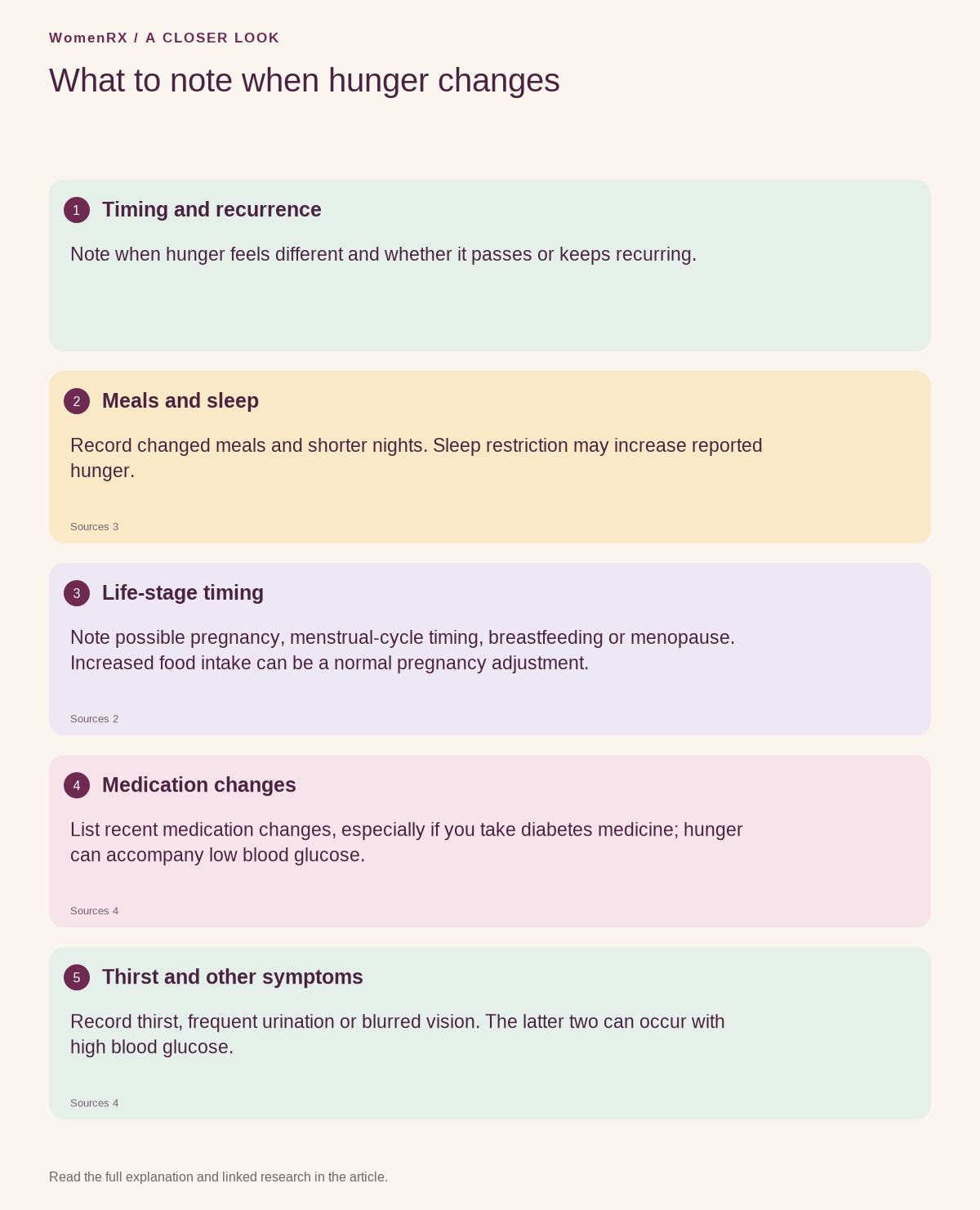
Timing and recurrence: Note when hunger feels different and whether it passes or keeps recurring.
Meals and sleep: Record changed meals and shorter nights. Sleep restriction may increase reported hunger.3
Life-stage timing: Note possible pregnancy, menstrual-cycle timing, breastfeeding or menopause. Increased food intake can be a normal pregnancy adjustment.2
Medication changes: List recent medication changes, especially if you take diabetes medicine; hunger can accompany low blood glucose.4
Thirst and other symptoms: Record thirst, frequent urination or blurred vision. The latter two can occur with high blood glucose.4
Read the figure as text
Use these prompts to describe the pattern, not to score symptoms or diagnose a cause.- Timing and recurrence: Note when hunger feels different and whether it passes or keeps recurring.
- Meals and sleep: Record changed meals and shorter nights. Sleep restriction may increase reported hunger.3
- Life-stage timing: Note possible pregnancy, menstrual-cycle timing, breastfeeding or menopause. Increased food intake can be a normal pregnancy adjustment.2
- Medication changes: List recent medication changes, especially if you take diabetes medicine; hunger can accompany low blood glucose.4
- Thirst and other symptoms: Record thirst, frequent urination or blurred vision. The latter two can occur with high blood glucose.4
More questions, answered
Does feeling hungry mean I have diabetes?
No. Hunger can occur with low blood glucose, particularly in people taking certain diabetes medicines, but hunger alone cannot diagnose diabetes. Diabetes is identified using blood tests.41
Sources you can check
- Diabetes | Type 1 Diabetes | Type 2 Diabetes | MedlinePlusAccessed 2026-09-25Return to first citation
- The Gestational Effects of Maternal Appetite Axis Molecules on Fetal Growth, Metabolism and Long-Term Metabolic Health: A Systematic Review.Dimas A, Politi A, Papaioannou G, Barber TM, Weickert MO, Grammatopoulos DK, Kumar S, Kalantaridou S, Valsamakis G. · International journal of molecular sciences · 2022Return to first citation
- Effect of sleep duration on dietary intake, desire to eat, measures of food intake and metabolic hormones: A systematic review of clinical trials.Soltanieh S, Solgi S, Ansari M, Santos HO, Abbasi B. · Clinical nutrition ESPEN · 2021Return to first citation
- Blood Glucose | Blood Sugar | Diabetes | MedlinePlusAccessed 2026-09-25Return to first citation