How to Build a Filling Meal With Lentils
Lentils can be the main protein-rich component of a meal, a side, or a swap for some meat or grain, but their role matters more than adding them on top.
Lentils can fit into a weight-management meal, but they aren’t a standalone weight-loss treatment. Research on pulses, including lentils, suggests a modest average weight effect, while direct evidence on lentils alone is limited. Choose whether lentils replace part of another food or accompany it; don’t assume you need to add them to a meal that’s already complete. 2 4
First choose what the lentils are doing
Lentils bring protein, fiber, and slowly digested carbohydrates to a meal. That makes them flexible, but it also means they can play more than one role. You might make them the center of a meal, use them instead of some meat, or serve a smaller amount alongside another protein. 4
A useful question is: What will the lentils replace, if anything? If you’re adding them to a meal that already has a substantial protein and grain, they’re an addition. If they’re taking the place of some meat or grain, they’re part of a swap. The research doesn’t establish one arrangement as best for everyone, but making the choice deliberately can help you build a meal that feels satisfying without simply piling on more ingredients.
Three ways to use them
As the main component: Build around lentils, then add vegetables and seasonings you enjoy. A grain can be part of the meal, but lentils don’t need to be paired with a grain at every meal to count as a useful plant-protein choice. MedlinePlus notes that protein needs vary with age, sex, health, and activity, and that people can eat different plant proteins across the day. 1
As a partial replacement: Use lentils in place of some of the meat in a familiar dish, such as a stew, soup, or taco filling. This is a practical way to make the meal more plant-based, not a proven lentil-specific weight-loss formula. Research on legume-based diets generally combines several kinds of pulses and other dietary changes. 3
As a side: Serve lentils beside vegetables and another protein if that’s the meal you want. If you’re also having a grain, decide whether you want both, or whether the lentils are taking the grain’s place in that meal. There’s no requirement to make every plate follow the same pattern.
These are meal-building options, not measured portions or a prescribed plan. Your preferences, appetite, health, and overall eating pattern matter. Protein needs aren’t identical for all women, either. 1
What the weight research can, and can’t, say
The strongest weight evidence here is about pulses as a group, which includes lentils, beans, chickpeas, and dry peas. A 2016 meta-analysis pooled 21 randomized trials with 940 participants. Compared with diets without a pulse intervention, diets containing pulses were associated with an average 0.34 kg lower body weight; the median pulse intake was about 132 g a day, and the median study lasted six weeks. That is a modest group average over a short period, not a prediction for one person or proof that lentils alone cause weight loss. 2
A review of pulse studies also found that some controlled, short-term meal experiments showed greater satiety for two to four hours after pulse meals. Those experiments don’t establish that lentils will keep every person full for that long in everyday life. 4
One small randomized study gives a more specific example of a legume-based eating pattern: 30 adults, including 13 women, followed one of two calorie-restricted diets for eight weeks. The legume-based diet included weekly servings drawn from lentils, chickpeas, peas, and beans. The study reported greater weight loss in that group, but it did not test lentils alone. Its abstract does not report outcomes separately for women. 3
Taken together, the evidence supports treating lentils as one useful meal ingredient, not as a special treatment. The studies don’t establish an ideal lentil portion, the best meal combination, or a lentil-specific long-term weight effect. Because the small study’s abstract doesn’t give separate results for women, those reported results can’t tell us whether the outcome differed by sex. 2 3
A simple meal check
Before serving, ask yourself: Are lentils the main component, replacing some meat or grain, or joining a meal that already has both? Any of these can work. If a lentil-centered meal suits your appetite and tastes good to you, it may be easier to repeat than a meal that feels like a rule. Lentils are an option within an overall eating pattern, not a requirement for weight management.
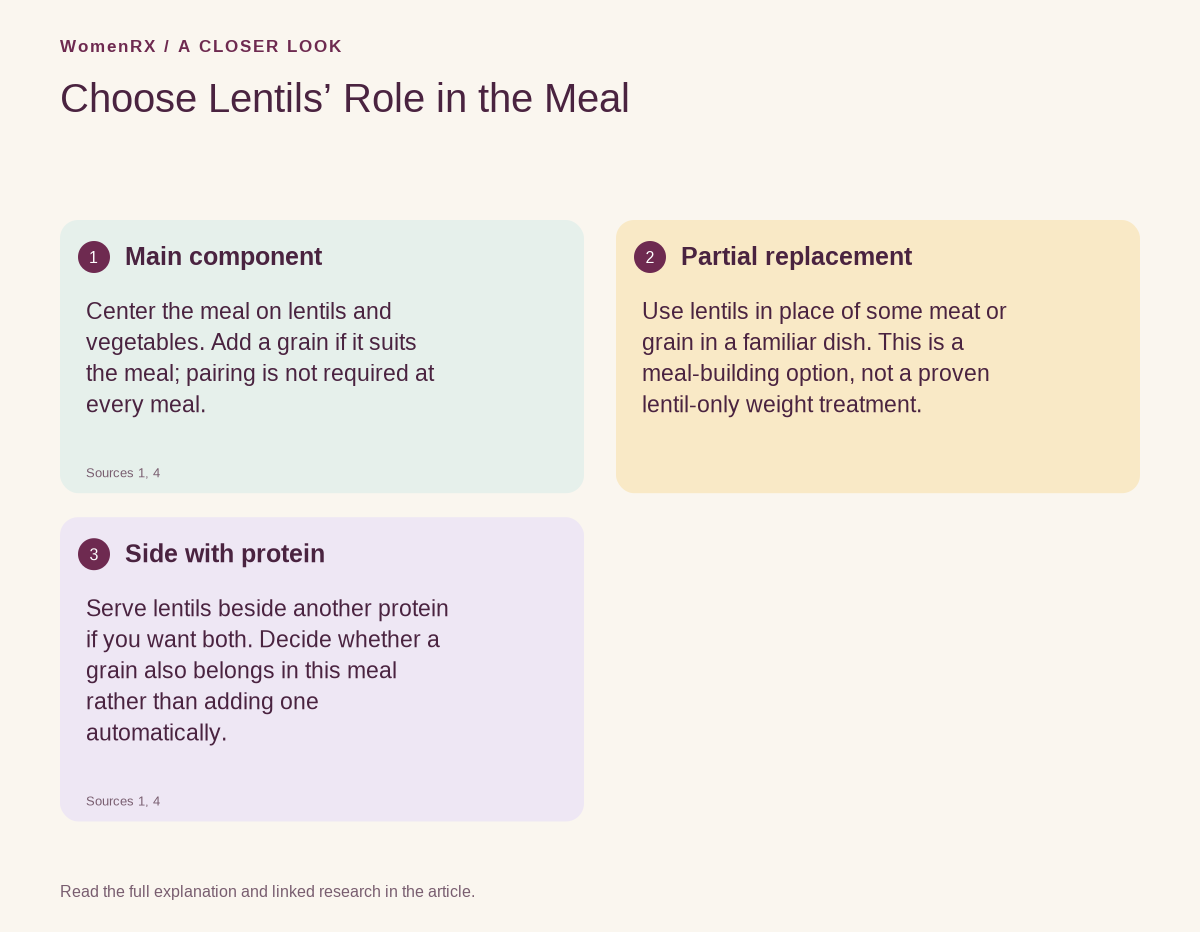
Choose Lentils’ Role in the Meal
Main component: Center the meal on lentils and vegetables. Add a grain if it suits the meal; pairing is not required at every meal.14
Partial replacement: Use lentils in place of some meat or grain in a familiar dish. This is a meal-building option, not a proven lentil-only weight treatment.
Side with protein: Serve lentils beside another protein if you want both. Decide whether a grain also belongs in this meal rather than adding one automatically.14
Read the figure as text
Compare three ways lentils can fit, and decide whether they replace another component or accompany it.- Main component: Center the meal on lentils and vegetables. Add a grain if it suits the meal; pairing is not required at every meal.14
- Partial replacement: Use lentils in place of some meat or grain in a familiar dish. This is a meal-building option, not a proven lentil-only weight treatment.
- Side with protein: Serve lentils beside another protein if you want both. Decide whether a grain also belongs in this meal rather than adding one automatically.14
More questions, answered
Do lentils have to be paired with rice or another grain?
No. MedlinePlus describes getting different plant proteins across the day; it doesn’t say you must combine them in every meal. You can include a grain if you enjoy it or want it as part of the meal. 1
Sources you can check
- Dietary Proteins: MedlinePlusAccessed 2026-09-25Return to first citation
- Effects of dietary pulse consumption on body weight: a systematic review and meta-analysis of randomized controlled trials.Kim SJ, de Souza RJ, Choo VL, Ha V, Cozma AI, Chiavaroli L, Mirrahimi A, Blanco Mejia S, Di Buono M, Bernstein AM, Leiter LA, Kris-Etherton PM, Vuksan V, Beyene J, Kendall CW, Jenk... · The American journal of clinical nutrition · 2016Return to first citation
- A legume-based hypocaloric diet reduces proinflammatory status and improves metabolic features in overweight/obese subjects.Hermsdorff HH, Zulet MÁ, Abete I, Martínez JA. · European journal of nutrition · 2011Return to first citation
- Pulse consumption, satiety, and weight management.McCrory MA, Hamaker BR, Lovejoy JC, Eichelsdoerfer PE. · Advances in nutrition (Bethesda, Md.) · 2010Return to first citation