How to Compare Oatmeal and Build a Filling Breakfast
Start with the dry portion you’ll eat, then compare its fiber, protein and added sugars before deciding what else belongs in the bowl.
A 40-gram dry portion of plain regular or quick oats provides about 4 grams of fiber and 5.3 grams of protein, based on historical USDA data; your package may differ.7 Oats also contain beta-glucan, the fiber studied for cholesterol, but total fiber doesn’t tell you how much beta-glucan is in your bowl.3 Compare dry portions, then consider added sugars and what you’ll eat alongside the oats.
Start with the amount of oats, not the size of the bowl
A big-looking bowl isn’t necessarily a bigger portion of oats. Water changes the volume of cooked oatmeal, and packages can define a serving differently. To compare two products, start with the dry amount you’ll actually use. If their listed servings have different dry weights, the larger one may appear to offer more fiber or protein simply because it contains more food.
Here’s a reference point: historical USDA composition data for 40 grams of plain, unfortified regular or quick oats, measured dry, work out to about 152 calories, 4 grams of fiber and 5.3 grams of protein.7 That’s an illustrative portion, not a recommended serving or a promise about every brand. It gives you numbers to compare with your package while keeping the amount of oats in view.
A label reports nutrients for its stated serving, not for every bowl called oatmeal. Check the dry weight before comparing its fiber or protein numbers with those for another product. The 40-gram example above doesn’t give you the values for oat bran or a flavored instant serving.
Oats supply both soluble and insoluble fiber. Their soluble fiber includes beta-glucan, the component most closely studied for cholesterol. They also contain protein, but oats alone may not make a satisfying breakfast for every appetite.3 For example, if plain oatmeal leaves you hungry soon after breakfast, you could make it with milk or eat it alongside yogurt. Nuts are another protein-containing addition. Those choices change the meal, so include them when you compare what you’ll actually eat rather than judging the oats in isolation.2
Fiber can help you feel full sooner and supports digestion, though that general fiber benefit doesn’t mean any particular bowl of oatmeal will keep you full for a set number of hours. If you’re adding much more fiber than usual, build up gradually: a sudden increase can cause gas, bloating or cramps.1
Plain oats, oat bran and oat-containing products aren’t interchangeable
Oat bran and plain regular or quick oats are different ingredients, so don’t transfer the 40-gram plain-oat nutrition figures to oat bran.57 A trial included in a systematic review used 40 grams of oat bran per serving as porridge or muesli, corresponding to 3 grams of oat beta-glucan per day in that intervention. That describes the study’s food, not the beta-glucan content of every 40-gram oat-bran serving you might buy.5 Its usual-breakfast comparison also doesn’t tell you which option would be more filling.
Oats can be an ingredient in foods beyond porridge. An audit of Australian supermarket products and a global new-product database examined categories including breakfast cereals, breads, bars and plant-based milk alternatives.4 An oat-forward name therefore isn’t enough to tell you how much fiber or protein your portion supplies. Look at the ingredient list and the nutrition information for the amount you’ll eat.
The same approach helps with instant oatmeal. For example, when choosing between plain oats and a sweetened single-serving package, compare the dry amount and the fiber, protein and added sugars listed for each serving. A single-serving package is a convenient portion, not a fixed set of nutrition numbers. Instant oatmeal eaten with yogurt is also a different breakfast from plain oats cooked in water. If you like a sweet bowl, plain oats topped with fruit are another option; choose the combination you enjoy with a clear view of what’s been added.
The cholesterol evidence is about beta-glucan amount
The strongest reason to single out oats nutritionally is their beta-glucan. A review of randomized trials found that oat interventions improved LDL cholesterol compared with controls without oats. The 74 trials included 4,937 adults, predominantly people with elevated cholesterol, obesity or mild metabolic disturbances; most trials had at least some risk-of-bias concerns.5 This is evidence about a blood marker, not proof that eating oatmeal prevents a heart attack or independently causes weight loss.
Amount matters. A review of oat beta-glucan research describes cholesterol-lowering evidence around 3 grams of beta-glucan per day. Its discussion of a dose-response analysis reports no additional reduction in total cholesterol above that amount.3 That’s beta-glucan, not total dietary fiber. The 4 grams of fiber in the illustrative plain-oat portion above therefore isn’t 4 grams of beta-glucan, and it can’t tell you whether that portion reaches the amount studied.37 You needn’t treat one breakfast as responsible for an entire day’s intake.
For a sense of how specific the research can be, one trial assigned 62 adults in China with mildly elevated cholesterol to 80 grams of oats containing 3 grams of beta-glucan, or rice, daily for 45 days. The oat group had lower LDL cholesterol than the rice group at the end of the trial.6 That describes the oats used in that study, not a standard oatmeal serving or the beta-glucan content of every 80-gram portion sold in a store.
Choose for the breakfast you need
If your goal is a breakfast that satisfies you, compare the portion you’ll eat and the complete bowl: oats for fiber, plus a protein-containing food if oats alone don’t do the job. If your goal is specifically cholesterol, look for an oat beta-glucan amount when a product provides one, rather than relying on an oat image or the mere presence of oats in an ingredient list.23
The cholesterol trials summarized here were conducted in adults and don’t provide a separate pooled effect estimate for women, although the review includes trials that enrolled women.5 There’s no need to turn oatmeal into a women-only food to make it useful. Your appetite, the rest of your breakfast and your reason for choosing oats are more practical guides to the next bowl.
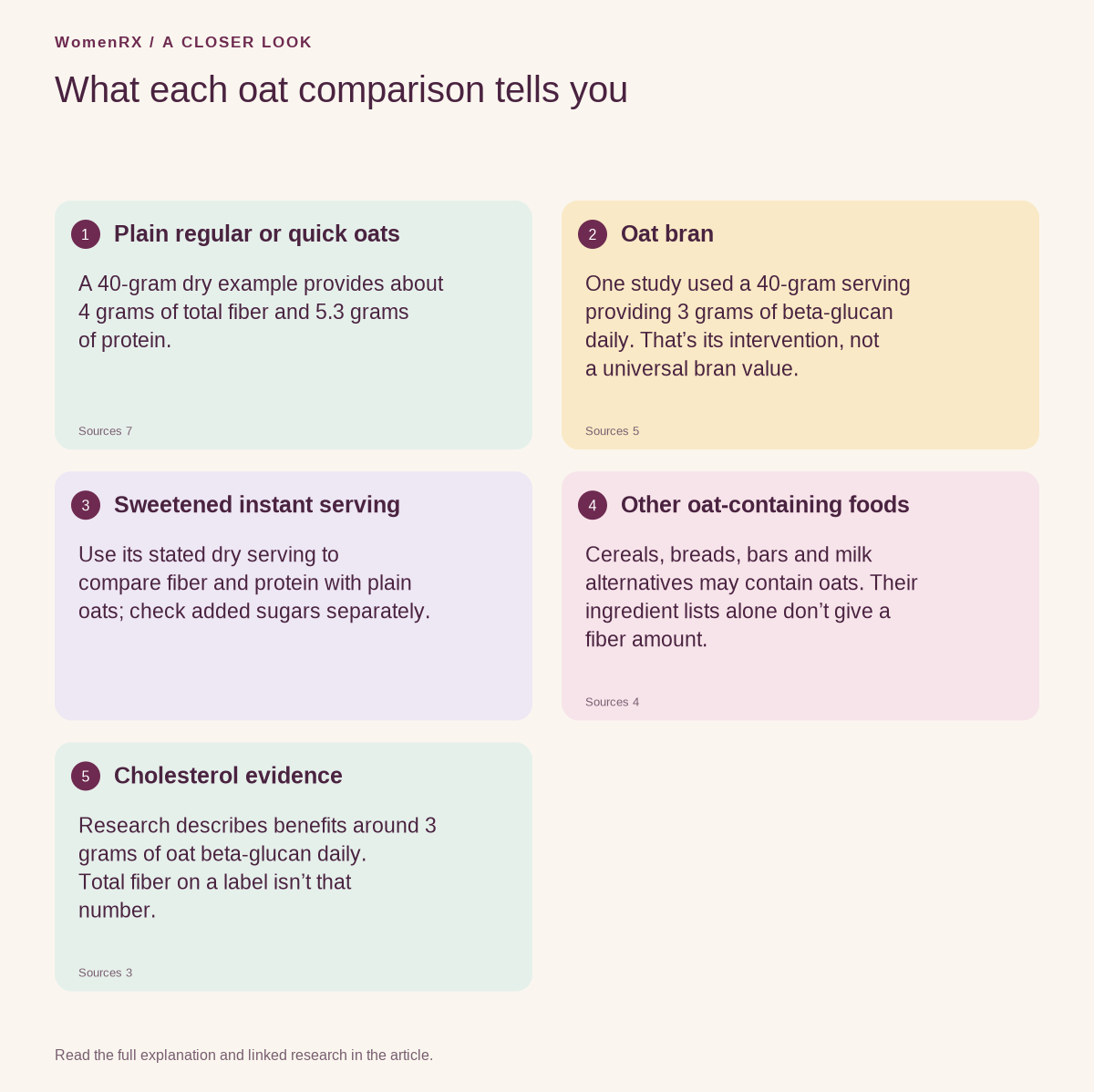
What each oat comparison tells you
Plain regular or quick oats: A 40-gram dry example provides about 4 grams of total fiber and 5.3 grams of protein.7
Oat bran: One study used a 40-gram serving providing 3 grams of beta-glucan daily. That’s its intervention, not a universal bran value.5
Sweetened instant serving: Use its stated dry serving to compare fiber and protein with plain oats; check added sugars separately.
Other oat-containing foods: Cereals, breads, bars and milk alternatives may contain oats. Their ingredient lists alone don’t give a fiber amount.4
Cholesterol evidence: Research describes benefits around 3 grams of oat beta-glucan daily. Total fiber on a label isn’t that number.3
Read the figure as text
Portion figures from one oat food or study don’t automatically apply to another. Compare the dry amount first, then the numbers relevant to your goal.- Plain regular or quick oats: A 40-gram dry example provides about 4 grams of total fiber and 5.3 grams of protein.7
- Oat bran: One study used a 40-gram serving providing 3 grams of beta-glucan daily. That’s its intervention, not a universal bran value.5
- Sweetened instant serving: Use its stated dry serving to compare fiber and protein with plain oats; check added sugars separately.
- Other oat-containing foods: Cereals, breads, bars and milk alternatives may contain oats. Their ingredient lists alone don’t give a fiber amount.4
- Cholesterol evidence: Research describes benefits around 3 grams of oat beta-glucan daily. Total fiber on a label isn’t that number.3
More questions, answered
Is the fiber number on a label the same as beta-glucan?
No. Oats contain beta-glucan as well as other fibers, so total dietary fiber and oat beta-glucan aren’t interchangeable numbers.3
Will eating oatmeal cause weight loss?
Oatmeal isn’t a stand-alone weight-loss treatment. Fiber can contribute to fullness, but how satisfying a breakfast is depends on the portion and the rest of the meal. Trials of oat interventions have examined weight alongside other outcomes; their results don’t show what a particular bowl will do for you.15
Sources you can check
- Dietary Fiber: MedlinePlusAccessed 2026-09-25Return to first citation
- Dietary Proteins: MedlinePlusAccessed 2026-09-25Return to first citation
- The Cholesterol-Lowering Effect of Oats and Oat Beta Glucan: Modes of Action and Potential Role of Bile Acids and the Microbiome.Joyce SA, Kamil A, Fleige L, Gahan CGM. · Frontiers in nutrition · 2019Return to first citation
- Oat and Barley in the Food Supply and Use of Beta Glucan Health Claims.Hughes J, Grafenauer S. · Nutrients · 2021Return to first citation
- Effect of oat supplementation interventions on cardiovascular disease risk markers: a systematic review and meta-analysis of randomized controlled trials.Llanaj E, Dejanovic GM, Valido E, Bano A, Gamba M, Kastrati L, Minder B, Stojic S, Voortman T, Marques-Vidal P, Stoyanov J, Metzger B, Glisic M, Kern H, Muka T. · European journal of nutrition · 2022Return to first citation
- Serum Metabolomics Reveals Underlying Mechanisms of Cholesterol-Lowering Effects of Oat Consumption: A Randomized Controlled Trial in a Mildly Hypercholesterolemic Population.Xu D, Wang S, Feng M, Shete V, Chu Y, Kamil A, Yang C, Liu H, Xia H, Wang X, Sun G, Yang Y. · Molecular nutrition & food research · 2021Return to first citation
- USDA SRLegacy: calculated illustrative oats portionAccessed 2026-09-26Return to first citation