Barley: Fiber, Everyday Uses, and Who Should Avoid It
A cup of cooked pearled barley provides 6 grams of fiber, but barley contains gluten and isn’t suitable for someone with celiac disease.
Barley works in soups, salads, or as a side. One cup of cooked pearled barley provides about 6 grams of fiber, 44 grams of carbohydrate, and 3.5 grams of protein; other forms need their own nutrition information.5 Barley contains gluten, so people with celiac disease must avoid it. It may also be unsuitable if gluten triggers your symptoms.2
What’s in a bowl of barley?
For a concrete reference point, one cup of cooked pearled barley (157 grams) has about 193 calories, 44.3 grams of carbohydrate, 6 grams of fiber, and 3.5 grams of protein, according to USDA food-composition data. These are estimates for plain, cooked barley, not dry barley or a particular packaged product.5
That makes barley a useful way to add fiber to a meal. It also helps to see the protein number in context: if you want the meal to include more protein, you could serve barley with beans, tofu, eggs, or fish rather than count on the grain alone. Fiber helps digestion and can help prevent constipation, but a sudden increase may cause gas, bloating, or cramps. If barley is new to you, start with an amount that feels comfortable and build up gradually.56
Barley also contains beta-glucan. Research has measured beta-glucan in barley flour and foods made with it. How the grain is processed can affect its composition, but the USDA figure above is for total fiber: it doesn’t tell you how much beta-glucan is in your bowl. If you’re choosing barley because you’ve heard about beta-glucan and cholesterol, the total-fiber figure alone isn’t enough to compare beta-glucan amounts.345
Which form works for your meal?
Pearled barley has been processed by removing material from the outside of the kernel. That matters if you’re looking for a whole grain: don’t assume a pearled product retains all of the original kernel. It’s the form for which the cooked-cup nutrition figures above are available. Try it in a soup, or cook it separately to add to a salad or serve alongside vegetables. Check the package for preparation directions rather than applying the cooked-cup figures to a dry measure.45
Dehulled or hull-less kernels are distinct from pearling: research describes dehulled and hull-less barley as starting grains that can then be pearled. If you want a less-processed kernel, check what the package says about further pearling rather than treating “dehulled” or “hull-less” as a guarantee of whole-grain status. If you choose either for a soup or grain salad, follow that product’s preparation directions. Don’t assign it the cooked pearled-barley nutrition numbers: pearling and milling can change grain composition, and barley varieties differ.45
Barley flour and foods containing barley need their own label check. For example, crackers or pasta made with a mixture of wheat and barley flour aren’t nutritionally equivalent to a cup of cooked barley. The proportion of barley and the way the food is made matter.3
What about cholesterol?
If cholesterol is why you’re considering barley, keep the distinction between a food’s composition and a treatment result. You may have heard about barley’s beta-glucan, but the study of barley-based foods cited here examined the foods and simulated digestion, not changes in people’s blood cholesterol. It can’t tell you whether a particular serving will lower your cholesterol. Your cholesterol level also reflects factors beyond any one grain. A blood test, not how you feel after eating, tells you your levels.31
Cholesterol risk can rise after menopause, but that doesn’t turn barley into a menopause-specific food or establish a special benefit for women. The cooked-barley nutrition figures are food-composition estimates, not results from a study of pregnancy, menopause, or another life stage.15
When barley is the wrong choice
Barley contains gluten. If you have celiac disease, avoid barley, including barley ingredients in other foods: gluten triggers the condition and can damage the small intestine. Gluten sensitivity is different from celiac disease; it can cause symptoms without that intestinal damage. If gluten triggers your symptoms, barley may be unsuitable for you too. Don’t assume a barley-based product is gluten-free. Check its ingredients rather than relying on how prominently barley appears on the front of the package.2
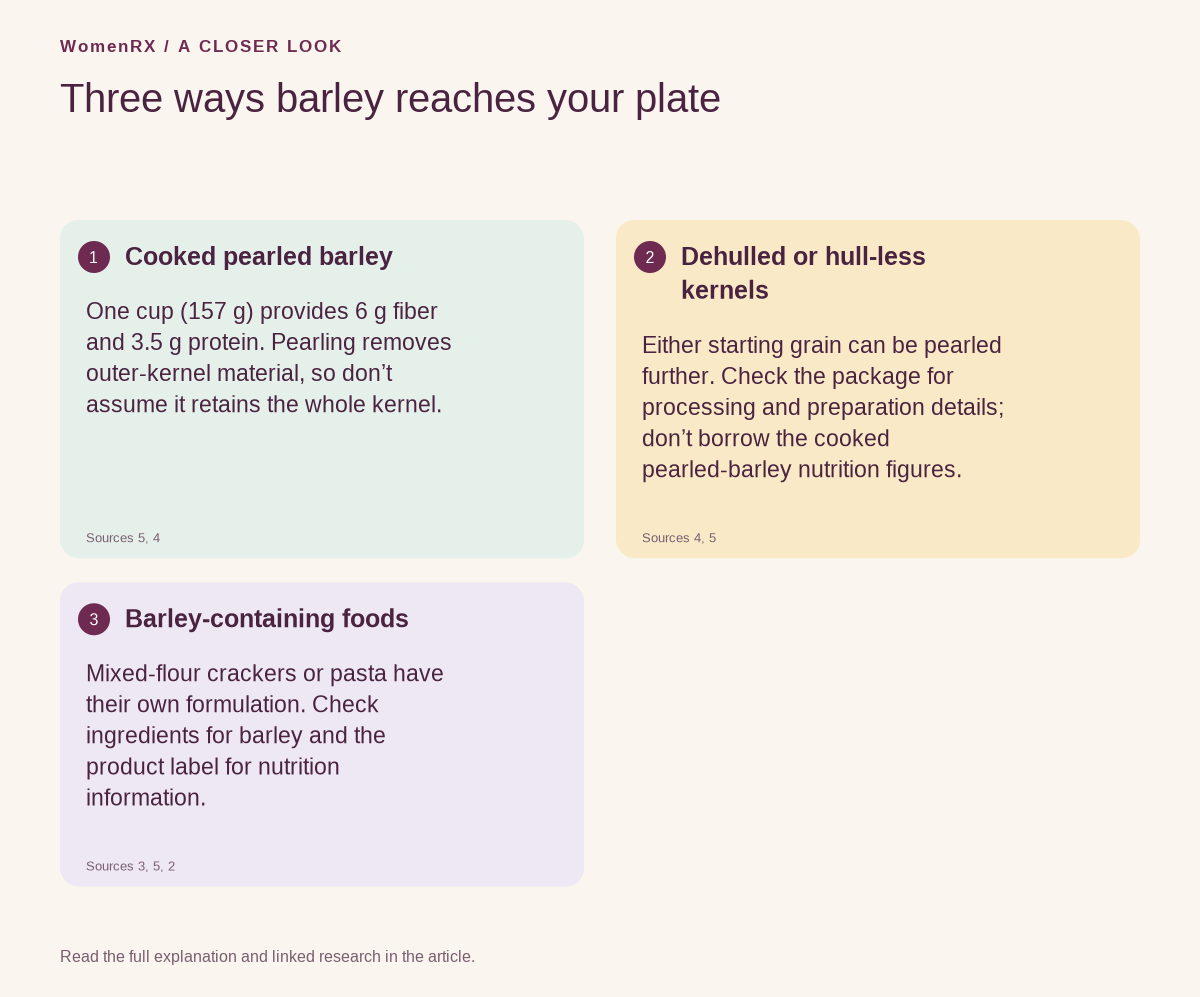
Three ways barley reaches your plate
Cooked pearled barley: One cup (157 g) provides 6 g fiber and 3.5 g protein. Pearling removes outer-kernel material, so don’t assume it retains the whole kernel.54
Dehulled or hull-less kernels: Either starting grain can be pearled further. Check the package for processing and preparation details; don’t borrow the cooked pearled-barley nutrition figures.45
Barley-containing foods: Mixed-flour crackers or pasta have their own formulation. Check ingredients for barley and the product label for nutrition information.352
Read the figure as text
Compare what each form tells you about processing and nutrition before using it in a meal.- Cooked pearled barley: One cup (157 g) provides 6 g fiber and 3.5 g protein. Pearling removes outer-kernel material, so don’t assume it retains the whole kernel.54
- Dehulled or hull-less kernels: Either starting grain can be pearled further. Check the package for processing and preparation details; don’t borrow the cooked pearled-barley nutrition figures.45
- Barley-containing foods: Mixed-flour crackers or pasta have their own formulation. Check ingredients for barley and the product label for nutrition information.352
Sources you can check
- Cholesterol Levels: What You Need to Know: MedlinePlusAccessed 2026-09-25Return to first citation
- Celiac Disease | MedlinePlusAccessed 2026-09-25Return to first citation
- Beta-Glucan and Phenolic Compounds: Their Concentration and Behavior during in Vitro Gastrointestinal Digestion and Colonic Fermentation of Different Barley-Based Food Products.Mosele JI, Motilva MJ, Ludwig IA. · Journal of agricultural and food chemistry · 2018Return to first citation
- Dry fractionation methods to produce barley meals varying in protein, beta-glucan, and starch contents.Liu K, Barrows FT, Obert D. · Journal of food science · 2009Return to first citation
- USDA SR Legacy: Barley, pearled, cooked (FDC 170285)Accessed 2026-09-25Return to first citation
- Dietary Fiber: MedlinePlusAccessed 2026-09-25Return to first citation