NEAT: How Everyday Movement Uses Energy
Standing, walking around the house, and other everyday movement count as NEAT, which varies with your activity and body weight.
NEAT, or non-exercise activity thermogenesis, is the energy your body uses for everyday movement outside purposeful exercise. It includes things like standing, walking during daily tasks, and fidgeting. Daily energy use also includes resting metabolism, exercise, and the energy used to process food. NEAT varies with your routine and activity, so it isn’t one standard calorie amount for everyone. 1 2 3
What counts as NEAT?
NEAT stands for non-exercise activity thermogenesis: the energy your body uses for daily activities other than purposeful exercise. That can include standing, walking from place to place, keeping your posture upright, fidgeting, gardening, or doing physical tasks at work. A planned workout is exercise, not NEAT, even though both contribute to daily energy use. 1 2
Your total daily energy expenditure includes more than movement. It also includes energy used at rest and energy used to process food. NEAT is one part of that bigger picture, not a separate kind of workout or a score you need to hit. 1 2
Why it differs from one day to another
NEAT reflects what your day asks of you. Someone who spends much of a shift standing or moving between tasks may have a different pattern from someone whose work is mostly seated. The same goes for routines at home. For example, walking around while doing household tasks or moving between caregiving tasks may add everyday movement; caregiving itself doesn’t automatically mean a person is active. Occupation, mobility, available time, and the shape of your routine all matter.
That variation is one reason not to rely on a universal calorie estimate for standing, steps, or chores. A review describes NEAT as dependent in part on body weight and activity level, rather than as one standard amount that applies to everyone. 3
NEAT and exercise are related, but not interchangeable
Adding a workout doesn’t necessarily mean your non-exercise movement will also rise. In a study of 17 female collegiate lacrosse players, the training phase with more exercise had higher total daily energy expenditure, but measured NEAT did not significantly differ between phases. That’s a specific example from young athletes, not a prediction for every woman or every routine. 4
A separate four-month exercise study in 72 nonobese women ages 60 to 75 found no average change in NEAT or total daily energy expenditure across the full group. Results varied with participants’ activity levels at the start, which is a reminder that responses aren’t identical. These findings don’t mean exercise has no value; they show why exercise minutes and NEAT shouldn’t be treated as the same thing. 1
A practical way to use the idea
If adding a little movement sounds useful, look for an option that fits your existing day rather than trying to manufacture a specific calorie burn. Examples might include standing for part of a task, walking a short route when it’s convenient, or choosing a movement-based household task. These are possible ways to add movement, not a prescribed routine.
If you’re pregnant or have a mobility limitation, pain, or fatigue, the concept of NEAT doesn’t tell you which movement is appropriate for you. Standing and walking aren’t universal goals. Adapt the idea to what fits your circumstances, including seated movement or no added activity when that’s what your day allows.
The useful takeaway is simple: NEAT names the movement woven into ordinary life. It helps distinguish that movement from resting metabolism and planned exercise, but it doesn’t give you a personal calorie number. 3
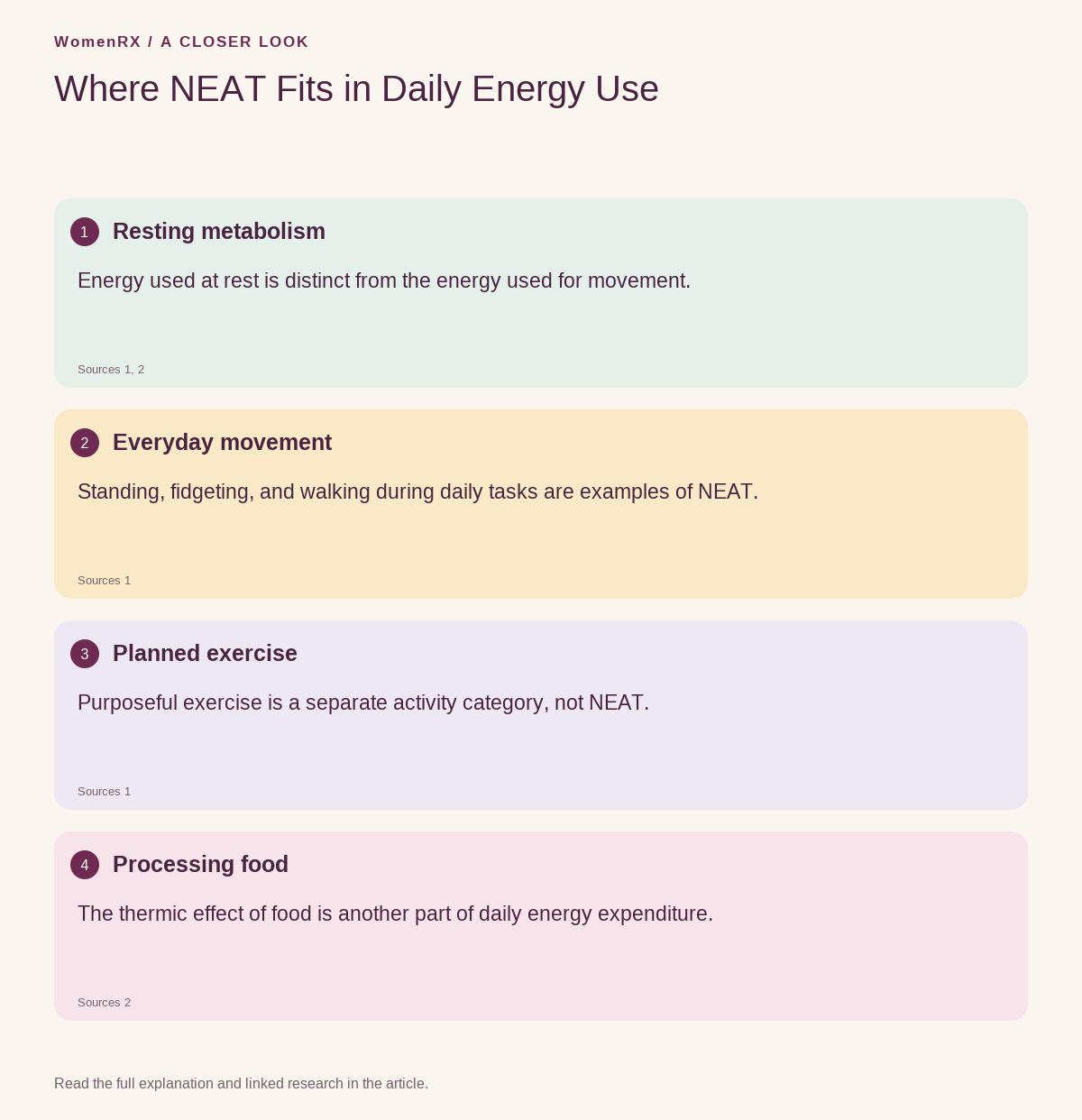
Where NEAT Fits in Daily Energy Use
Resting metabolism: Energy used at rest is distinct from the energy used for movement.12
Everyday movement: Standing, fidgeting, and walking during daily tasks are examples of NEAT.1
Planned exercise: Purposeful exercise is a separate activity category, not NEAT.1
Processing food: The thermic effect of food is another part of daily energy expenditure.2
Read the figure as text
This map separates everyday movement from resting energy use and planned exercise, while showing that all are parts of daily energy expenditure.- Resting metabolism: Energy used at rest is distinct from the energy used for movement.12
- Everyday movement: Standing, fidgeting, and walking during daily tasks are examples of NEAT.1
- Planned exercise: Purposeful exercise is a separate activity category, not NEAT.1
- Processing food: The thermic effect of food is another part of daily energy expenditure.2
Sources you can check
- Energy expenditure responses to exercise training in older women.Wang X, Bowyer KP, Porter RR, Breneman CB, Custer SS. · Physiological reports · 2017Return to first citation
- Nonexercise Activity Thermogenesis-Induced Energy Shortage Improves Postprandial Lipemia and Fat Oxidation.Chiu CH, Chen CH, Wu MH, Ding YF. · Life (Basel, Switzerland) · 2020Return to first citation
- Nonexercise activity thermogenesis in obesity management.Villablanca PA, Alegria JR, Mookadam F, Holmes DR, Wright RS, Levine JA. · Mayo Clinic proceedings · 2015Return to first citation
- Dietary Intake and Energy Expenditure During Two Different Phases of Athletic Training in Female Collegiate Lacrosse Players.Kumahara H, Ohta C, Nabeshima E, Nakayama A, Mine S, Yamato T. · Journal of strength and conditioning research · 2020Return to first citation