Lentils: Protein, Fiber, and a More Satisfying Meal
Cooked lentils bring protein, fiber, and iron to the plate, but the foods around them help make a complete meal.
Lentils are a useful plant protein and a source of fiber and iron, not a stand-in for every food a meal needs. Their fiber can help you feel full sooner. Try them with vegetables and other foods you enjoy, and include varied protein sources across the day. If iron is a concern, what matters depends partly on your life stage and health history.123
Start with the cooked portion
Nutrition numbers for dry lentils can be misleading when you’re planning dinner: lentils absorb water as they cook. In one published nutrition comparison, 100 grams of cooked lentils provided about 9-18 grams of protein and 8-16 grams of fiber. Those are ranges, not a promise for every bowl. Lentil type and cooking can change the composition, and a lentil soup also depends on how many lentils end up in your serving.54
That combination makes lentils useful in more than one role. Their protein contributes to the protein you need to maintain muscles and other tissues. Their fiber adds bulk to food and can help you feel full sooner; it also supports digestion. If you’re new to eating much fiber, build up gradually, since a sudden increase can cause gas, bloating, or cramps.21
Make lentils the anchor, not the whole meal
A bowl of plain lentils gives you something substantial to build on. For example, add tomatoes and bell peppers to lentil soup, or put lentils over rice with roasted vegetables. Another option is to toss them into a salad with greens, a grain, and a dressing you like. These are meal ideas, not required combinations.
Lentils are a plant protein, but relying on them as your only protein source would miss the point of a varied diet. Most plant proteins are incomplete, meaning they don’t provide all the amino acids your body needs on their own. Eating different kinds of plant proteins across the day, rather than trying to engineer a perfect pairing in every bowl, is the practical approach described by MedlinePlus. Beans, nuts, seeds, and grains can all be part of that variety.2
If you’re choosing between cooked lentils and a packaged lentil dish, look at what you’re actually getting. A soup may contain vegetables and a modest amount of lentils; another product may use lentils as its main ingredient. The nutrition of the finished meal isn’t captured by a dry-lentil number or by the word “lentil” on the front of a package.45
Think about iron in the context of your life
Lentils contain iron, which your body uses to make hemoglobin, the protein in red blood cells that carries oxygen. But eating lentils doesn’t guarantee that you’ll get enough iron or prevent anemia. Plant-based iron is less readily absorbed than iron from animal foods; pairing lentils with a vitamin-C-rich food, such as bell peppers, may help your body absorb more of it.35
Iron needs aren’t identical for every woman. Heavy menstrual bleeding can raise the risk of low iron, and pregnancy is another time when iron deserves particular attention. Breastfeeding is also listed among circumstances associated with higher risk. Later in life, don’t assume that being a woman means you need extra iron: most people in the US get enough, and taking too much supplemental iron can be harmful.3
If you have heavy periods and persistent fatigue or shortness of breath, food choices alone won’t tell you whether low iron is the cause. Those symptoms can occur with iron-deficiency anemia.3
Lentils work best as a flexible ingredient: they can add protein and fiber to a meal, while vegetables, grains, and other foods bring variety. You don’t have to make every lentil dish nutritionally perfect for it to be worth making.12
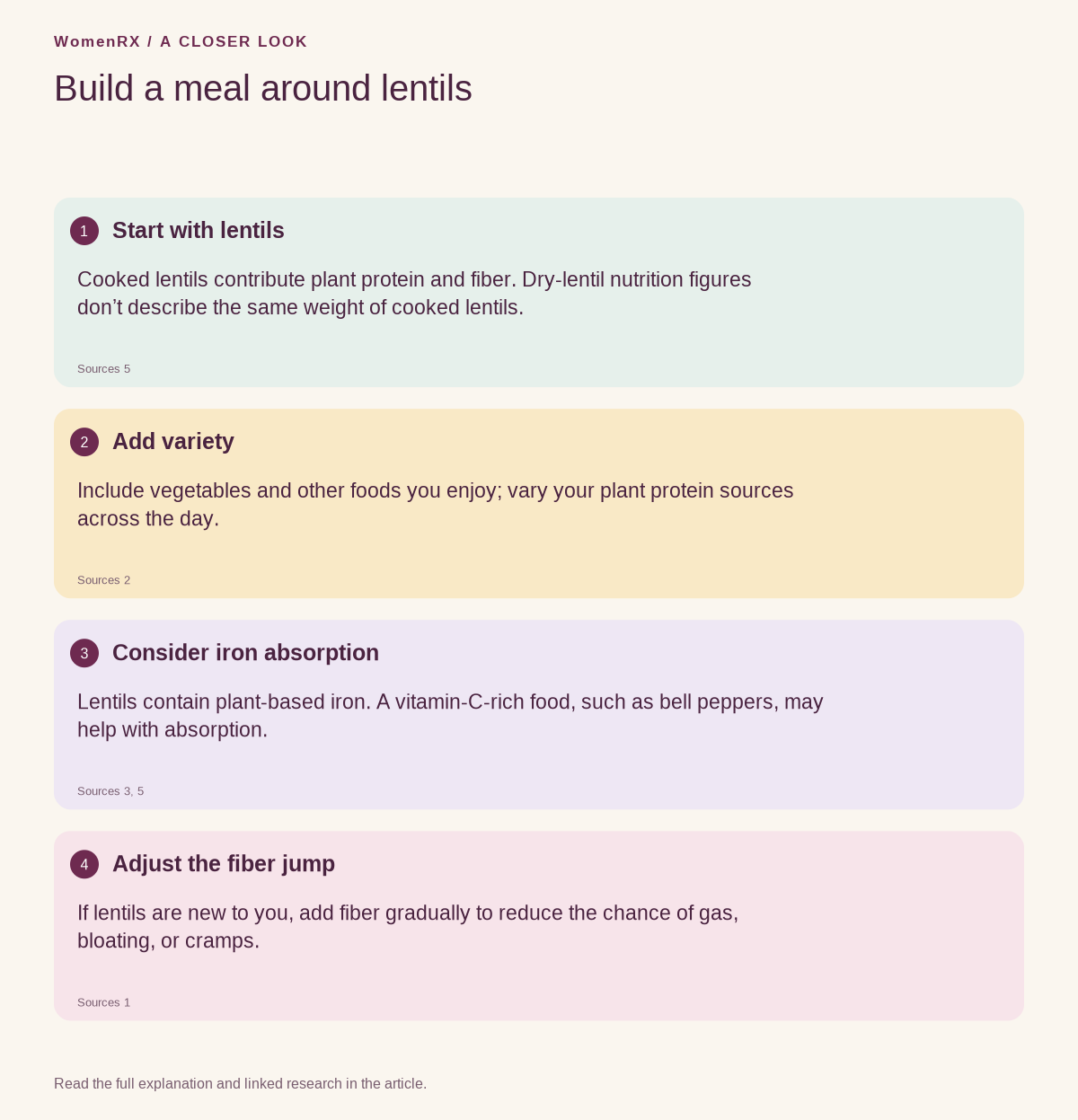
Build a meal around lentils
Start with lentils: Cooked lentils contribute plant protein and fiber. Dry-lentil nutrition figures don’t describe the same weight of cooked lentils.5
Add variety: Include vegetables and other foods you enjoy; vary your plant protein sources across the day.2
Consider iron absorption: Lentils contain plant-based iron. A vitamin-C-rich food, such as bell peppers, may help with absorption.35
Adjust the fiber jump: If lentils are new to you, add fiber gradually to reduce the chance of gas, bloating, or cramps.1
Read the figure as text
Use these roles to make sense of what lentils contribute and what you can add.- Start with lentils: Cooked lentils contribute plant protein and fiber. Dry-lentil nutrition figures don’t describe the same weight of cooked lentils.5
- Add variety: Include vegetables and other foods you enjoy; vary your plant protein sources across the day.2
- Consider iron absorption: Lentils contain plant-based iron. A vitamin-C-rich food, such as bell peppers, may help with absorption.35
- Adjust the fiber jump: If lentils are new to you, add fiber gradually to reduce the chance of gas, bloating, or cramps.1
Sources you can check
- Dietary Fiber: MedlinePlusAccessed 2026-09-25Return to first citation
- Dietary Proteins: MedlinePlusAccessed 2026-09-25Return to first citation
- Iron: MedlinePlusAccessed 2026-09-25Return to first citation
- Nutritional Composition and Functional Properties of Commonly Consumed Lentils: Impact of Commercial Lentil Types and Cooking Processes.Zeng H, Safratowich BD, Liu Z, Bussan DD. · Foods (Basel, Switzerland) · 2026Return to first citation
- Health-promoting benefits of lentils: Anti-inflammatory and anti-microbial effects.Alexander R, Khaja A, Debiec N, Fazioli A, Torrance M, Razzaque MS. · Current research in physiology · 2024Return to first citation