How to Choose a Meal Replacement Shake That Fits
A useful shake has to do the job you’re giving it, whether that’s covering a missed lunch or fitting into a planned weight-management routine.
If the shake will replace a meal, start with a product intended for that job, not one marketed only for protein. Compare calories, protein, fiber, and listed vitamins and minerals in the serving you’d actually drink. There’s no single best shake for everyone: the better choice depends on what it would replace and whether you have nutrition needs that call for a more specific plan. 347
First, decide what the shake needs to do
If lunch sometimes disappears between meetings, you may want a convenient stand-in for lunch. If you’ve already eaten and want something alongside your usual meals, you’re looking for a different product. And if your goal is weight management, a shake is one possible way to structure eating, not a requirement for losing weight. Healthy eating patterns and activity can support weight loss without meal replacements. 8
The name on the front of the bottle won’t settle which job it can do. Research on meal replacements uses formulated products intended to take the place of a meal, rather than products defined by protein content alone. Descriptions of meal replacements include energy, protein, and vitamins and minerals. Fiber deserves its own check because researchers have raised inadequate fiber as a concern with some total meal-replacement plans. 346
Read the serving as a meal, not a marketing claim
Put two labels side by side and compare what you would actually drink. If a powder’s label describes a prepared serving, check what it assumes you’ll mix in. Then work through these questions:
How much energy does a serving provide? Calories help you see whether a product is a substantial part of the meal you meant to replace or a smaller addition to it. Meal replacements described in one research paper commonly provided 200 to 400 calories per serving. 3 That range isn’t a target for every woman or every meal. Whether a serving is enough depends on the rest of your eating and your health needs.
What comes with the protein? Check the grams of protein, then look beyond them. A product promoted chiefly for protein may offer little information about how it covers the other parts of a meal. Compare its carbohydrate and fat as well as its energy, rather than assuming the highest protein number makes it the best replacement. 34
Is fiber listed? Fiber is one way to distinguish two shakes with otherwise similar labels. Don’t assume a product contains it because it’s called a meal replacement. Researchers studying partial meal replacement in type 2 diabetes note that inadequate fiber has been a concern in some total meal-replacement trials. 6
Which vitamins and minerals are actually included? Look at the amounts on the label instead of relying on words such as “complete.” In a pregnancy study, investigators selected the available replacement products after considering their nutrient composition, meal-plan scenarios, and prenatal vitamin use. Participants’ meal plans were then tailored to their needs. That illustrates why a fortified shake needs to be judged in the context of everything else you eat and take. 7
Here’s how that comparison can change your choice. If you need something alongside a meal, a drink sold primarily for protein may fit that job. If you need something instead of lunch, look first at products intended as meal replacements, then compare their prepared servings for energy, protein, carbohydrate, fat, fiber, and vitamins and minerals. 346 A label showing more of those nutrients gives you more to assess, but it doesn’t prove that one serving covers your lunch. Your other meals and your health needs still matter. 7
Weight-loss results aren’t a product ranking
Meal replacements can be useful within a structured weight-management plan, but a trial result doesn’t tell you which bottle to buy. In an eight-week trial of adult women with overweight, a group combining exercise with intermittent use of a protein-enriched meal-replacement shake lost more weight than a group assigned exercise alone. The result applies to that specific intermittent meal-replacement intervention alongside exercise; it doesn’t establish that any protein shake will have the same effect. 3
A separate 90-day trial in Chinese adults with obesity compared a formulated dinner replacement with a conventional energy-restricted diet. Both groups lost weight; the meal-replacement group lost more. The reported result is for Chinese adults with obesity, not specifically women, and the study tested a planned approach, not an everyday choice between store shelves. 2 Convenience may be a good reason to use a shake. It isn’t a reason to treat one as necessary for weight loss. 8
Know when a general-purpose shake isn’t a general-purpose answer
Pregnant? Don’t borrow a weight-loss shake routine from a study of nonpregnant adults. One trial in pregnant women with overweight or obesity used partial meal replacements within individually tailored meal plans. Investigators selected the available product options after considering nutrient composition, meal-plan scenarios, and prenatal vitamin use. The findings don’t make an off-the-shelf shake plan interchangeable with pregnancy nutrition care. 7
Breastfeeding? There’s a difference between keeping a convenient drink on hand and adopting a plan that regularly replaces meals for weight loss. You’re also feeding your baby, and the adult weight-loss trials discussed here didn’t evaluate breastfeeding or milk supply. A label can help you compare drinks, but it can’t tell you whether a meal-replacement routine fits your eating needs while you’re nursing. 39
Have an eating-disorder history? A weight-loss routine deserves a different kind of consideration when it could affect your relationship with food. A review of behavioral weight-management trials in people diagnosed with binge-eating disorder or bulimia nervosa found no significant average difference from comparison groups in eating-disorder symptoms after treatment, but results varied by intervention and long-term evidence was sparse. It didn’t establish that meal-replacement shakes are suitable for someone with an eating-disorder history. If a planned meal swap could bring back restrictive habits, get advice that takes your history into account rather than treating the bottle’s nutrition label as the whole answer. 10
Managing diabetes or kidney disease? The type of formula and your wider care plan matter. Trials in adults with type 2 diabetes tested diabetes-specific formulas as part of planned care; they don’t show that a standard shake has the same effects. 56 Kidney disease can impair the kidneys’ ability to filter blood and keep the body’s chemicals balanced. That fact alone doesn’t tell you whether a particular shake fits your nutrition needs. 1
The best choice starts with the job you need done. A protein add-on and a meal stand-in aren’t interchangeable, and no weight-loss trial establishes a winner among the products on a store shelf. 234
Is this shake doing the job?
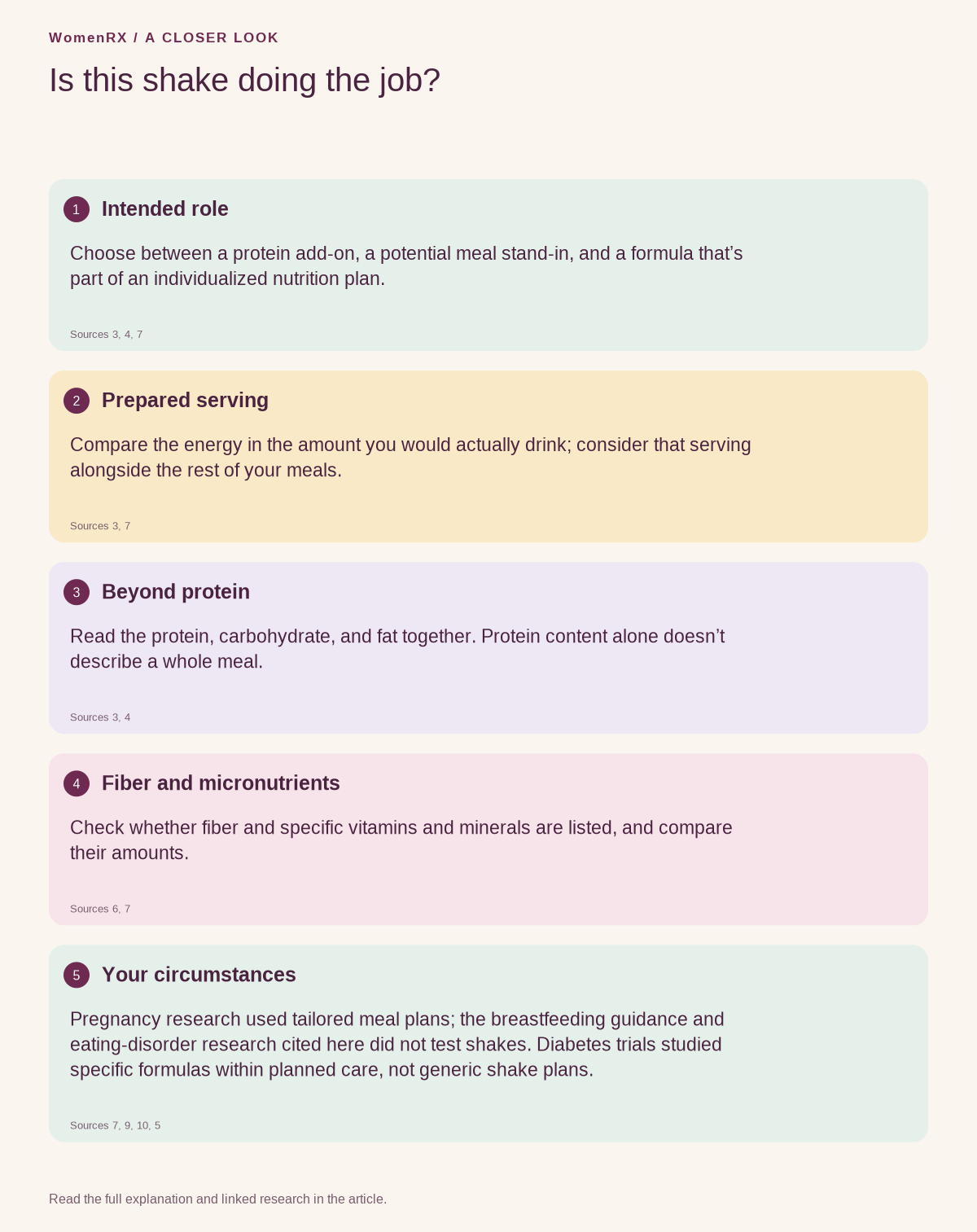
Intended role: Choose between a protein add-on, a potential meal stand-in, and a formula that’s part of an individualized nutrition plan.347
Prepared serving: Compare the energy in the amount you would actually drink; consider that serving alongside the rest of your meals.37
Beyond protein: Read the protein, carbohydrate, and fat together. Protein content alone doesn’t describe a whole meal.34
Fiber and micronutrients: Check whether fiber and specific vitamins and minerals are listed, and compare their amounts.67
Your circumstances: Pregnancy research used tailored meal plans; the breastfeeding guidance and eating-disorder research cited here did not test shakes. Diabetes trials studied specific formulas within planned care, not generic shake plans.79105
Read the figure as text
Use these label checks to compare two products for the same intended use.- Intended role: Choose between a protein add-on, a potential meal stand-in, and a formula that’s part of an individualized nutrition plan.347
- Prepared serving: Compare the energy in the amount you would actually drink; consider that serving alongside the rest of your meals.37
- Beyond protein: Read the protein, carbohydrate, and fat together. Protein content alone doesn’t describe a whole meal.34
- Fiber and micronutrients: Check whether fiber and specific vitamins and minerals are listed, and compare their amounts.67
- Your circumstances: Pregnancy research used tailored meal plans; the breastfeeding guidance and eating-disorder research cited here did not test shakes. Diabetes trials studied specific formulas within planned care, not generic shake plans.79105
Sources you can check
- Chronic Kidney Disease | Kidney Disease | CKD | MedlineplusAccessed 2026-09-25Return to first citation
- Differences in the effects of meal replacement products and traditional dietary control on weight control in obese adults: a 90-day randomized controlled trial.Hu Q, Wang Y, Jiang J, Li B, Chen B, Ma D. · Food & function · 2026Return to first citation
- Protein-enriched intermittent meal replacement combined with moderate-intensity training for weight loss and body composition in overweight women.Liu Q, Guo Y, Peng B, Fan D, Wu J, Wang J, Wang R, Liu JM, Wu J, Wang S, Zhao Y. · Scientific reports · 2025Return to first citation
- Efficacy of Meal Replacement Products on Weight and Glycolipid Metabolism Management: A 90-Day Randomized Controlled Trial in Adults with Obesity.Chen B, Hong S, Wang Y, Hu Q, Ma D. · Nutrients · 2024Return to first citation
- Diabetes-specific formula with standard of care improves glycemic control, body composition, and cardiometabolic risk factors in overweight and obese adults with type 2 diabetes: results from a randomized controlled trial.Tey SL, Chee WSS, Deerochanawong C, Berde Y, Lim LL, Boonyavarakul A, Wakefield B, Baggs G, Huynh DTT. · Frontiers in nutrition · 2024Return to first citation
- Efficacy of diabetes-specific partial meal replacement on glycemic and weight control in type 2 diabetes: A randomized controlled trial.Chen LL, Tohit NM, Ludin AFM, Manaf ZA, Wong A, Kuan KL, Chien HW, Shahar S. · Diabetes, obesity & metabolism · 2025Return to first citation
- Prenatal Intervention with Partial Meal Replacement Improves Micronutrient Intake of Pregnant Women with Obesity.Phelan S, Abrams B, Wing RR. · Nutrients · 2019Return to first citation
- Weight Control: MedlinePlusAccessed 2026-09-25Return to first citation
- Breastfeeding | Benefits of Breastfeeding | MedlinePlusAccessed 2026-09-25Return to first citation
- Effect of Behavioral Weight Management Interventions on Symptoms of Binge-Eating Disorder and Bulimia Nervosa: A Systematic Review and Meta-Analysis.Berry MP, Gunderson CG, Alshaeba SE, Funaro MC, Holleck JL, Marhoffer EA, Masheb RM. · Obesity reviews : an official journal of the International Association for the Study of Obesity · 2026Return to first citation