How to Choose a Fast-Food Meal That Fits
Compare the whole order, then choose what best fits your appetite, budget, and needs today.
Start with the restaurant’s current menu or app and compare the actual portions you’d order, including sides, drinks, and add-ons. Use nutrition numbers as one point of comparison, not a scorecard: the best fit depends on what you need, enjoy, and can spend. There’s no single calorie target a woman should take from a menu listing. 1
A fast-food meal doesn’t have to be a test of willpower or a hunt for the smallest number on the menu. A more useful approach is to check what you’d actually order, compare a few realistic options, and decide which one fits your priorities today. Those priorities might include feeling satisfied, sticking to a budget, accommodating a dietary need, or choosing a meal with particular nutrition information.
A healthy eating pattern can include favorite foods and should account for your energy and nutrient needs, preferences, traditions, and budget. It doesn’t have to mean following a strict set of rules. 1
Start with the current menu
Check the restaurant’s current website or app rather than relying on an old roundup or a remembered menu. A study of US chain restaurant menus from 2010 to 2011 found that changes differed by restaurant and menu item, with no meaningful overall change during that one-year period. That historical comparison cannot tell you what’s offered today. 4
Choose two or three options you’d genuinely consider. Compare like with like where possible: a main with a main, or a full meal with another full meal. Check the stated serving or portion, then include the sides, drink, sauces, and extras you plan to order. Comparing one sandwich with a whole combo can make the numbers look more informative than they are.
Decide what matters for this meal
Before comparing numbers, pick one or two priorities. For example, you may want a meal that feels substantial, costs less, includes a food you enjoy, or fits a particular dietary need. You don’t need to make every meal optimize every nutrition measure.
If you’re comparing calories, compare the whole order you intend to eat, not just the main item. But don’t treat the lowest figure as a universal winner. Your body needs energy and nutrients, and individual needs vary; a menu number can describe a listed item, but it can’t tell you by itself what you need for this meal. 1
That applies to women, too: there isn’t one calorie target a woman should infer from a fast-food menu. Use the listing to compare the options in front of you, then weigh it against your own appetite, needs, preferences, and budget. A healthy eating pattern should provide needed energy and nutrients and account for those personal priorities, rather than rely on strict rules. 1
If another menu detail matters to you, compare that consistently across your options too. For instance, look at the same listed nutrient for each full order rather than judging one meal by calories and another by a different measure. If a restaurant doesn’t provide the information you need, you can still compare the portions, ingredients described on the menu, cost, and what sounds satisfying. Don’t guess at missing nutrition numbers.
Make a small, realistic comparison
Try this quick example: you’re deciding between a sandwich meal and a salad with a side. First check the portion and what comes with each. Then consider what you’re hungry for, whether you want the listed side or drink, and which option fits your budget and dietary needs. If the salad sounds unsatisfying or costs more than you can spend, that matters too. This is a way to organize the choice, not a claim that either meal is inherently better.
Menu labels can help some people compare, but they don’t reliably change everyone’s choice. In an online experiment with 1,294 adults in Australia, participants who saw kilojoule information selected meals with about 120 fewer calories on average than those who saw no labels. That was a menu-selection experiment, not evidence of weight loss or a guaranteed effect on what people eat in daily life. 2 In a randomized study where 372 Hispanic adults chose from hypothetical fast-food lunch menus, calorie or exercise labels did not change calories ordered. 3 Taken together, these studies support using available numbers as information, not expecting them to make the decision for you.
Let the choice be flexible
Once you’ve compared the options, choose the one that best fits your priorities right now. If you want to adjust the order, consider whether changing a side, drink, portion, or add-on would make it fit better without turning the meal into something you don’t want. You can also choose convenience, familiarity, or cost when those are what matter most.
There’s no need to make one order stand for how you eat overall. A useful choice is one you can make with the information available, that meets the needs you have today, and that works in your real life.
A quick menu comparison
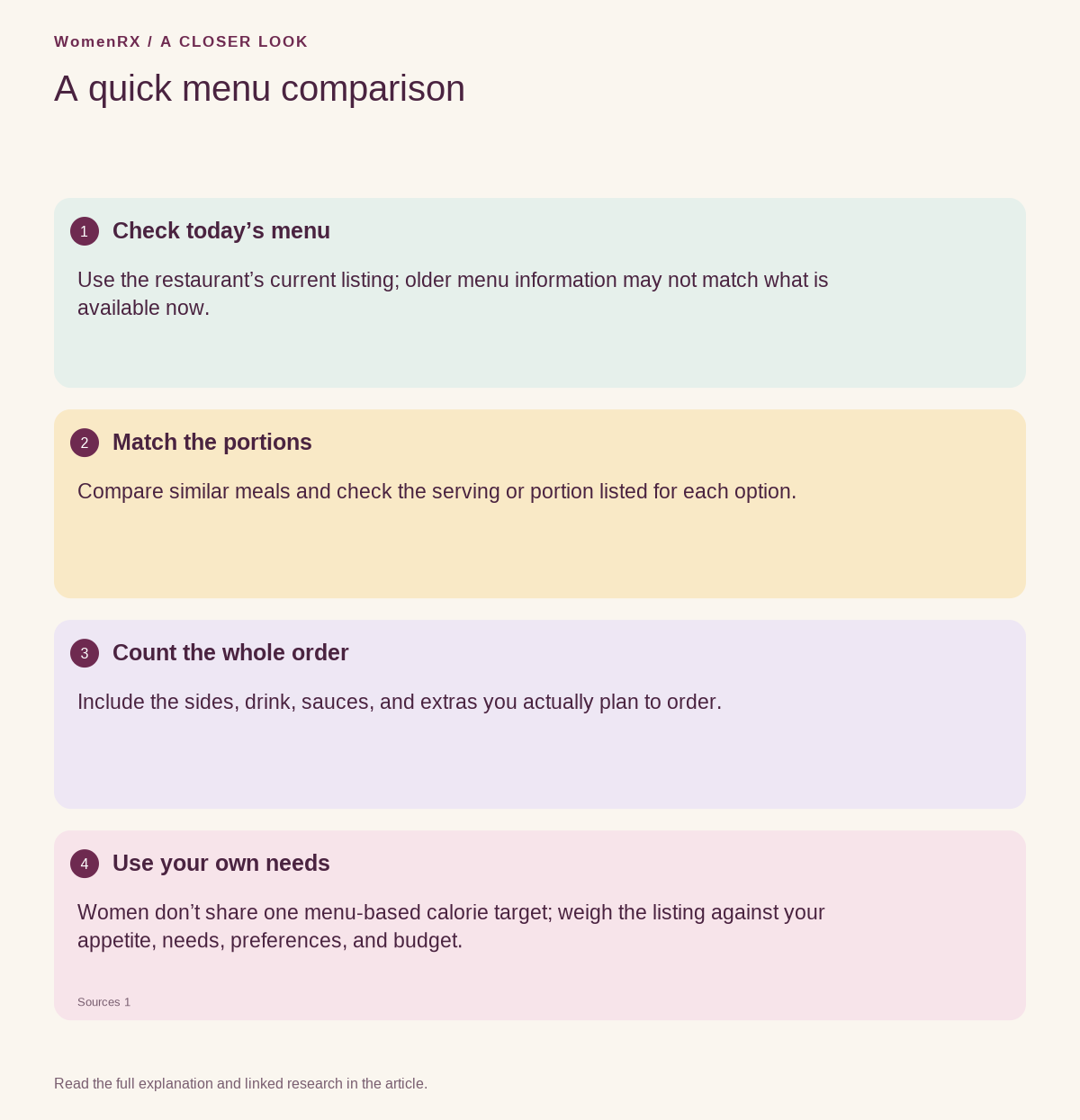
Check today’s menu: Use the restaurant’s current listing; older menu information may not match what is available now.
Match the portions: Compare similar meals and check the serving or portion listed for each option.
Count the whole order: Include the sides, drink, sauces, and extras you actually plan to order.
Use your own needs: Women don’t share one menu-based calorie target; weigh the listing against your appetite, needs, preferences, and budget.1
Read the figure as text
Use these steps to compare the order you’d actually eat, rather than judging a single menu item in isolation.- Check today’s menu: Use the restaurant’s current listing; older menu information may not match what is available now.
- Match the portions: Compare similar meals and check the serving or portion listed for each option.
- Count the whole order: Include the sides, drink, sauces, and extras you actually plan to order.
- Use your own needs: Women don’t share one menu-based calorie target; weigh the listing against your appetite, needs, preferences, and budget.1
More questions, answered
Should I always choose the lowest-calorie item?
No. Calories are one comparison point, not a measure of whether a meal is right for you. Your energy and nutrient needs, appetite, preferences, and budget matter too. 1
Is there one calorie target women should use when ordering?
This menu guide can’t set a personal target. A menu listing describes the item; it doesn’t determine what you need. A healthy eating pattern should provide energy and nutrients and account for personal needs and preferences. 1
Do menu labels change what people order?
Results vary. One Australian online menu experiment found lower-calorie selections when some energy labels were shown, while a randomized study of hypothetical menus with Hispanic adults found no difference. Neither result means labels will determine your choice or weight change. 2 3
Sources you can check
- Nutrition: MedlinePlusAccessed 2026-09-25Return to first citation
- What types of nutrition menu labelling lead consumers to select less energy-dense fast food? An experimental study.Morley B, Scully M, Martin J, Niven P, Dixon H, Wakefield M. · Appetite · 2013Return to first citation
- Effect of calorie or exercise labels on menus on calories and macronutrients ordered and calories from specific foods in Hispanic participants: a randomized study.Shah M, Bouza B, Adams-Huet B, Jaffery M, Esposito P, Dart L. · Journal of investigative medicine : the official publication of the American Federation for Clinical Research · 2016Return to first citation
- Changes in the energy and sodium content of main entrées in US chain restaurants from 2010 to 2011.Wu HW, Sturm R. · Journal of the Academy of Nutrition and Dietetics · 2014Return to first citation