Eat Out Without Making the Meal a Test
A satisfying restaurant meal can start with your needs, adjust to the menu, and end without a pass-or-fail verdict.
Try a simple before-during-after approach: notice what you need from the meal, choose the best fit from the menu you actually have, and check in with how it tastes and feels as you eat. You don’t need strict tracking for that. Eating with friends can influence how much people eat, but it isn’t a rule that predicts what you’ll do. 3
Start with what you need today
Before opening the menu, take a moment to ask what would make this meal work for you. You might be very hungry after a long stretch without eating, short on time, hoping for something filling, or choosing around a dietary need. The point isn’t to settle on a perfect meal in advance. It’s to give yourself a useful starting point when the menu is unfamiliar or the table is moving quickly.
This is different from setting a calorie target or deciding what you’re allowed to order. Mindful eating is described as paying attention to hunger and fullness signals rather than counting calories. A small randomized trial in women with overweight or obesity explored mindful eating, but it was not a study of restaurant choices. So treat this as a flexible way to approach the meal, not a proven restaurant program or a promise about weight. 1
When the menu is limited, choose a workable fit
Look for the option that best meets your needs among the choices that are actually available. If there’s a component you don’t want or can’t eat, ask whether it can be left off or swapped. If none of the options feels ideal, choose the one that seems most workable rather than turning the meal into a search for a perfect answer.
For example, imagine you’re hungry and the menu has tomato soup, a side salad, a cheese sandwich, fries, and a few small plates. If you want a meal that feels more substantial and the sandwich appeals, ordering it is a reasonable fit. If you’d rather have soup and salad, ask whether they can be served together. If the restaurant can’t make that work, choose the available option you’re most willing to eat. These are examples of deciding from the menu in front of you, not rules about what a meal must contain.
When a dietary need affects what is suitable for you, let that need lead the choice. For example, if you avoid an ingredient, ask whether a dish contains it or can be prepared without it. If the restaurant can’t answer your question, choose another option you can assess. The right choice may be different for someone managing a health condition or avoiding an ingredient; a general menu strategy can’t answer every specific dietary question.
At the table, let the meal give you information
You don’t have to eat slowly or monitor every bite. You can simply notice whether you’re enjoying the food, whether you still want more, and whether the meal is meeting the need you started with. If conversation or a busy setting distracts you, that’s normal; you can check in again when there’s a natural pause.
Eating with other people can affect eating behavior. A systematic review of 42 studies found that people tended to select and eat more with friends than when eating alone. The review found no clear evidence of the same effect when people ate with strangers or acquaintances. That’s a group-level finding, not a prediction about your meal or a reason to avoid eating with friends. 3
If the table is sharing dishes, you can take what you want, wait to see whether you’re still hungry, or order your own meal. You don’t need to match anyone else’s pace or portions. The choice is yours, whether you’re enjoying a longer dinner with friends or grabbing a quick meal between commitments.
Afterward, move on without compensation
Once the meal is over, it’s over. There’s no need to skip your next meal, exercise to “make up for” what you ate, or judge the evening by whether you followed a plan. If the meal was more or less satisfying than expected, that’s useful information for another day: perhaps the portion, timing, or menu option didn’t suit you. It doesn’t make the meal a failure.
A pilot randomized study of 50 women found that a sensory-based intervention was associated with changes in reported eating-related attitudes and behaviors, including greater unconditional permission to eat. It was preliminary and did not test restaurant meals, so it can’t tell us that this approach will have the same effect for everyone dining out. 2
A quick before-during-after check
- Before: What do I need from this meal today?
- During: Is this working for me, or would I prefer something different?
- After: What did I learn, if anything, without turning the meal into a verdict?
That’s enough structure to make a choice without making eating out a test.
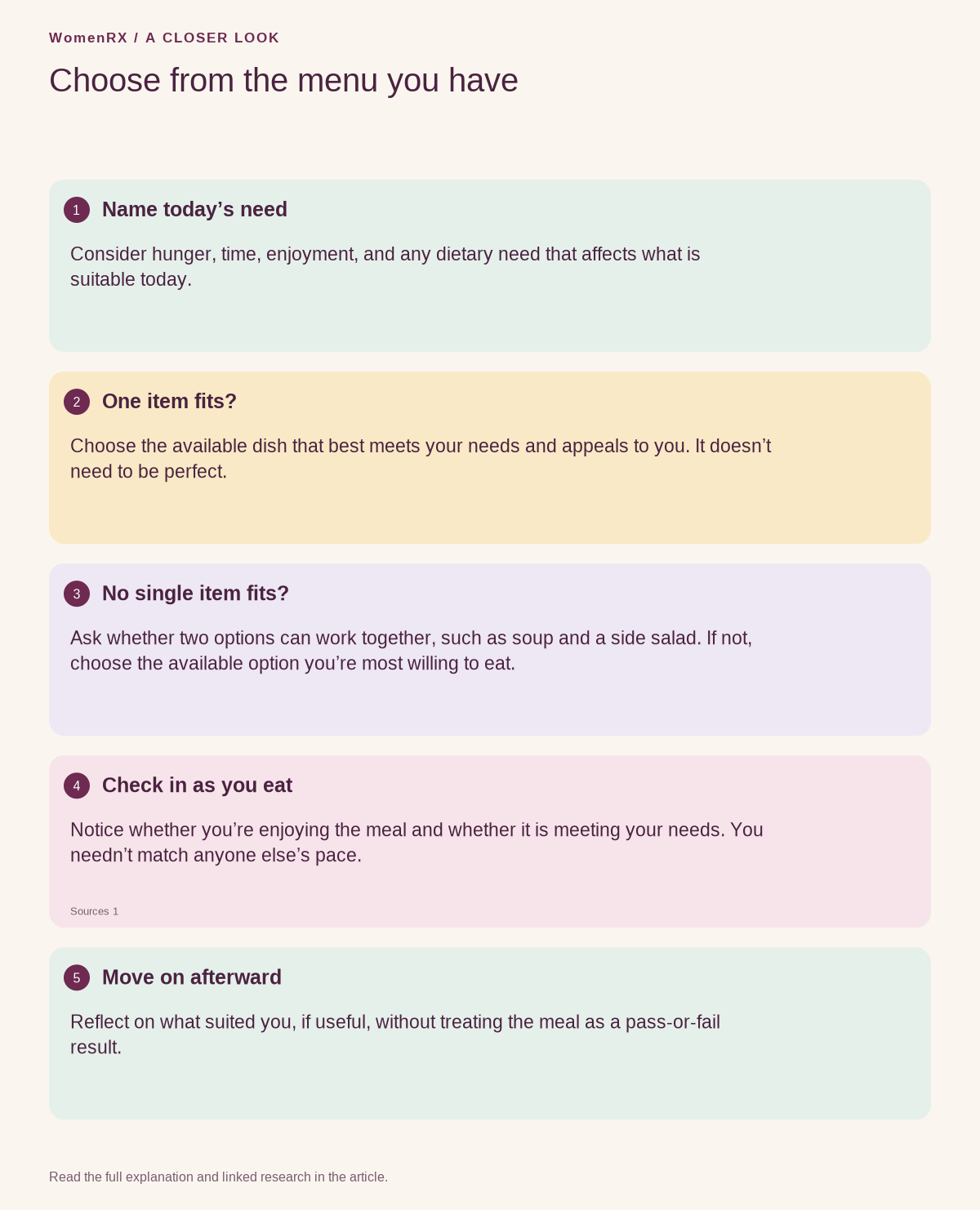
Choose from the menu you have
Name today’s need: Consider hunger, time, enjoyment, and any dietary need that affects what is suitable today.
One item fits?: Choose the available dish that best meets your needs and appeals to you. It doesn’t need to be perfect.
No single item fits?: Ask whether two options can work together, such as soup and a side salad. If not, choose the available option you’re most willing to eat.
Check in as you eat: Notice whether you’re enjoying the meal and whether it is meeting your needs. You needn’t match anyone else’s pace.1
Move on afterward: Reflect on what suited you, if useful, without treating the meal as a pass-or-fail result.
Read the figure as text
A flexible path from naming what you need to choosing a workable option, including what to try when no single menu item fits.- Name today’s need: Consider hunger, time, enjoyment, and any dietary need that affects what is suitable today.
- One item fits?: Choose the available dish that best meets your needs and appeals to you. It doesn’t need to be perfect.
- No single item fits?: Ask whether two options can work together, such as soup and a side salad. If not, choose the available option you’re most willing to eat.
- Check in as you eat: Notice whether you’re enjoying the meal and whether it is meeting your needs. You needn’t match anyone else’s pace.1
- Move on afterward: Reflect on what suited you, if useful, without treating the meal as a pass-or-fail result.
More questions, answered
What if I’m eating with friends who order differently?
You can order what suits you rather than matching their choices. Research suggests people may select and eat more with friends than alone on average, but that finding doesn’t determine what any one person will eat. 3
Do I need to track my food to make a thoughtful choice?
No. You can choose based on what you need and what the menu offers. Mindful eating focuses on awareness of hunger and fullness rather than calorie counting. 1
Sources you can check
- Effects of Mindful Eating and YogaDance among Overweight and Obese Women: An Exploratory Randomized Controlled Trial.Henninger SH, Fibieger AY, Magkos F, Ritz C. · Nutrients · 2023Return to first citation
- Sensory-based nutrition pilot intervention for women.Gravel K, Deslauriers A, Watiez M, Dumont M, Dufour Bouchard AA, Provencher V. · Journal of the Academy of Nutrition and Dietetics · 2014Return to first citation
- A systematic review and meta-analysis of the social facilitation of eating.Ruddock HK, Brunstrom JM, Vartanian LR, Higgs S. · The American journal of clinical nutrition · 2019Return to first citation