How to Judge Portions Without Counting Calories
Your hands and plate can help you choose a starting serving, while appetite and context help you decide what’s enough.
Try using a fist, palm, or cupped hand to compare foods as you serve them, then look at the balance of foods on your plate. For example, you might start with vegetables, beans, and rice, then add more of anything you’re still hungry for. These are flexible prompts, not exact servings or a weight-loss formula. MedlinePlus notes that food needs vary from person to person. 3
Start with the meal, not a target number
Look at the foods you’re about to eat. Is there produce? A protein food? Something else that makes the meal satisfying, such as rice, bread, or potatoes? You don’t need every plate to look alike. A varied eating pattern can include vegetables, fruit, whole grains, dairy, and proteins such as fish, beans, lentils, or tofu. 3
A plate can give you a quick picture without turning dinner into a calculation. For example, you could start a bean-and-rice lunch with vegetables covering roughly half the plate and beans and rice sharing the rest. Or you could serve a sandwich with fruit and yogurt alongside it. Those are ways to arrange foods, not proportions you need to meet. MedlinePlus notes that food needs can vary with your size, activity, age, and medical circumstances. 3
Let your hands compare, not prescribe
When you’re serving that bean-and-rice plate, you could compare the vegetables to your fist, the beans to your palm, and a scoop of rice to your cupped hand. The comparison helps you see what you’ve served without getting out a measuring cup. It doesn’t mean one fist of vegetables, one palm of beans, and one cupped hand of rice is the right meal for you. Hands differ, foods differ, and none of these shapes is an exact calorie equivalent.
Then check in as you eat. You can begin with what looks appealing, pause to notice whether you’re still hungry, and have more if you want it. Hunger is useful information, not a test you have to pass. This hand-and-appetite routine is a practical way to make a meal decision, not a promise of weight loss. A U.S. dietary-guidelines committee review could not draw a conclusion about portion size and adults’ body composition or obesity risk because the studies differed too much in their approaches and outcomes. 1
When there isn’t a tidy plate
A plate layout is easiest to see when foods are separate. With a mixed dish, compare a scoop of the whole dish with your fist rather than trying to measure invisible sections. For example, if dinner is pasta with lentils and vegetables, serve a starting amount, notice whether the lentils and vegetables are mixed throughout, and add more pasta, vegetables, or another scoop if the meal calls for it. You don’t have to pull the ingredients apart to make the meal count.
At a restaurant, the serving brought to your table is an offer, not an instruction to finish it or a limit on what you’re allowed to eat. If a large plate makes it hard to tell where to start, look at its components: you might compare a piece of fish with your palm and the potatoes with your cupped hand, then decide as you eat whether you want the rest. The same approach works when your appetite differs from yesterday’s: adjust the serving rather than forcing every meal to match a template.
There is evidence that a specific portion-control plate helped in one setting, but it shouldn’t be stretched into a universal plate rule. In a six-month trial of 130 patients with obesity and type 2 diabetes, those assigned to that plate lost an average of 1.8% of their starting weight, compared with 0.1% in a group receiving usual dietary teaching. That result applies to the specific plate used in the trial. 2
Know when the shortcut isn’t a good fit
A smaller portion isn’t automatically a better one. The dietary-guidelines committee found too little evidence to draw a conclusion about portion size and weight gain during pregnancy, and no qualifying evidence for its postpartum weight-change question. That does not establish a portion rule for pregnancy or breastfeeding. 1 If you’re pregnant or breastfeeding, you can set aside the generic plate example rather than treat it as a serving target.
Likewise, menopause doesn’t turn a generic hand rule into a personal prescription. Food needs differ between people. 3 If you have a history of disordered eating and hand comparisons feel rigid or distressing, you can skip this optional shortcut. A meal does not need to match a hand shape.
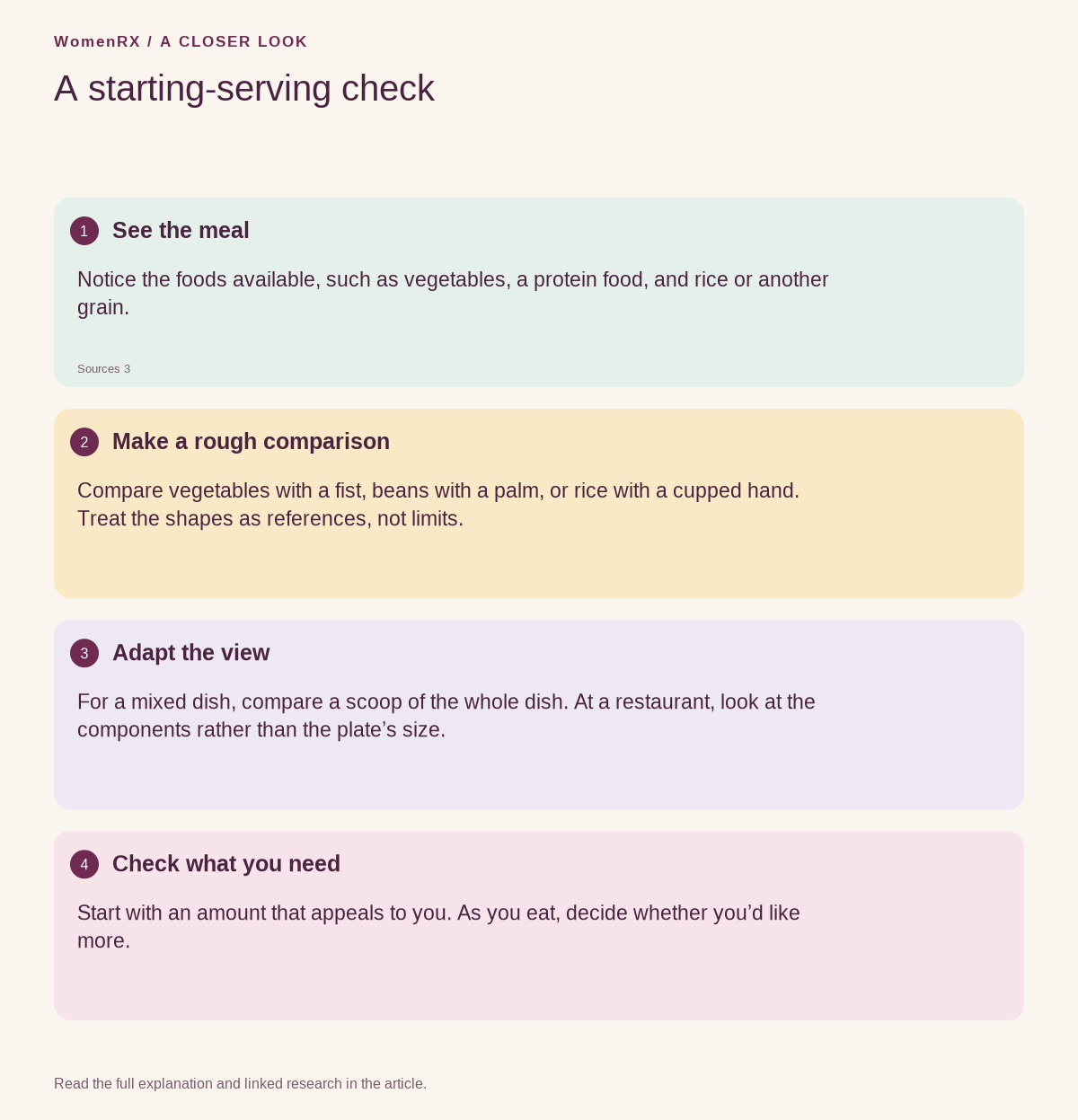
A starting-serving check
See the meal: Notice the foods available, such as vegetables, a protein food, and rice or another grain.3
Make a rough comparison: Compare vegetables with a fist, beans with a palm, or rice with a cupped hand. Treat the shapes as references, not limits.
Adapt the view: For a mixed dish, compare a scoop of the whole dish. At a restaurant, look at the components rather than the plate’s size.
Check what you need: Start with an amount that appeals to you. As you eat, decide whether you’d like more.
Read the figure as text
Try these prompts when you want a rough estimate without making your plate follow a rule.- See the meal: Notice the foods available, such as vegetables, a protein food, and rice or another grain.3
- Make a rough comparison: Compare vegetables with a fist, beans with a palm, or rice with a cupped hand. Treat the shapes as references, not limits.
- Adapt the view: For a mixed dish, compare a scoop of the whole dish. At a restaurant, look at the components rather than the plate’s size.
- Check what you need: Start with an amount that appeals to you. As you eat, decide whether you’d like more.
Sources you can check
- Portion Size and Growth, Body Composition, and Risk of Obesity: A Systematic ReviewRaynor HA, Gardner CD, Anderson CAM, Andres A, Fisher JO, Giovannucci E, Hoelscher DM, Jernigan VBB, Odoms-Young A, Palacios C, Stanford FC, Fultz AK, Obbagy J, Butera G, Higgins M... · 2024Return to first citation
- Portion control plate for weight loss in obese patients with type 2 diabetes mellitus: a controlled clinical trial.Pedersen SD, Kang J, Kline GA. · Archives of internal medicine · 2007Return to first citation
- MedlinePlus: Managing weight with healthy eatingAccessed 2026-09-25Return to first citation