Can You Manage Weight Without Counting Calories?
You can test meal, appetite, and activity routines without logging calories, then judge whether they fit your life and support your goal.
Yes. Try one repeatable change, such as planning a meal for a busy day, noticing hunger and fullness at meals, or making room for regular activity. 1 Check whether the routine feels workable, then assess your health or weight goal separately. Following a routine doesn’t automatically mean losing weight. Pregnancy calls for a different goal: appropriate pregnancy weight gain, not an unchanged weight-loss plan. 7
Calorie counting can give you detailed feedback, but recording meals may take more time and attention than you want to give it. If that tradeoff doesn’t suit you, you can try changing a routine instead. The key distinction is that a routine may help you notice or shape your eating; it isn’t automatically a weight-loss method. Body weight reflects more than a single meal or habit, and a scale can’t tell you whether a change is fat, muscle, or water. 1 2
Choose a routine you can actually test
Start with one specific pattern you want to understand or change. These are practical options to test, not routines established to cause weight loss:
- Plan for a busy meal. For example, decide what you’ll have for lunch before the workday starts. Notice whether having a plan changes what happens when lunchtime gets crowded out.
- Use a repeatable meal cue. For example, make sitting down for an afternoon meal part of your workday routine. Notice whether that structure fits your schedule better than deciding what to eat at the last minute.
- Check in with appetite. Pause before and after a meal to notice hunger and comfortable fullness, without turning those cues into a score. This tells you something different from a calorie total: how the meal felt to you.
- Choose an activity cue. For example, set aside time for a walk you enjoy. Notice whether it fits your week. Regular physical activity can be part of weight management, but completing a walk doesn’t tell you what happened to your weight. 1
Try one change first so you can tell what’s workable. Did it happen on an ordinary day as well as an easy one? Did eating feel satisfying, or did the routine leave you feeling deprived or preoccupied with food? Those answers tell you about fit, not whether your weight-related goal is changing.
An app doesn’t have to count calories to offer feedback, but logging food can still feel like tracking. In a four-week study, 45 college students used an app designed around intuitive eating. Some measures of diet quality improved, while global intuitive eating and overall disordered eating did not significantly change. The study wasn’t a weight-loss trial, so it doesn’t show that this kind of app leads to weight loss. 3
What tracking gives you, and what it costs
Calorie tracking can make quantities and patterns more visible. Its tradeoff is the time and attention involved, and the numbers may become a source of stress rather than useful information. You don’t have to keep using a tool that isn’t helping you.
Nor does less tracking automatically mean a change in weight. In a randomized study of 112 adults with type 2 diabetes in a 12-month very-low-carbohydrate program, adding daily rather than monthly dietary self-monitoring did not show a statistically significant benefit on the main outcomes. The study tested tracking frequency within that specific program, not calorie counting against a set of non-tracking routines for women generally. Results for daily tracking were mixed, including a possible increase in depressive symptoms that did not reach statistical significance. 6
To decide whether your approach is working, check fit and progress separately. Fit means you can use the routine without it making eating harder to live with. For progress, return to the goal you chose: if it’s a weight goal, compare readings over time rather than deciding from one reading; if it’s a broader health goal, consider changes such as energy, sleep, and overall well-being alongside any weight change. A scale measures muscle, bone, fat, and water together, so one reading can’t tell you which has changed. If your weight changes suddenly without trying, that’s a reason to seek care rather than assume your routine caused it. 2
Let your life stage shape the goal
During pregnancy, intentional weight loss shouldn’t be assumed to be the goal. A study of pregnant women in Japan found that dieting behaviors were common in the group studied and that previous dieting was associated with continued restriction or other dieting behaviors during pregnancy. Because this was an observational study, it can’t establish that dieting caused an outcome. It does support treating pregnancy as a distinct context, with attention to appropriate pregnancy weight gain rather than carrying a pre-pregnancy weight-loss plan forward unchanged. 7
While breastfeeding, treat a proposed weight-loss goal as a separate decision, too. The routines above are ways to notice eating patterns, not established breastfeeding weight-loss plans.
Across the menstrual cycle, appetite can feel different from month to month, but small studies don’t show that every woman needs a cycle-based eating plan. In one study of 18 healthy premenopausal women, appetite and measured food intake did not significantly differ between the late-follicular and mid-luteal phases. Another study found no phase-related differences in appetite or energy intake after moderate exercise among its female participants. These findings are limited to the people and settings studied; your own patterns can still be useful to notice without treating them as a rule. 4 5
When calorie tracking is a poor fit
If calorie logging makes you anxious, encourages rigid restriction, or starts to dominate your thoughts about food, that’s a reason to reconsider whether the tool is working for you. Those are practical signs to pay attention to, not a test that determines whether tracking is safe. A four-week study of an intuitive-eating app found no significant change in overall disordered eating, but it did not test calorie counting or establish whether calorie tracking is appropriate for someone with an eating-disorder history. 3 If you have that history, your past experience with tracking matters more to this decision than the app study does.
The most useful method is the one that gives you relevant feedback without making eating harder to live with. If a simple routine feels sustainable, keep testing it. If it doesn’t, changing tools is a reasonable next move.
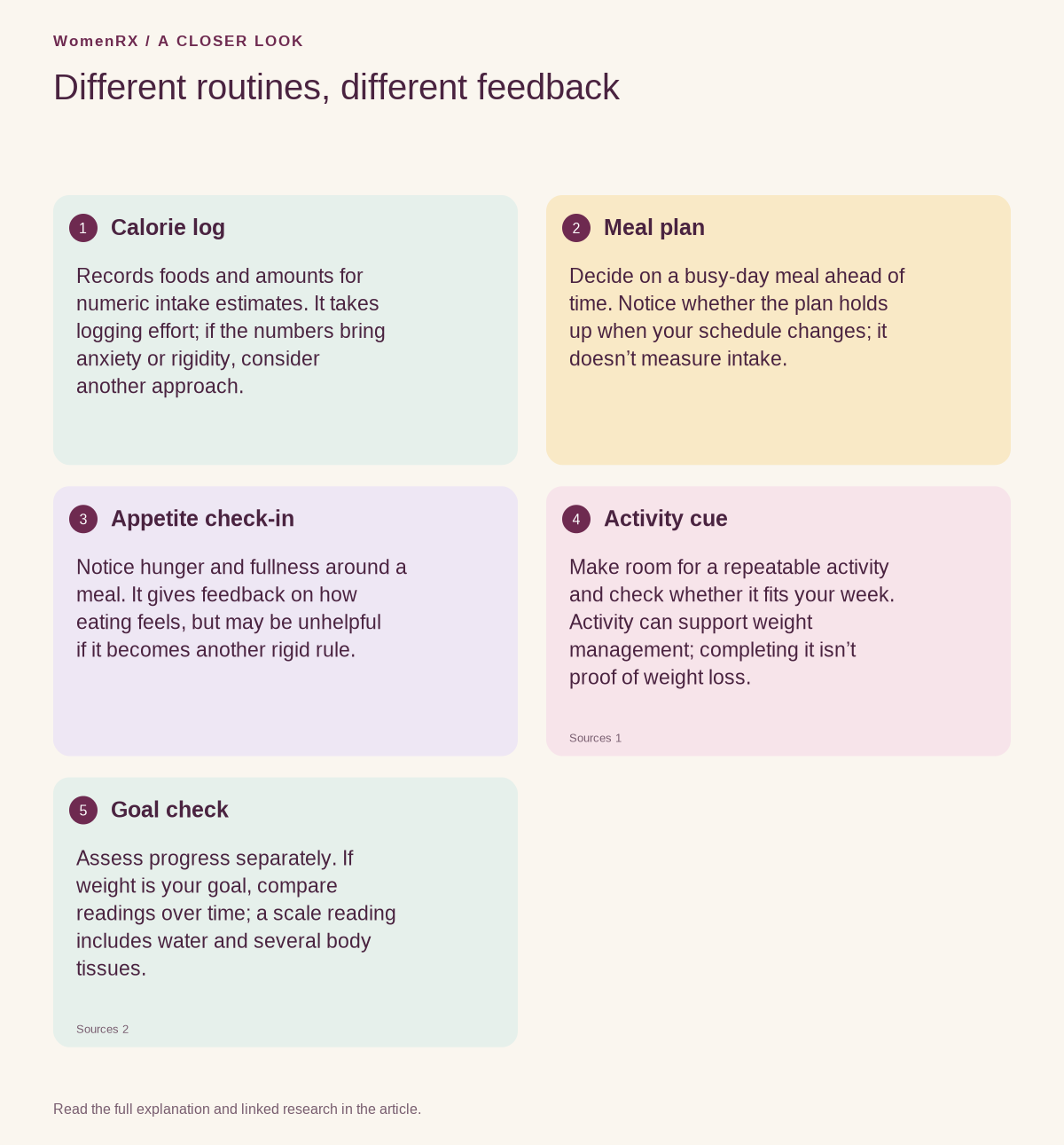
Different routines, different feedback
Calorie log: Records foods and amounts for numeric intake estimates. It takes logging effort; if the numbers bring anxiety or rigidity, consider another approach.
Meal plan: Decide on a busy-day meal ahead of time. Notice whether the plan holds up when your schedule changes; it doesn’t measure intake.
Appetite check-in: Notice hunger and fullness around a meal. It gives feedback on how eating feels, but may be unhelpful if it becomes another rigid rule.
Activity cue: Make room for a repeatable activity and check whether it fits your week. Activity can support weight management; completing it isn’t proof of weight loss.1
Goal check: Assess progress separately. If weight is your goal, compare readings over time; a scale reading includes water and several body tissues.2
Read the figure as text
Choose a method by the effort it asks of you and the information it gives back. Check goal progress separately from whether you completed the routine.- Calorie log: Records foods and amounts for numeric intake estimates. It takes logging effort; if the numbers bring anxiety or rigidity, consider another approach.
- Meal plan: Decide on a busy-day meal ahead of time. Notice whether the plan holds up when your schedule changes; it doesn’t measure intake.
- Appetite check-in: Notice hunger and fullness around a meal. It gives feedback on how eating feels, but may be unhelpful if it becomes another rigid rule.
- Activity cue: Make room for a repeatable activity and check whether it fits your week. Activity can support weight management; completing it isn’t proof of weight loss.1
- Goal check: Assess progress separately. If weight is your goal, compare readings over time; a scale reading includes water and several body tissues.2
More questions, answered
Does eating without tracking calories lead to weight loss?
Not by itself. A non-tracking routine may change how you eat, but following it only shows that you can do the routine. Check your chosen health or weight goal separately rather than treating the routine as a guaranteed weight-loss method. Healthy eating patterns and physical activity can be part of weight management, while individual results vary. 1
Should I track appetite changes around my period?
You can notice your own patterns if that’s useful, but small studies haven’t found consistent appetite or intake differences across menstrual-cycle phases. They don’t establish a cycle-based plan that everyone needs. 4 5
Sources you can check
- Obesity: MedlinePlusAccessed 2026-09-25Return to first citation
- Body Weight: MedlinePlusAccessed 2026-09-25Return to first citation
- A Smartphone App to Improve Intuitive Eating and Diet Quality: Design and Usability Study.Korpusik M, YazdanSepas D, Almstedt HC. · JMIR human factors · 2026Return to first citation
- Effects of sex and menstrual cycle phase on postexercise appetite regulation.Tucker JAL, McCarthy SF, Bornath DPD, Frayne JM, Claeys DA, Aube JJ, Cohen TR, Medeiros PJ, Hazell TJ. · American journal of physiology. Regulatory, integrative and comparative physiology · 2026Return to first citation
- Energy intake and appetite in laboratory and free-living conditions may be consistent across menstrual cycle phases.Smith M, Aghayan M, Little J, Prior JC, Cohen TR, Soon Z, Bomide H, Purcell S. · Appetite · 2026Return to first citation
- Psychological Support Strategies for Adults With Type 2 Diabetes in a Very Low-Carbohydrate Web-Based Program: Randomized Controlled Trial.Saslow LR, Missel AL, O'Brien A, Kim S, Hecht FM, Moskowitz JT, Bayandorian H, Pietrucha M, Raymond K, Richards B, Liestenfeltz B, Mason AE, Daubenmier J, Aikens JE. · JMIR diabetes · 2023Return to first citation
- [Weight-control behaviors during pregnancy and their association with pre-pregnancy dieting experiences].Kudo A, Kato-Kogoe N, Fujita D, Hayashi E, Tamaki J. · [Nihon koshu eisei zasshi] Japanese journal of public health · 2026Return to first citation