Managing Weight After 40 Without a Restrictive Diet
A flexible approach can support your health after 40 without treating the scale, or your birthday, as the whole story.
You don’t need a restrictive meal plan to work on weight or health after 40. Start with an eating pattern you can live with, regular movement that includes strength work, and enough room for sleep and recovery. These habits support health, but they don’t promise weight loss without changes in how much you eat. Menopause may change body composition; turning 40 doesn’t set one outcome for everyone. 7910
Start with the goal, not a diet rule
Maybe your clothes fit differently, or a number on the scale has crept up. Before deciding what to change, ask what you want the change to do for you. You might want more strength for everyday tasks, better stamina, steadier eating habits, or help with a weight-related health concern. Those goals can point to different first steps.
Weight is one measure, not a complete health report: it includes muscle, bone, fat, and water. BMI also cannot distinguish muscle from fat. A health assessment can consider your waist circumference, health history, and risk factors alongside weight. 3 That matters when you’re building strength, for example. The scale alone won’t tell you whether you’re getting better at carrying groceries or climbing stairs.
What changes in midlife, and what doesn’t
The midlife study cited here does not establish age 40 as a cutoff or show that weight gain at 40 is inevitable. Aging, activity, and the menopausal transition can overlap, which makes it difficult to attribute a body change to any one of them. In a cross-sectional study of 248 white and Chinese women ages 47 to 57, later perimenopausal and postmenopausal status was associated with lower lean mass in both groups. Higher physical activity was generally associated with lower body-fat percentage and a smaller waist, though those activity findings were not statistically significant among the Chinese women. Because the study measured women at one point in time, it cannot show that menopause caused an individual woman’s weight change or that activity caused the differences observed. 10
If hot flashes or night sweats are disrupting your rest, address that problem on its own terms rather than assuming you need a stricter diet. Regular sleep routines, physical activity, and a balanced diet are among the practical measures recommended for perimenopause and menopause symptoms. 6 You can be in your 40s and still have cycles, be in perimenopause, or have reached menopause. Your priorities won’t necessarily match someone else’s.
Make meals easier to repeat, not harder to follow
A nonrestrictive approach still involves paying attention to food. Healthy eating patterns and physical activity can help with weight management; when weight loss is the goal, changes in energy intake are generally part of the picture. No particular food needs to become a moral test. 29
Choose a change that solves a real friction point. For example, if lunch is often whatever you can find between meetings, you might plan a satisfying lunch you can bring or buy reliably rather than writing rules for every meal. If evenings are when eating feels rushed, you might make dinner easier to put together. These are ways to make a balanced pattern more workable, not promises that one meal change will produce weight loss. A balanced eating plan is one part of reaching and maintaining a weight that suits you. 7
Be wary of a product that offers to do the work instead. The evidence for weight-loss supplements varies widely by ingredient, many products combine ingredients that haven’t been studied together, and some carry safety concerns or can interfere with medicines. 2
Give movement two jobs
Walking, dancing, or another activity that raises your breathing rate can help you build a regular movement habit. The general adult recommendation is 150 minutes of physical activity a week, and that time can be broken into shorter stretches. Strength activity has a different job: it challenges muscles by having you push or pull against resistance. 9
During and after the menopausal transition, strength and weight-bearing activities are also recommended to help protect bone health. 6 That gives you a reason to include them even if your weight stays the same. For example, you might pair walks you enjoy with a manageable strength routine, rather than expecting extra cardio to answer every concern about midlife body changes. Start with what fits your current ability and build a pattern you can keep.
Check what else may be shaping the plan
Sleep deserves a place in the decision. Adults generally need 7 to 9 hours, and ongoing trouble sleeping may need attention in its own right. 8 If nights are repeatedly interrupted, it may be more useful to work on the sleep problem than to add another demanding food rule. Stress and your home or work environment can also affect how feasible daily eating and activity choices feel. 79
Consider individual medical advice if your weight is changing unexpectedly, you have a weight-related condition, or you suspect a medicine or health issue may be involved. Unexpected weight gain or loss can signal a medical problem; a clinician can assess your health history and goals rather than judging from a scale reading alone. 3 Bring the names of medicines and supplements you take so the conversation can be specific.
If you’re planning a pregnancy, discuss weight goals as part of preconception care, which can address weight alongside conditions such as high blood pressure or diabetes. Pregnancy has its own nutrition needs. 14
A review of structured weight-loss interventions in adults with overweight or obesity found that disordered-eating scores improved on average, but its behavioral programs prescribed energy restriction and had explicit weight-loss goals. It does not establish that any particular plan is a good fit for you. 5
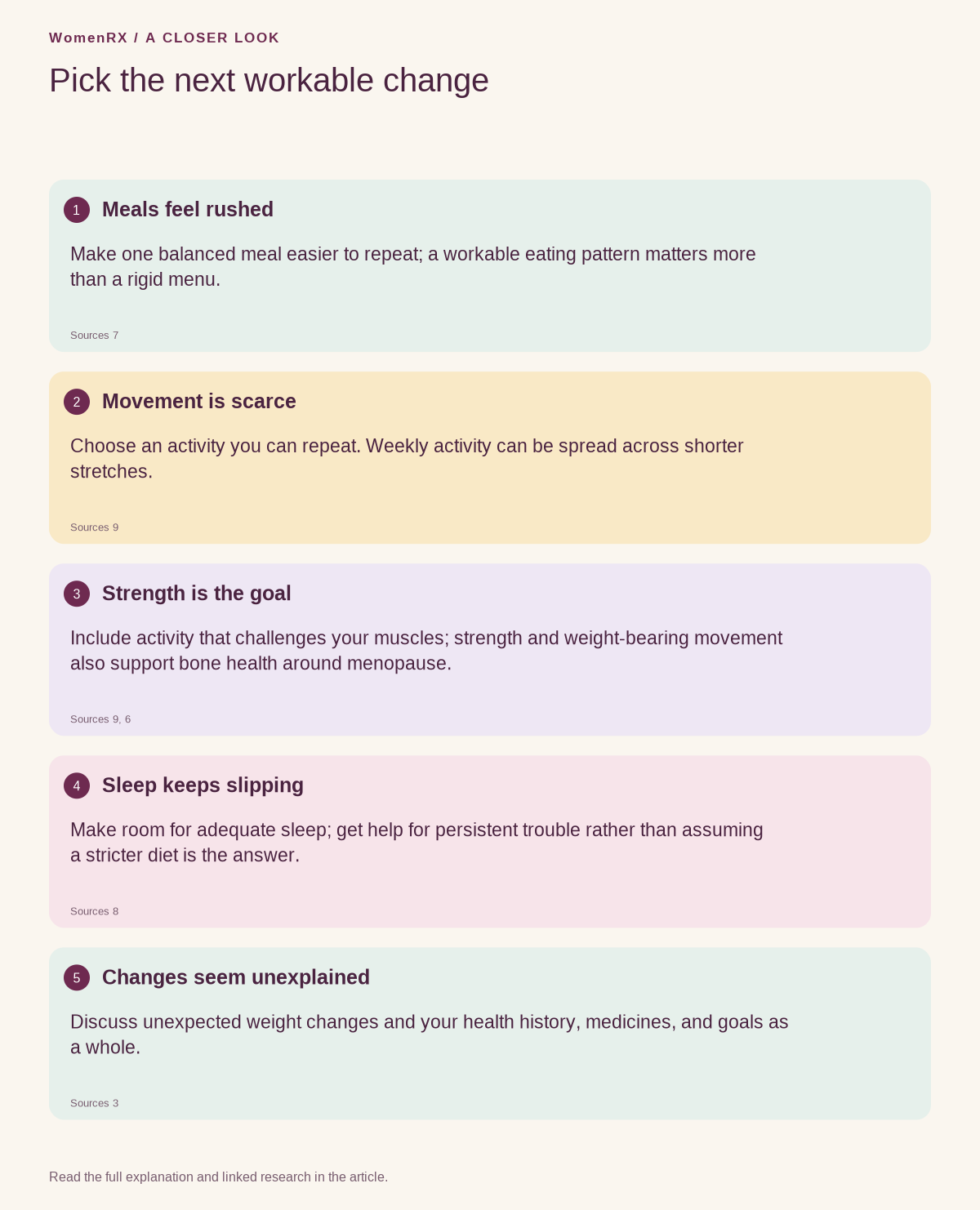
Pick the next workable change
Meals feel rushed: Make one balanced meal easier to repeat; a workable eating pattern matters more than a rigid menu.7
Movement is scarce: Choose an activity you can repeat. Weekly activity can be spread across shorter stretches.9
Strength is the goal: Include activity that challenges your muscles; strength and weight-bearing movement also support bone health around menopause.96
Sleep keeps slipping: Make room for adequate sleep; get help for persistent trouble rather than assuming a stricter diet is the answer.8
Changes seem unexplained: Discuss unexpected weight changes and your health history, medicines, and goals as a whole.3
Read the figure as text
Use these prompts to choose a focus, not to score yourself or start five new habits at once.- Meals feel rushed: Make one balanced meal easier to repeat; a workable eating pattern matters more than a rigid menu.7
- Movement is scarce: Choose an activity you can repeat. Weekly activity can be spread across shorter stretches.9
- Strength is the goal: Include activity that challenges your muscles; strength and weight-bearing movement also support bone health around menopause.96
- Sleep keeps slipping: Make room for adequate sleep; get help for persistent trouble rather than assuming a stricter diet is the answer.8
- Changes seem unexplained: Discuss unexpected weight changes and your health history, medicines, and goals as a whole.3
Sources you can check
- Preconception Care: MedlinePlusAccessed 2026-09-25Return to first citation
- Dietary Supplements for Weight Loss - Health Professional Fact SheetAccessed 2026-09-25Return to first citation
- Body Weight: MedlinePlusAccessed 2026-09-25Return to first citation
- Dietary Supplements and Life Stages: Pregnancy - Health Professional Fact SheetAccessed 2026-09-25Return to first citation
- The impact of weight loss interventions on disordered eating symptoms in people with overweight and obesity: a systematic review & meta-analysis.Tsompanaki E, Koutoukidis DA, Wren G, Tong H, Theodoulou A, Wang D, Park RJ, Jebb SA, Aveyard P. · EClinicalMedicine · 2025Return to first citation
- Things you can do to help menopause and perimenopause symptoms - NHSAccessed 2026-09-25Return to first citation
- Healthy Eating & Physical Activity for Life - NIDDKAccessed 2026-09-25Return to first citation
- Healthy Sleep | MedlinePlusAccessed 2026-09-25Return to first citation
- Weight Control: MedlinePlusAccessed 2026-09-25Return to first citation
- Menopause, physical activity, and body composition/fat distribution in midlife women.Sternfeld B, Bhat AK, Wang H, Sharp T, Quesenberry CP. · Medicine and science in sports and exercise · 2005Return to first citation