Managing Weight Changes After Menopause Without Hormones
The scale, your waist, and your strength can tell different stories, and each points to a different next step.
Start by noticing what changed: weight, waist size, strength, or some combination. Then choose an eating or activity change you could keep doing, while protecting strength as you age. A sudden, unexplained weight change calls for a health review. If you need more support, ask about options beyond lifestyle changes. Menopausal hormone therapy isn’t a weight-loss treatment. 1 6 7
First, work out what you want to change
You may notice a tighter waistband even when the scale barely moves. That isn’t a contradiction. Weight includes fat, muscle, bone, and water, so a number on the scale cannot tell you which changed. BMI cannot separate those components either and may underestimate body fat in someone who has lost muscle. Waist size adds another piece of information: carrying more fat around the abdomen is associated with higher risk of heart disease and type 2 diabetes. 1
Menopause can be part of this picture. A clinical review describes an increase in abdominal fat and a decrease in lean body mass around the menopause transition that aren’t explained solely by chronological age. But that pattern doesn’t tell you why your weight or shape changed. Your health history and circumstances still matter. 7
Let the change guide the goal. If your weight is fairly steady but your waist or strength has changed, focusing only on losing pounds may miss what concerns you. If weight has gradually risen, you can consider whether a sustainable change to eating or activity would serve your health. If weight has changed suddenly without an obvious reason, look into that before assuming it’s menopause. 1 6
Pick a change you can actually repeat
There’s no need to adopt an extreme restriction plan to make a useful start. Balanced nutrition and physical activity are broad foundations for weight management. In later life, maintaining muscle and strength matters too, while safe activity and a balanced diet also support bone health. 1 6
Choose one area that fits your real week:
- Eating: Look at your usual pattern rather than a single meal. For example, if rushed evenings often leave you eating whatever is easiest, your first change might be making a balanced dinner easier to put together. That’s an example of a workable adjustment, not a special menopause diet. A dietitian can help tailor an eating plan if you’d benefit from support. 1
- Activity: Think about both movement you can do safely and the strength you want to keep for daily life. For example, you might choose an activity you enjoy enough to repeat, then consider whether your current routine gives you opportunities to use your muscles. The useful choice is one that fits your abilities, not a promised calorie burn. 1 6
- Sleep and symptoms: If bothersome vasomotor symptoms or poor sleep are disrupting your days, include them in the conversation rather than treating weight as the only issue. Menopause symptoms and weight concerns can overlap, and evidence-based nonhormonal options exist for bothersome vasomotor symptoms. Treating those symptoms is a separate goal from prescribing a weight-loss treatment. 3 5
Give the change a chance to become part of your routine, then ask whether it’s helping with the goal you chose, whether that’s a weight trend, waist change, or day-to-day strength. Progress needn’t mean uninterrupted weight loss. In the Women’s Health Initiative dietary modification trial, postmenopausal women assigned to a low-fat eating intervention had a modest average weight reduction early on, and many regained weight in later years as the intervention became less intensive. The study reports this pattern, but it doesn’t show why regain occurred or establish a low-fat diet as the preferred approach. 4
Know when habits aren’t the whole answer
A sudden or unexplained gain or loss of weight deserves a health review because it can signal a medical problem. Even with a gradual change, it’s reasonable to bring up a new health concern. If you’re having a health review, bring a list of the medicines you take so they can be considered as part of the discussion. Bring the pattern you’ve noticed and when it began. 1
If eating and activity changes haven’t been enough, or you have health concerns related to weight, ask what kind of support fits your situation. That might include help from a dietitian or a discussion of medical weight-management options. Anti-obesity medications are among the options used when appropriate, but whether one makes sense depends on an individual assessment, not simply on being postmenopausal. 1 7
Keep hormone therapy in a separate lane. It can be considered for established menopause-related reasons, including bothersome hot flashes and prevention of bone loss, with benefits and risks assessed individually. Although it may affect body composition, it is not a primary weight-loss treatment. You can address menopause symptoms and weight concerns without asking one treatment to do both jobs. 2 7
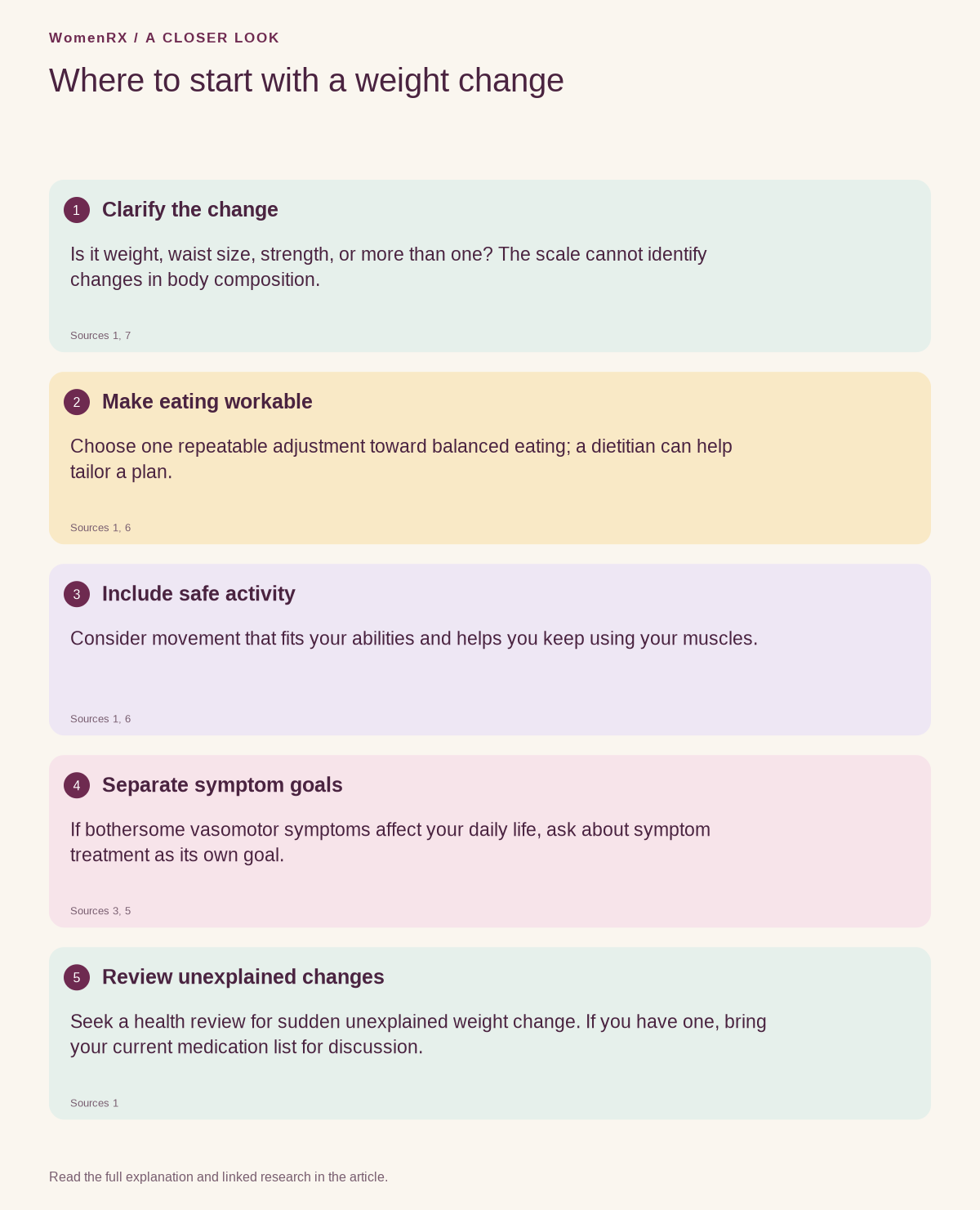
Where to start with a weight change
Clarify the change: Is it weight, waist size, strength, or more than one? The scale cannot identify changes in body composition.17
Make eating workable: Choose one repeatable adjustment toward balanced eating; a dietitian can help tailor a plan.16
Include safe activity: Consider movement that fits your abilities and helps you keep using your muscles.16
Separate symptom goals: If bothersome vasomotor symptoms affect your daily life, ask about symptom treatment as its own goal.35
Review unexplained changes: Seek a health review for sudden unexplained weight change. If you have one, bring your current medication list for discussion.1
Read the figure as text
Use these distinct areas to choose an everyday step or decide whether a health review would help. This is not a diagnostic score.- Clarify the change: Is it weight, waist size, strength, or more than one? The scale cannot identify changes in body composition.17
- Make eating workable: Choose one repeatable adjustment toward balanced eating; a dietitian can help tailor a plan.16
- Include safe activity: Consider movement that fits your abilities and helps you keep using your muscles.16
- Separate symptom goals: If bothersome vasomotor symptoms affect your daily life, ask about symptom treatment as its own goal.35
- Review unexplained changes: Seek a health review for sudden unexplained weight change. If you have one, bring your current medication list for discussion.1
More questions, answered
What if my weight is stable but my waist is changing?
The scale may not capture a change in body composition. Waist size offers information about abdominal fat, while changes in strength may point to a different concern. Consider what has changed over time rather than treating a stable weight as the whole answer. 1 7
Sources you can check
- Body Weight: MedlinePlusAccessed 2026-09-25Return to first citation
- The 2022 hormone therapy position statement of The North American Menopause Society.“The 2022 Hormone Therapy Position Statement of The North American Menopause Society” Advisory Panel. · Menopause (New York, N.Y.) · 2022Return to first citation
- The 2023 nonhormone therapy position statement of The North American Menopause Society.Menopause (New York, N.Y.) · 2023Return to first citation
- Impact of Genetic Predisposition to Obesity on Long-Term Maintenance of Modest Weight Loss in Postmenopausal Women.Lee HH, Avery CL, Graff M, Kim D, Arias J, Van Horn L, Kooperberg C, North KE. · Obesity (Silver Spring, Md.) · 2026Return to first citation
- Management of obesity in the menopause transition and postmenopausal period.Allen JT, Zahler-Miller C, Lough M, Titus H. · Surgery for obesity and related diseases : official journal of the American Society for Bariatric Surgery · 2026Return to first citation
- Management of postmenopausal osteoporosis.Reid IR, Bolland MJ. · Endocrine reviews · 2026Return to first citation
- Clinical review: Menopause hormone therapy in weight management.Younglove C. · Obesity pillars · 2026Return to first citation