Perimenopause Weight Changes: What’s Shifting and What Helps
Your waist or body composition may change even when the scale barely moves, and menopause is rarely the only possible explanation.
Perimenopause may coincide with more abdominal fat and less lean mass, sometimes without much change on the scale. Aging, habits, medicines, and health conditions can contribute too, so timing alone can’t identify the cause. A sustainable eating pattern and physical activity are useful starting points; hormone therapy treats menopause symptoms, not weight gain. A sudden, unexplained weight change deserves a closer look. 1271112
First, ask what has changed
Maybe the scale has crept up. Or maybe your weight is steady, but pants fit differently at the waist. Those are different observations. Body weight includes fat, muscle, bone, and water, so a scale cannot show which component changed. BMI cannot make that distinction either. Waist size adds information because carrying more fat around the abdomen is associated with higher risk of heart disease and type 2 diabetes. None of these measures explains why a change happened. 1
A 2026 narrative review describes increased abdominal fat and reduced lean mass as possible changes during perimenopause, including changes that occur without substantial weight gain. It draws on studies of women and relevant animal models, so it cannot predict your individual pattern or cleanly separate hormonal effects from aging. The practical point is to pay attention to shape, strength, and health as well as weight, without assuming a change is inevitable. 12
Why menopause and aging are hard to untangle
Perimenopause brings hormonal fluctuations at the same time that age-related changes are unfolding. Daily activity, eating patterns, genetics, medicines, and medical conditions can affect weight too. For example, a less active routine or a newly prescribed medicine is useful context when you’re trying to understand a gradual change. Neither proves that you’ve found the sole cause. 121112
Research does suggest a biological role for estrogen, but it’s easy to take that finding too far. A systematic review of studies in women found that estrogen medication increased resting energy expenditure in some settings. Resting energy expenditure is energy the body uses at rest; a change in that measure does not, by itself, demonstrate lasting weight loss or prove that menopausal hormone therapy prevents midlife weight gain. 5
Choose an approach that fits the change you’re seeing
If your goal is weight management, a healthy eating pattern and regular physical activity are a better-supported foundation than a menopause-branded fix. General adult prevention guidance also recommends attention to sleep and stress. It suggests limiting portion sizes and energy-dense ultra-processed foods, with physical activity built into daily life, leisure, and work. 11 These are worthwhile approaches, but they are not a tested formula that guarantees weight loss during perimenopause. If you want more tailored support, nutrition counseling can take your health history and circumstances into account. 2311
If your concern is shape or strength despite a fairly steady weight, don’t make the scale your only measure of progress. Notice whether your waist or your ability to do everyday physical tasks has changed. Resistance training is a reasonable activity to discuss if preserving muscle is a priority, although the perimenopause-specific review describes its potential rather than proving a particular routine will reverse a body-composition change. This distinction matters if you’re considering a weight-loss diet: a review of studies in adults with overweight or obesity found that lean mass and resting metabolic rate tended to fall with diet-based weight loss, though results varied. That review did not focus on perimenopause. 1012
If hot flashes or other menopause symptoms are disrupting your life, address those as their own problem. Menopausal hormone therapy is the most effective treatment for hot flashes and night sweats and can prevent bone loss; whether it’s a good fit depends on individual benefits and risks. A review of hormone therapy containing micronized progesterone found no BMI change in the postmenopausal groups it assessed, but that finding does not establish a weight benefit in perimenopause or for every hormone regimen. Treating symptoms and managing weight are related parts of your health, not interchangeable treatment goals. 67
Weight loss has some evidence as a possible approach to hot flashes, but that does not mean you must lose weight to deserve symptom relief. The Menopause Society’s nonhormone guidance distinguishes weight loss from exercise: it lists weight loss among options with limited or inconsistent evidence for hot flashes, while it does not recommend exercise as a hot-flash treatment. Physical activity can still serve other health and weight-management goals. 811
Where medicines and supplements fit
Weight-loss medicines may be worth discussing when there is an appropriate weight-related health concern, rather than simply because your body changed during perimenopause. Eligibility and treatment choices depend on your health history and the medicine. For context, a tirzepatide weight-management trial described in US prescribing information enrolled adults with obesity, or adults with overweight and at least one weight-related condition; it was not a trial of perimenopause-related weight change. A four-month semaglutide study reported similar average weight and fat-mass changes in postmenopausal and premenopausal women, but it did not study women in perimenopause or determine who should receive treatment. 249
Weight-loss supplements are a different proposition. Evidence for many ingredients is limited or inconsistent, and products containing several ingredients are especially hard to evaluate. Some ingredients can cause harm or interfere with medicines. A supplement marketed for a “menopause metabolism” problem should not be treated as a substitute for an approach matched to your actual health concern. 3
A gradual change gives you room to consider weight, waist, strength, routines, symptoms, and medicines together. A sudden, unexplained gain or loss is different: MedlinePlus advises discussing an unexpected weight change with a health care provider because it can signal a medical problem. 1
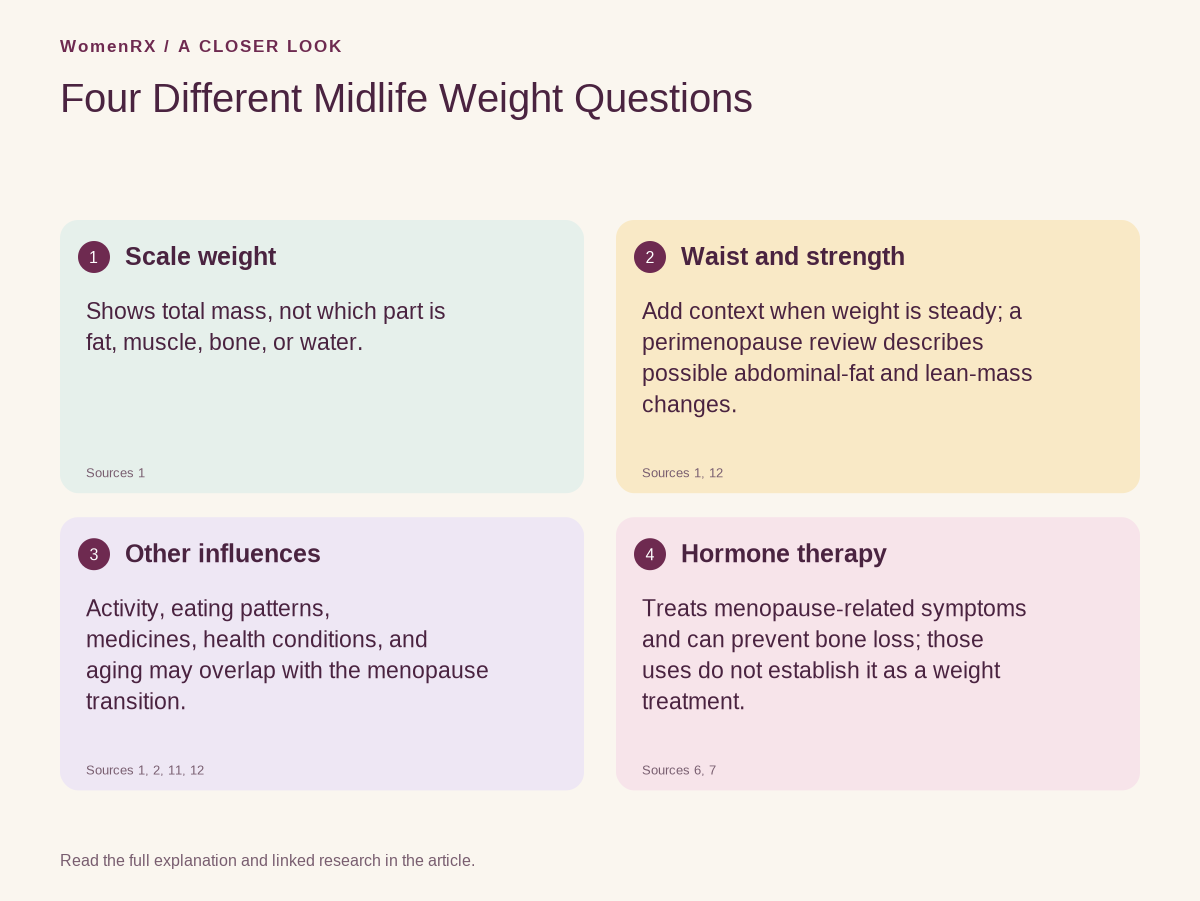
Four Different Midlife Weight Questions
Scale weight: Shows total mass, not which part is fat, muscle, bone, or water.1
Waist and strength: Add context when weight is steady; a perimenopause review describes possible abdominal-fat and lean-mass changes.112
Other influences: Activity, eating patterns, medicines, health conditions, and aging may overlap with the menopause transition.121112
Hormone therapy: Treats menopause-related symptoms and can prevent bone loss; those uses do not establish it as a weight treatment.67
Read the figure as text
These clues point to different questions; none identifies a single cause on its own.- Scale weight: Shows total mass, not which part is fat, muscle, bone, or water.1
- Waist and strength: Add context when weight is steady; a perimenopause review describes possible abdominal-fat and lean-mass changes.112
- Other influences: Activity, eating patterns, medicines, health conditions, and aging may overlap with the menopause transition.121112
- Hormone therapy: Treats menopause-related symptoms and can prevent bone loss; those uses do not establish it as a weight treatment.67
More questions, answered
Can my waist change if my weight stays the same?
Yes. The scale combines several body components, and a perimenopause review describes possible shifts in abdominal fat and lean mass without major weight change. Waist size offers another health clue, but it cannot identify the cause by itself. 112
Sources you can check
- Body Weight: MedlinePlusAccessed 2026-09-25Return to first citation
- Obesity: MedlinePlusAccessed 2026-09-25Return to first citation
- Dietary Supplements for Weight Loss - Health Professional Fact SheetAccessed 2026-09-25Return to first citation
- ZEPBOUND (TIRZEPATIDE) INJECTION, SOLUTION ZEPBOUND (TIRZEPATIDE) INJECTION, SOLUTION ZEPBOUND KWIKPEN (TIRZEPATIDE) INJECTION, SOLUTION [ELI LILLY AND COMPANY] | US prescribing information and patient instructionsAccessed 2026-09-25Return to first citation
- Impact of estrogens on resting energy expenditure: A systematic review.Weidlinger S, Winterberger K, Pape J, Weidlinger M, Janka H, von Wolff M, Stute P. · Obesity reviews : an official journal of the International Association for the Study of Obesity · 2023Return to first citation
- Impact of micronized progesterone on body weight, body mass index, and glucose metabolism: a systematic review.Coquoz A, Gruetter C, Stute P. · Climacteric : the journal of the International Menopause Society · 2019Return to first citation
- The 2022 hormone therapy position statement of The North American Menopause Society.“The 2022 Hormone Therapy Position Statement of The North American Menopause Society” Advisory Panel. · Menopause (New York, N.Y.) · 2022Return to first citation
- The 2023 nonhormone therapy position statement of The North American Menopause Society.Menopause (New York, N.Y.) · 2023Return to first citation
- Effectiveness of Low Doses of Semaglutide on Weight Loss and Body Composition Among Women in Their Menopause.Nicolau J, Blanco-Anesto J, Bonet A, Félix-Jaume JJ, Gil-Palmer A. · Metabolic syndrome and related disorders · 2025Return to first citation
- Impact of Diet Interventions for Weight Loss on Lean Body Mass and Resting Metabolic Rate: A Systematic Review.Lastovka N, Stanfar KL, Ghajar M, Bailey A, Byham-Gray LD, Radler DR. · Nutrition reviews · 2026Return to first citation
- Prevention of Obesity among Adults: Evidence- and Consensus-Based Guideline.von Philipsborn P, Bahlke M, Breidenassel C, Holzapfel C, Joisten C, Plachta-Danielzik S, Nothacker M, Rubin D, Rung-Friebe M, de Zwaan M, Hauner H. · Obesity facts · 2025Return to first citation
- Perimenopause and metabolic vulnerability: hormones, body composition and lifestyle changes.Lobato VA, Minari TP, Pisani LP. · Climacteric : the journal of the International Menopause Society · 2026Return to first citation