Perimenopause and Weight: What May Change
The scale can stay nearly the same while body fat, muscle, or where you carry fat shifts.
Perimenopause doesn’t bring one predictable amount or duration of weight gain. In a small study that followed women across menopause, average scale weight changed little over about five years, even as fat mass rose and lean mass fell. That’s why weight, body composition, and waist measurement tell different parts of the story. A useful next step is to consider the trend and your overall health, not just one number. 3
Three measurements, three different stories
Weight is the total of muscle, bone, fat, and water. It can be useful to notice a trend, but it can’t show what changed inside that total. Body composition separates fat from lean tissue; a waist measurement offers a different clue about fat carried around the abdomen. None of these measures, by itself, describes your whole health. 1
That distinction matters around menopause. In a prospective study of 97 women measured before and after menopause, about five years apart, average body weight changed very little and the difference wasn’t statistically significant. Yet total fat mass increased by 1.3 kilograms and lean mass decreased by 0.4 kilograms. The proportional increase was greatest for visceral fat, the fat around internal organs. These are group averages from a small study, not a forecast for any one woman. 3
So, a stable scale number doesn’t necessarily mean your body composition stayed the same. And if your waist measurement changes, that tells you something different from a change in total weight. Waist circumference can help put abdominal fat in context, but it isn’t a direct measure of total body fat or a diagnosis. 1
Is menopause the cause, or one part of the picture?
It can be hard to separate menopause-stage changes from aging, because they happen over the same years. A study following women across menopause found changes in fat and lean mass even though scale weight barely changed; it did not establish that menopause alone caused those changes. 3 A separate study of women after surgically induced menopause also notes that aging and menopause can be difficult to disentangle. Its results concern a particular group considering ovarian surgery, so they aren’t a simple guide to natural perimenopause. 4
Your own weight can also reflect diet, family history, and genetics. A change in health or medication may matter too, and an unexplained sudden change deserves attention rather than an automatic menopause explanation. 1 Sleep, activity, and daily demands can be useful context when you look back at when a change began, but the research summarized here doesn’t tell us how much each one contributes to weight changes during perimenopause.
There isn’t a dependable menopause countdown that predicts when your weight or waist will change, or when a change will stop. The available studies describe different groups and outcomes, not a universal timeline for an individual woman.
A practical way to take stock
If you want to understand a change, start with the question you’re trying to answer. If it’s whether your overall weight is trending up or down, the scale may help. If the number is steady but your shape or strength feels different, weight alone can’t resolve that question. If abdominal change is your concern, waist measurement may add context, though it still isn’t a complete health assessment. BMI has a similar limitation: it doesn’t distinguish fat from muscle or bone. 1
Next, place the change in context. Consider when it started, whether there were changes in health or medication, and whether your routines or circumstances shifted. You don’t need to turn this into a perfect tracking project. A few observations can help you decide whether a change is gradual, sudden, or connected to something else.
If your goal is to support strength and body composition, resistance and weight-bearing exercise are one practical area to consider. In a secondary analysis of a randomized trial, 276 postmenopausal women with osteopenia were assigned to exercise, medication, or control groups. Over 12 months, the exercise group gained more lean mass on average than the control group. That study supports a possible lean-mass benefit in that specific population; it does not show that exercise will cause weight loss or produce the same result for everyone. 5 Choose activity that fits your body and circumstances rather than treating the study as a required routine.
Nutrition and activity can be part of weight management, but the right goal depends on your health and what you want to change. 1 Menopausal hormone therapy is used for indications such as bothersome hot flashes and prevention of bone loss in appropriate women; the menopause position statement doesn’t present it as a weight-loss treatment. 2
If you have a sudden, unexplained weight change, or want help making sense of weight alongside your health history, bring that specific concern to your care team. 1 The useful question isn’t only “What does the scale say?” It’s “What changed, which measure reflects it, and what would I like to improve?”
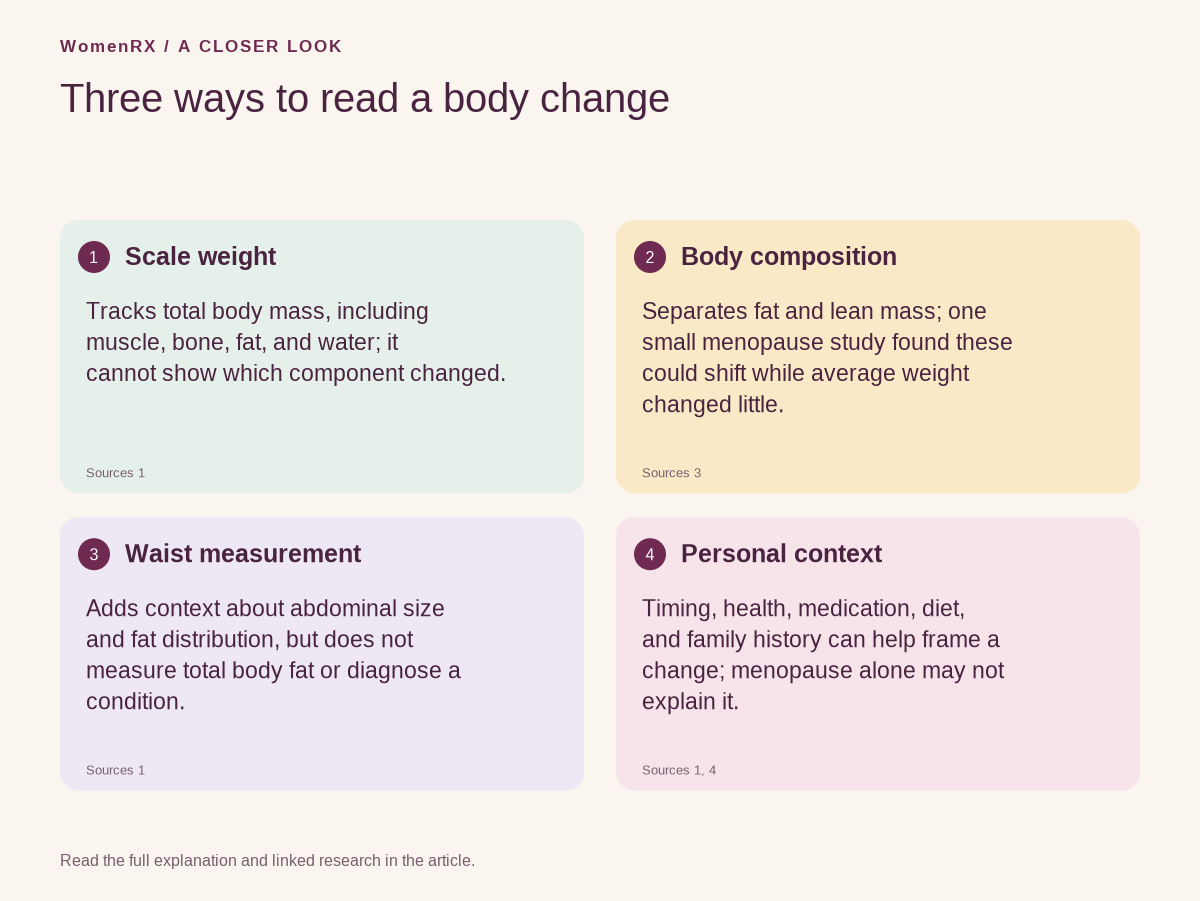
Three ways to read a body change
Scale weight: Tracks total body mass, including muscle, bone, fat, and water; it cannot show which component changed.1
Body composition: Separates fat and lean mass; one small menopause study found these could shift while average weight changed little.3
Waist measurement: Adds context about abdominal size and fat distribution, but does not measure total body fat or diagnose a condition.1
Personal context: Timing, health, medication, diet, and family history can help frame a change; menopause alone may not explain it.14
Read the figure as text
These measures answer different questions. None tells the whole story alone.- Scale weight: Tracks total body mass, including muscle, bone, fat, and water; it cannot show which component changed.1
- Body composition: Separates fat and lean mass; one small menopause study found these could shift while average weight changed little.3
- Waist measurement: Adds context about abdominal size and fat distribution, but does not measure total body fat or diagnose a condition.1
- Personal context: Timing, health, medication, diet, and family history can help frame a change; menopause alone may not explain it.14
More questions, answered
Can my weight stay the same while my body changes?
Yes. In one small study of women followed across menopause, average weight changed little while fat mass rose and lean mass fell. A scale cannot distinguish those tissues. 3 1
Is menopausal hormone therapy a weight-loss treatment?
No. The menopause position statement describes hormone therapy for concerns such as bothersome hot flashes and prevention of bone loss in appropriate women, not as a weight-loss treatment. 2
Sources you can check
- Body Weight: MedlinePlusAccessed 2026-09-25Return to first citation
- The 2022 hormone therapy position statement of The North American Menopause Society.“The 2022 Hormone Therapy Position Statement of The North American Menopause Society” Advisory Panel. · Menopause (New York, N.Y.) · 2022Return to first citation
- A prospective study of the relationships between change in body composition and cardiovascular risk factors across the menopause.Dehghan A, Vasan SK, Fielding BA, Karpe F. · Menopause (New York, N.Y.) · 2021Return to first citation
- WHAM-A Prospective Study of Weight and Body Composition After Risk-Reducing Bilateral Salpingo-oophorectomy.Price SAL, Finch S, Krejany E, Jiang H, Kale A, Domchek S, Wrede D, Wark JD, Hickey M. · The Journal of clinical endocrinology and metabolism · 2023Return to first citation
- Risedronate or Exercise for Lean Mass Preservation During Menopause: Secondary Analysis of a Randomized Controlled Trial.Flores LE, Kupzyk K, Waltman N, Beavers KM, Bilek L. · JCSM rapid communications · 2022Return to first citation