Why Desire Can Change During Perimenopause
Perimenopause can play a part, while discomfort, mood, health, medicines, and relationship context may also matter.
A drop in sexual desire can happen during perimenopause, but it isn’t automatically caused by hormones or a problem that needs fixing. Health, vaginal discomfort, mood, medicines, and relationship context may all be relevant. If the change bothers you, noticing what changed alongside it can help you ask more focused questions. 1 3 5 6
Desire is one part of sexual function
Wanting sex, having sex, enjoying it, and feeling satisfied are related but different experiences. A change in desire doesn’t necessarily mean sexual activity or pleasure has changed in the same way. In a large US study that followed women through midlife, desire declined by late perimenopause, while the transition itself wasn’t independently associated with several other measures, including sexual frequency, arousal, and satisfaction. Health, psychological functioning, relationship changes, and vaginal dryness were also associated with sexual function. 5
That’s why “Is this just hormones?” can be too narrow a question. Perimenopause may be part of the picture, but it doesn’t explain every change in desire.
Look for what changed around the same time
Pain, dryness, or less comfortable sex. Desire may feel different when sexual activity has become uncomfortable. In the US SWAN cohort, vaginal or pelvic pain increased and desire decreased by late perimenopause; vaginal dryness was also associated with sexual function. If you have dryness or pain, describe that directly rather than treating it as a separate, unimportant detail. 5 6
Mood, stress, and overall health. Psychological functioning and health were related to sexual-function measures in the SWAN study. Chronic conditions can also affect sexual health. This doesn’t mean a mood or health condition is necessarily the cause; it means changes in mood, stress, energy, or health are relevant context, not distractions from a hormone question. 1 5
Medicines. Some medicines can affect sexual desire or performance, and antidepressants are specifically mentioned among possible contributors in a review of perimenopausal sexual concerns. If your desire changed after a medicine was started or adjusted, note that timing and ask whether it could be relevant. 1 7
Relationship and personal context. Relationship factors, how important sex feels to you, and attitudes toward sex and aging were strongly associated with several sexual-function measures in SWAN. Your circumstances, preferences, and sense of connection belong in the assessment too. A lower level of desire isn’t, by itself, proof that something is wrong with you or your relationship. 6 7
Sleep as context. One observational study of partnered Chinese women aged 40 to 65 found an association between sleep disorders and low sexual frequency. That cited finding concerns sexual frequency, not desire, and it can’t show that sleep problems caused lower frequency. If your sleep changed too, you can mention it without assuming it explains your desire. 4
Make the pattern easier to describe
Before raising the change, consider what it looks like in your own life. For example, you might feel interested in intimacy but avoid it because sex has become painful, or notice that your desire changed after starting a medicine. These observations don’t establish a cause, but they can help make the conversation more specific.
Useful details to bring up include when the change began, whether it feels distressing to you, whether pain or dryness is present, what has changed with sleep or mood, and whether a new health issue or medicine overlapped with it. You don’t need to decide on a cause first. The aim is to make the conversation specific enough to explore plausible contributors together.
If dryness or pain is part of the problem, ask about that symptom specifically. Menopause guidance includes treatments for bothersome genitourinary symptoms, but the best option depends on the symptom and the person. Menopausal hormone therapy is not a one-size-fits-all answer to lower desire; its benefits and risks depend on individual circumstances and the reason it’s being considered. 2
When it’s worth raising
You don’t need to seek treatment just because your desire differs from someone else’s or from an earlier stage of your life. It’s worth bringing up when the change is persistent and distressing to you, when it affects intimacy in a way you want help with, or when pain, dryness, mood changes, sleep problems, a health condition, or a medicine change may be involved. A review of sexual function through menopause describes evaluation across distinct areas, including desire, arousal, pain, satisfaction, and orgasm, rather than treating them as one issue. 3
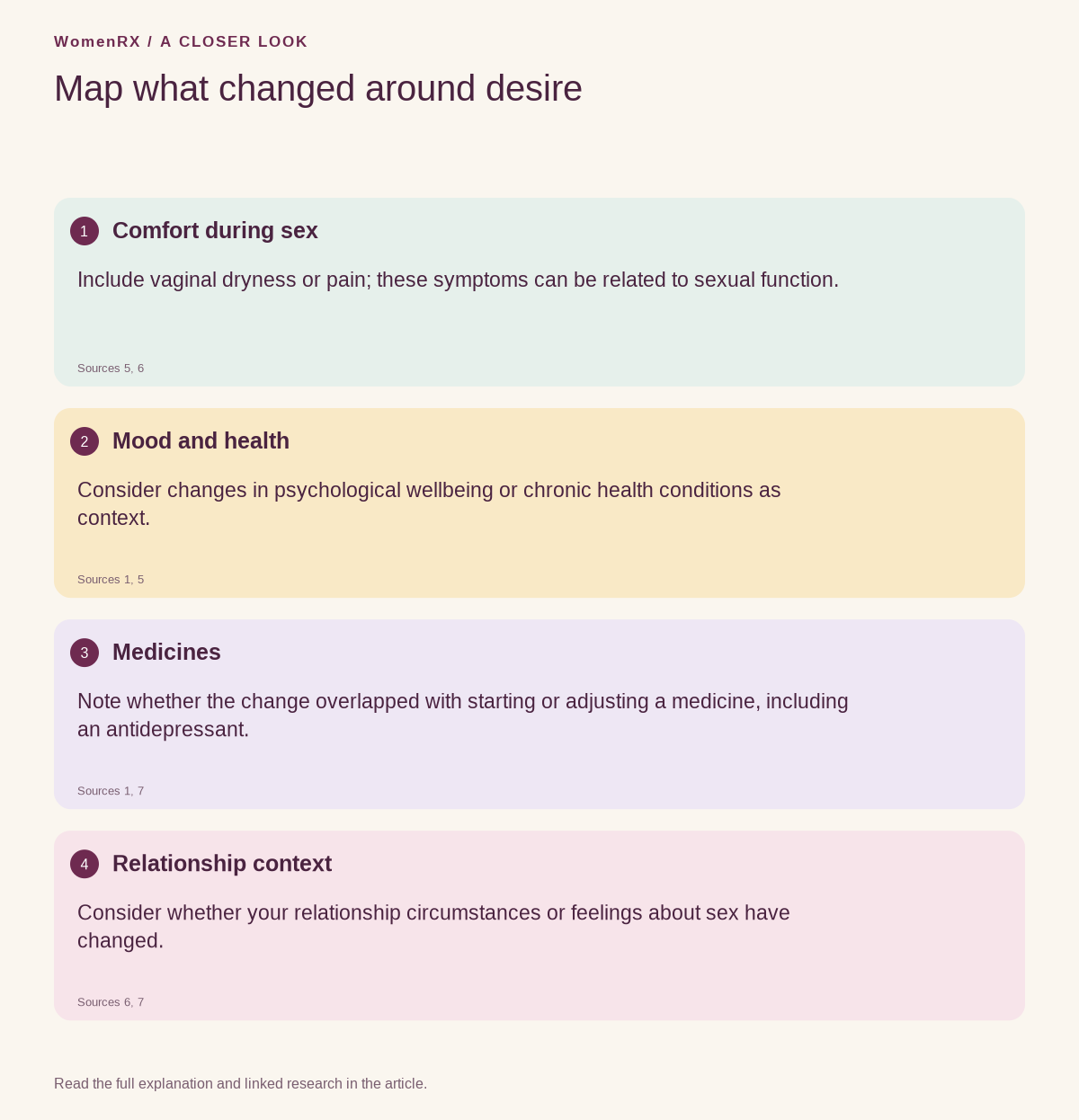
Map what changed around desire
Comfort during sex: Include vaginal dryness or pain; these symptoms can be related to sexual function.56
Mood and health: Consider changes in psychological wellbeing or chronic health conditions as context.15
Medicines: Note whether the change overlapped with starting or adjusting a medicine, including an antidepressant.17
Relationship context: Consider whether your relationship circumstances or feelings about sex have changed.67
Read the figure as text
Use these prompts to notice what changed alongside desire. More than one factor may be relevant, and the list is not a diagnostic test.- Comfort during sex: Include vaginal dryness or pain; these symptoms can be related to sexual function.56
- Mood and health: Consider changes in psychological wellbeing or chronic health conditions as context.15
- Medicines: Note whether the change overlapped with starting or adjusting a medicine, including an antidepressant.17
- Relationship context: Consider whether your relationship circumstances or feelings about sex have changed.67
More questions, answered
Does less sexual activity mean I’ve lost desire?
Not necessarily. Sexual frequency and desire are separate measures, so frequency alone doesn’t tell the whole story. 4 5 For example, sex might happen less often because a partner isn’t available, even if your desire hasn’t changed.
Should I assume hormones are the reason?
No. Desire can change during the transition, but studies also link sexual function with health, psychological, relationship, and vaginal symptoms. Hormonal changes may be one contributor among several. 5 6 7
Sources you can check
- Sexual Health | MedlinePlusAccessed 2026-09-25Return to first citation
- The 2022 hormone therapy position statement of The North American Menopause Society.“The 2022 Hormone Therapy Position Statement of The North American Menopause Society” Advisory Panel. · Menopause (New York, N.Y.) · 2022Return to first citation
- Sexual Function Through Menopause: A Review of Basic Evaluation and Treatment.Pope R. · BJOG : an international journal of obstetrics and gynaecology · 2025Return to first citation
- Prevalence and predictors of sexual function in midlife partnered Chinese women assessed by two simple indicators: Sexual frequency and sexual desire.Zhou Y, Li C, Jin F, Shao H, Teng Y, Tao M. · The journal of obstetrics and gynaecology research · 2019Return to first citation
- Longitudinal changes in sexual functioning as women transition through menopause: results from the Study of Women's Health Across the Nation.Avis NE, Brockwell S, Randolph JF, Shen S, Cain VS, Ory M, Greendale GA. · Menopause (New York, N.Y.) · 2009Return to first citation
- Correlates of sexual function among multi-ethnic middle-aged women: results from the Study of Women's Health Across the Nation (SWAN).Avis NE, Zhao X, Johannes CB, Ory M, Brockwell S, Greendale GA. · Menopause (New York, N.Y.) · 2018Return to first citation
- Sex and perimenopause.Davis SR, Jane F. · Australian family physician · 2011Return to first citation