Testosterone or Menopause Hormone Therapy for Low Desire?
Menopause hormone therapy and testosterone can have different jobs: one treats menopausal symptoms, while testosterone may help some postmenopausal women with persistent, distressing low desire.
Menopausal hormone therapy (MHT) is mainly used for symptoms such as hot flashes and vaginal or urinary changes; it doesn’t reliably treat low desire itself. Testosterone may improve desire for some postmenopausal women whose low desire is persistent and distressing, but it isn’t a routine treatment for every woman. The evidence is less clear for women in perimenopause, and a testosterone level alone doesn’t explain desire. 2 5
Start with what’s affecting sex
A change in desire can be frustrating, especially when it feels different from what you want for yourself or your relationship. Clinicians may use the term hypoactive sexual desire disorder (HSDD) when low desire is persistent and causes personal distress. The distress matters: a lower level of desire by itself doesn’t mean you need treatment. 4
Before comparing hormones, separate low desire from problems that make sex uncomfortable or less appealing. Menopause-related vaginal symptoms can affect sexual comfort, and medicines or chronic health conditions can also affect sexual health. It can help to identify whether the main issue is desire, discomfort, hot flashes or another symptom, or a mix. 1 2
For example, you might bring up whether sex has become painful or dry, whether hot flashes are disrupting sleep, and whether a medicine or health condition changed around the same time as your desire. These are starting points for a conversation, not a checklist that diagnoses the cause.
MHT treats menopausal symptoms, not desire directly
Menopausal hormone therapy is the most effective treatment for hot flashes and other vasomotor symptoms, and it can help genitourinary symptoms of menopause. For bothersome vaginal or urinary symptoms, the best-fitting option may differ from systemic hormone therapy; low-dose vaginal estrogen is one option described in menopause guidance when over-the-counter therapies haven’t helped. 2
That doesn’t make MHT a reliable direct treatment for low desire. A review reports that estrogen can ease vaginal symptoms but does not itself improve sexual desire. If discomfort is making sex less appealing, treating that discomfort may still matter, even if desire remains a separate concern. 5
The benefits and risks of systemic MHT vary with factors including the type and route of therapy, timing, and whether a progestogen is used. Its purpose should match the symptoms being treated, with the decision individualized rather than based on low desire alone. 2
Where testosterone may fit
Testosterone is considered differently: research reviews report improved sexual desire and more satisfying sexual experiences in postmenopausal women treated for distressing low desire. That evidence doesn’t mean testosterone is appropriate for everyone with a lower libido, or that it works as a general energy or menopause treatment. 5
A blood testosterone result isn’t a stand-alone explanation or diagnosis. The review found no clear relationship between circulating testosterone levels and sexual desire, even though trials of testosterone treatment reported benefits. The decision is about the persistent, distressing symptom and the overall picture, not simply whether a lab result looks low. 5
The evidence is most relevant to postmenopausal women. A systematic review of studies after surgical menopause and ovary removal also found possible improvements in desire, but noted that the studies were few and varied, and that bias could not be ruled out. These findings don’t establish the same benefit for women in perimenopause. 3
Testosterone is not routine MHT. If it’s being considered, ask what benefit is realistic for your situation, what monitoring is planned, and how side effects will be checked. The review describes monitoring side effects and hormone levels; it does not establish that a particular blood level can predict whether desire will improve. 5
A useful comparison to take into the conversation
- Name the main problem: Is it low desire, vaginal discomfort, hot flashes, or more than one of these?
- Look for other contributors: Review medicines and health conditions that could affect sexual health, and mention changes in comfort or menopause symptoms. 1 2
- Match treatment to purpose: Ask whether the goal is relief of menopausal symptoms, vaginal comfort, or improvement in persistent, distressing low desire.
- Clarify the evidence: If testosterone is raised, ask how the postmenopausal evidence applies to your stage of menopause and what monitoring would involve. 3 5
The practical distinction is simple: MHT may address symptoms that interfere with sex, while testosterone may be considered for a narrower situation, persistent and distressing low desire after menopause. Neither label replaces a discussion of what’s actually changed for you.
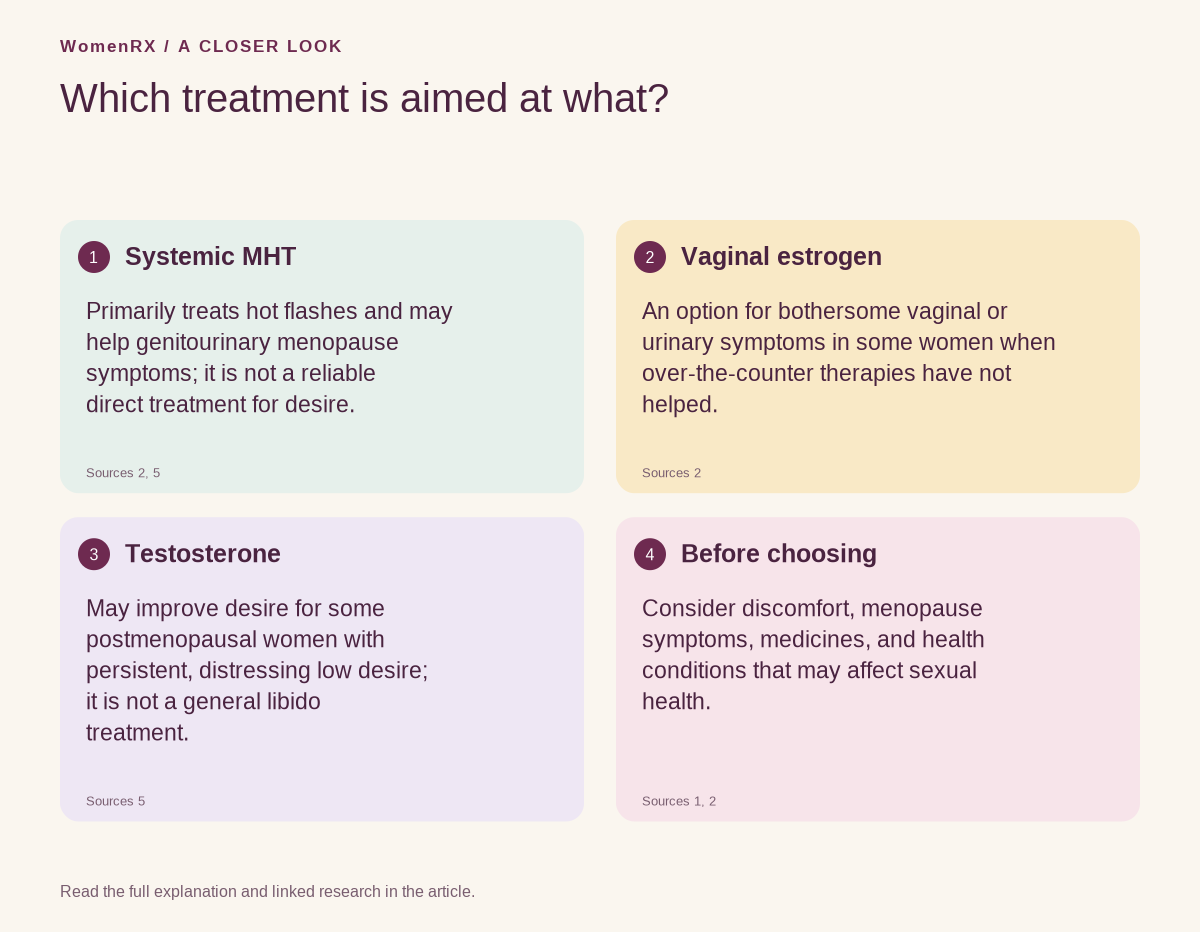
Which treatment is aimed at what?
Systemic MHT: Primarily treats hot flashes and may help genitourinary menopause symptoms; it is not a reliable direct treatment for desire.25
Vaginal estrogen: An option for bothersome vaginal or urinary symptoms in some women when over-the-counter therapies have not helped.2
Testosterone: May improve desire for some postmenopausal women with persistent, distressing low desire; it is not a general libido treatment.5
Before choosing: Consider discomfort, menopause symptoms, medicines, and health conditions that may affect sexual health.12
Read the figure as text
The distinction is the treatment goal: menopausal symptoms, vaginal comfort, or persistent distressing low desire.- Systemic MHT: Primarily treats hot flashes and may help genitourinary menopause symptoms; it is not a reliable direct treatment for desire.25
- Vaginal estrogen: An option for bothersome vaginal or urinary symptoms in some women when over-the-counter therapies have not helped.2
- Testosterone: May improve desire for some postmenopausal women with persistent, distressing low desire; it is not a general libido treatment.5
- Before choosing: Consider discomfort, menopause symptoms, medicines, and health conditions that may affect sexual health.12
More questions, answered
Can a testosterone blood test tell me why my desire is low?
Not by itself. A review found no clear relationship between circulating testosterone levels and sexual desire in women, so a test result alone cannot explain the symptom or determine whether treatment will help. 5
Sources you can check
- Sexual Health | MedlinePlusAccessed 2026-09-25Return to first citation
- The 2022 hormone therapy position statement of The North American Menopause Society.“The 2022 Hormone Therapy Position Statement of The North American Menopause Society” Advisory Panel. · Menopause (New York, N.Y.) · 2022Return to first citation
- Surgical Menopause and Bilateral Oophorectomy: Effect of Estrogen-Progesterone and Testosterone Replacement Therapy on Psychological Well-being and Sexual Functioning; A Systematic Literature Review.Stuursma A, Lanjouw L, Idema DL, de Bock GH, Mourits MJE. · The journal of sexual medicine · 2022Return to first citation
- A Single Centre Study to Describe the Changes in Serum Testosterone Concentration Following Application of Testosterone Gel in Post-Menopausal Women With Hypoactive Sexual Desire Disorder (HSSD) Already Receiving This as Part of Usual Care in Conjunction With Oestrogen-Containing Hormone Replacement Treatment (HRT).Heald A, Illangasekera Y, Rehman H, Livingston M, Keen A, Kochhar R, Panay N, Borzomato J, Mordaunt M, Taylor P, Hackett G. · Clinical endocrinology · 2026Return to first citation
- The role of testosterone in menopausal hormone treatment. What is the evidence?Johansen N, Lindén Hirschberg A, Moen MH. · Acta obstetricia et gynecologica Scandinavica · 2020Return to first citation