Can Menopause Hormone Therapy Help With Low Desire?
Estrogen may help with sexual comfort, but feeling more comfortable and feeling more desire aren’t the same thing.
Sometimes hormone therapy helps, but the answer depends on what’s changed. Estrogen alone may slightly improve overall sexual function for women with menopause symptoms or in early postmenopause, especially through improvements in lubrication, pain, and satisfaction. That doesn’t establish a reliable boost in desire. Vaginal estrogen and vaginal prasterone address bothersome genitourinary symptoms, not desire itself. 2 4
If your interest in sex has changed, you don’t have to decide first whether it’s “normal.” A more useful starting point is whether the change bothers you, and which part of sex or intimacy feels different. Desire, arousal, lubrication, comfort, and satisfaction are related, but they aren’t interchangeable. Menopause-related sexual concerns can involve physical changes alongside psychological and relationship factors. 5
What estrogen may change, and what it may not
Systemic hormone therapy affects more than the vaginal tissues and is an established treatment for bothersome menopause symptoms. Its effect on sexual desire is less clear. In a Cochrane review of randomized trials, estrogen alone probably slightly improved a combined sexual-function score, particularly among women with menopause symptoms or in early postmenopause. The review highlighted lubrication, pain, and satisfaction. An improvement in that combined score doesn’t mean estrogen reliably increases desire itself. 2 4
The distinction matters if low desire is your main concern. For example, if discomfort has made sexual contact less appealing, treating the discomfort may address a meaningful barrier. If you’re comfortable but miss your former level of interest, a treatment that mainly helps lubrication may not answer your question.
The trials also leave some uncertainty about who benefits. Of the 36 studies in the Cochrane review, 35 studied postmenopausal women and only one studied women in perimenopause. None enrolled only women with sexual dysfunction. For estrogen combined with a progestogen, the review could not establish whether overall sexual function improved in unselected postmenopausal women. These findings aren’t a reason to assume that every form of menopausal hormone therapy has the same effect on desire. 4
If dryness or pain is getting in the way
Name dryness, pain, or discomfort separately from desire. That helps identify a treatment aimed at the symptom you’re experiencing rather than treating every sexual concern as a libido problem.
For bothersome genitourinary symptoms that haven’t improved with over-the-counter options, low-dose vaginal estrogen or vaginal dehydroepiandrosterone, also called prasterone, may be options when there’s no other reason to use systemic hormone therapy. These local treatments target genitourinary symptoms; they shouldn’t be presented as direct treatments for low desire. Relief of discomfort could make intimacy more appealing for some women, but that’s a possible indirect change, not a promised result. 2
When the bigger picture matters more
Hormones aren’t the only possible contributor. Medicines can affect sexual desire, and sexual function during menopause can also be shaped by psychological factors and relationship dynamics. None of those possibilities should be assumed to explain your experience. 1 5
Think about what you’d most like to change. Did interest shift around the time a medicine changed? Are you interested in intimacy but avoiding contact because it hurts? Or is desire lower even when comfort isn’t an issue? These are different conversations. If bothersome hot flashes or night sweats are part of the picture, systemic hormone therapy may be considered for those symptoms on their own merits, with benefits and risks weighed for your circumstances. It still shouldn’t be treated as a guaranteed libido treatment. 2
Where testosterone fits
Testosterone is sometimes raised in conversations about persistent, distressing low desire, but it isn’t a universal next step after estrogen. A systematic review of trials in women after surgical menopause or removal of both ovaries found an improvement in sexual desire with testosterone over the medium term. The studies were few and varied, and the reviewers cautioned that bias could not be ruled out. That result doesn’t tell us that the same approach will help every woman in natural perimenopause or postmenopause. 3
You can ask a focused question without taking on a diagnosis: “Is the treatment we’re discussing meant to help my comfort, my other menopause symptoms, or desire itself?” The answer makes it easier to judge whether an option fits what you actually want help with.
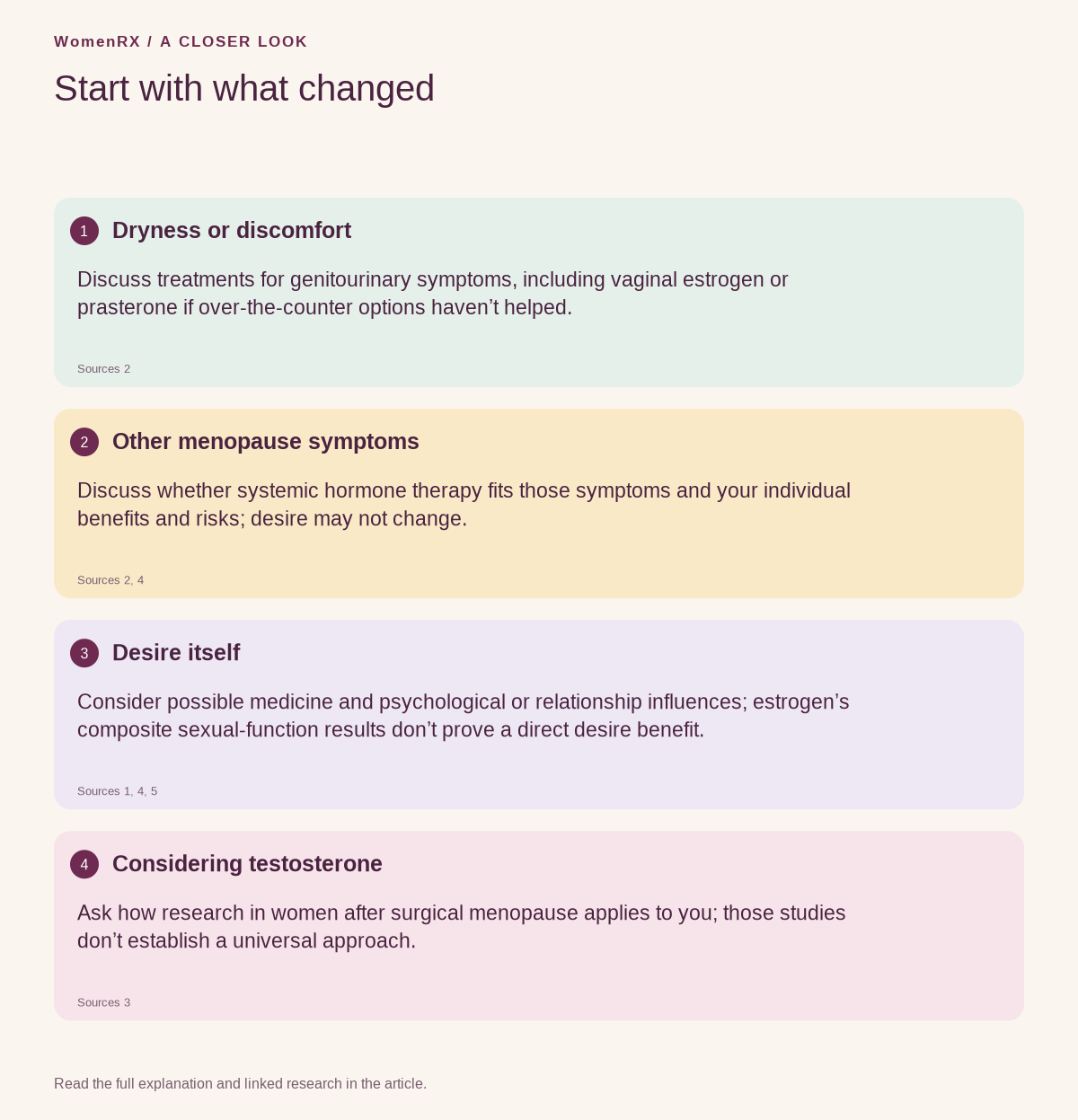
Start with what changed
Dryness or discomfort: Discuss treatments for genitourinary symptoms, including vaginal estrogen or prasterone if over-the-counter options haven’t helped.2
Other menopause symptoms: Discuss whether systemic hormone therapy fits those symptoms and your individual benefits and risks; desire may not change.24
Desire itself: Consider possible medicine and psychological or relationship influences; estrogen’s composite sexual-function results don’t prove a direct desire benefit.145
Considering testosterone: Ask how research in women after surgical menopause applies to you; those studies don’t establish a universal approach.3
Read the figure as text
Different concerns point to different treatment conversations; this is a guide to describing the problem, not a diagnostic test.- Dryness or discomfort: Discuss treatments for genitourinary symptoms, including vaginal estrogen or prasterone if over-the-counter options haven’t helped.2
- Other menopause symptoms: Discuss whether systemic hormone therapy fits those symptoms and your individual benefits and risks; desire may not change.24
- Desire itself: Consider possible medicine and psychological or relationship influences; estrogen’s composite sexual-function results don’t prove a direct desire benefit.145
- Considering testosterone: Ask how research in women after surgical menopause applies to you; those studies don’t establish a universal approach.3
Sources you can check
- Sexual Health | MedlinePlusAccessed 2026-09-25Return to first citation
- The 2022 hormone therapy position statement of The North American Menopause Society.“The 2022 Hormone Therapy Position Statement of The North American Menopause Society” Advisory Panel. · Menopause (New York, N.Y.) · 2022Return to first citation
- Surgical Menopause and Bilateral Oophorectomy: Effect of Estrogen-Progesterone and Testosterone Replacement Therapy on Psychological Well-being and Sexual Functioning; A Systematic Literature Review.Stuursma A, Lanjouw L, Idema DL, de Bock GH, Mourits MJE. · The journal of sexual medicine · 2022Return to first citation
- Hormone therapy for sexual function in perimenopausal and postmenopausal women.Lara LA, Cartagena-Ramos D, Figueiredo JB, Rosa-E-Silva ACJ, Ferriani RA, Martins WP, Fuentealba-Torres M. · The Cochrane database of systematic reviews · 2023Return to first citation
- Sexual Function Through Menopause: A Review of Basic Evaluation and Treatment.Pope R. · BJOG : an international journal of obstetrics and gynaecology · 2025Return to first citation