Low Libido Around Menopause: Do Supplements Help?
A small ginseng trial found an improvement in overall sexual function, but it can’t tell you whether a supplement will help with desire.
Maybe, but the evidence is too limited to count on a supplement for low desire around menopause. One small trial found better overall sexual-function scores with ginseng, without establishing a separate benefit for desire. 3 Before buying something, work out whether the change is in interest, arousal, comfort, or several things at once. Medicines and menopausal vaginal symptoms can call for different approaches. 1 5
You don’t need to want sex a certain number of times to be healthy. If a change in desire bothers you, though, it’s worth getting specific about what feels different. A supplement advertised for “sexual function” might not address the part you want help with.
Is it desire, arousal, or discomfort?
Less interest means sex appeals to you less than it used to. Arousal is different: you may want intimacy but find that your physical response doesn’t follow. Dryness or pain is different again. These experiences can overlap, so the question isn’t which single label fits. It’s which change you’d most like to address.
For example, if you’re interested in sex but discomfort makes you hesitate, a libido product misses the immediate problem. Menopause guidance addresses bothersome genitourinary symptoms with treatments distinct from desire treatment. It recommends considering vaginal estrogen, vaginal DHEA, or oral ospemifene when over-the-counter measures haven’t relieved those symptoms and systemic hormone therapy isn’t otherwise indicated. 5 If arousal, rather than dryness, is the concern, ask what you mean by that change: trouble feeling physically responsive, trouble staying engaged, or both. That description is more useful than assuming you need more lubrication.
Look at what changed around the same time
Medicines can affect sexual desire or performance, so a change that followed a new medicine or a change in treatment is worth raising before you add a supplement or stop the medicine yourself. 1
Mood and relationship context deserve room in the conversation, too, without being treated as automatic explanations. Have stress, low mood, poor sleep, conflict, or the amount of closeness you want changed? Would you still want help with desire if sex felt comfortable and you felt connected to your partner? Menopause care recognizes sleep and depression as concerns that may need their own attention, while sexual health includes affection and intimacy as well as sexual activity. 2 1
These questions aren’t a test for whether your desire is “normal.” They help you choose a next step that matches your experience, whether that’s talking with a partner about what you miss, discussing a possible medicine effect, or getting help for discomfort.
What do ginseng and maca tell us?
In one randomized trial, 62 postmenopausal women with sexual dysfunction received ginseng or placebo for four weeks. The ginseng group had a higher average score on a questionnaire of overall sexual function at the end of the trial. The reported result doesn’t isolate desire, show how long any benefit lasted, or establish that ginseng will help someone whose main concern is low interest. 3
If maca is the supplement you’re considering, don’t borrow the ginseng result as evidence for it. Likewise, a treatment result for vaginal DHEA says nothing about maca. Ask whether a claim for a maca product rests on research in menopausal women that measured desire itself, rather than a broad sexual-function score. The evidence for the other products discussed here cannot answer whether maca would help you. 3 5
DHEA is not one interchangeable product
Vaginal DHEA is discussed in menopause guidance as a treatment for genitourinary symptoms. That doesn’t establish that an over-the-counter DHEA supplement increases desire, or that different forms of DHEA can be used interchangeably. 5 4
Testosterone is a separate clinical treatment, not a supplement recommendation. A review reports benefit in carefully selected postmenopausal women with hypoactive sexual desire disorder after other contributors have been addressed. It also notes that long-term cardiovascular and breast cancer effects remain unknown and recommends clinical and laboratory monitoring. That evidence doesn’t make testosterone a general answer to changing desire during the menopause transition. 4
If you’re thinking of trying any product, bring its exact ingredient label and your medicine list to a pharmacist or clinician for an interaction and suitability check. Be clear about the outcome you’re hoping for: more interest, easier arousal, or less discomfort. That distinction can keep you from spending money on a product aimed at the wrong problem.
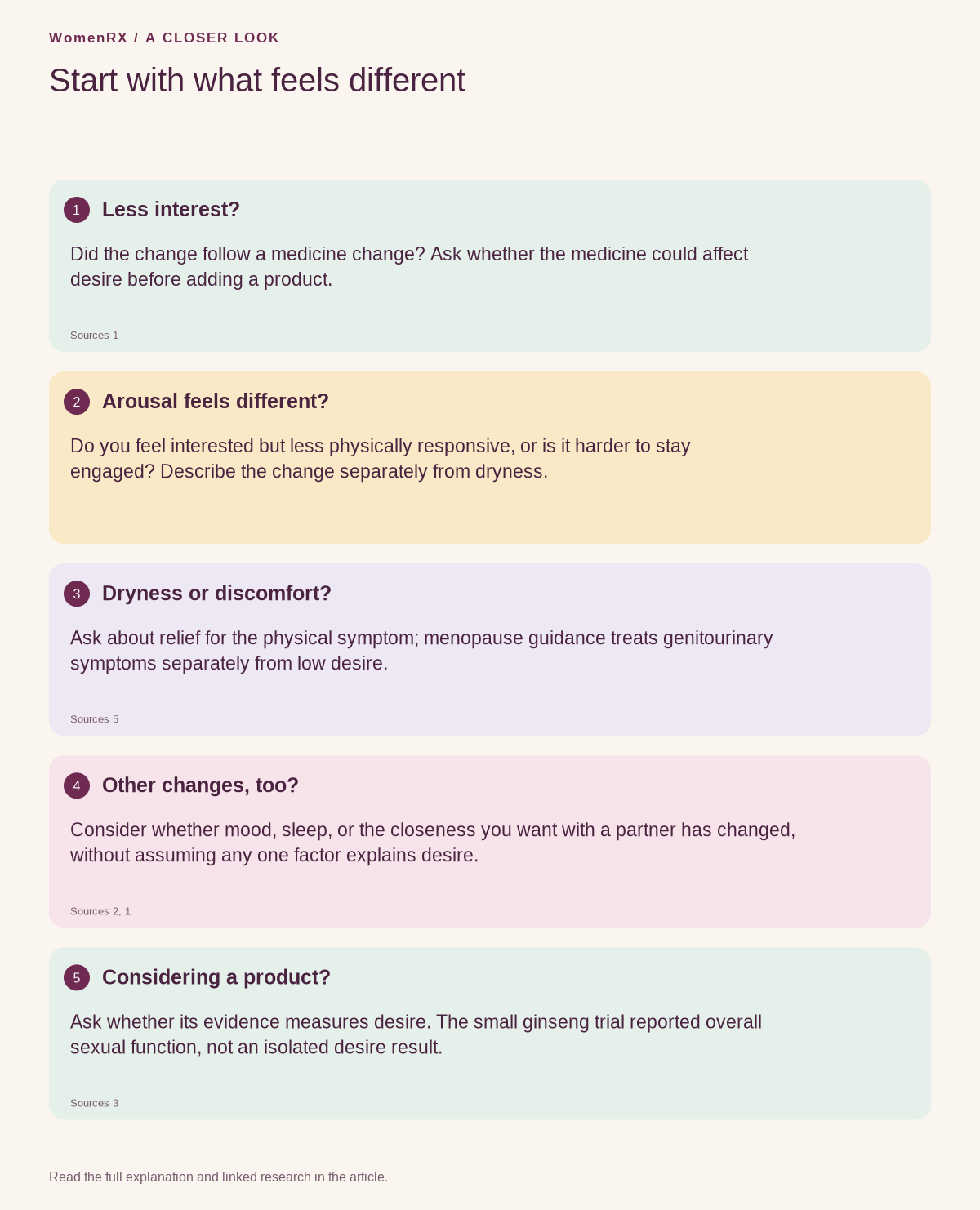
Start with what feels different
Less interest?: Did the change follow a medicine change? Ask whether the medicine could affect desire before adding a product.1
Arousal feels different?: Do you feel interested but less physically responsive, or is it harder to stay engaged? Describe the change separately from dryness.
Dryness or discomfort?: Ask about relief for the physical symptom; menopause guidance treats genitourinary symptoms separately from low desire.5
Other changes, too?: Consider whether mood, sleep, or the closeness you want with a partner has changed, without assuming any one factor explains desire.21
Considering a product?: Ask whether its evidence measures desire. The small ginseng trial reported overall sexual function, not an isolated desire result.3
Read the figure as text
Use the first question that fits your experience to choose a more relevant next conversation.- Less interest?: Did the change follow a medicine change? Ask whether the medicine could affect desire before adding a product.1
- Arousal feels different?: Do you feel interested but less physically responsive, or is it harder to stay engaged? Describe the change separately from dryness.
- Dryness or discomfort?: Ask about relief for the physical symptom; menopause guidance treats genitourinary symptoms separately from low desire.5
- Other changes, too?: Consider whether mood, sleep, or the closeness you want with a partner has changed, without assuming any one factor explains desire.21
- Considering a product?: Ask whether its evidence measures desire. The small ginseng trial reported overall sexual function, not an isolated desire result.3
Sources you can check
- Sexual Health | MedlinePlusAccessed 2026-09-25Return to first citation
- State of the art in menopause: current best practice approaches from the IMS World Congress 2024, Melbourne.Simon JA, Davis SR, Lindén Hirschberg A, Kiesel L, Pompei LM, Reginster JY, Simoncini T, Hillard T. · Climacteric : the journal of the International Menopause Society · 2025Return to first citation
- The effect of ginseng on sexual dysfunction in menopausal women: A double-blind, randomized, controlled trial.Ghorbani Z, Mirghafourvand M, Charandabi SM, Javadzadeh Y. · Complementary therapies in medicine · 2019Return to first citation
- Androgen Therapy in Women.Vegunta S, Kling JM, Kapoor E. · Journal of women's health (2002) · 2020Return to first citation
- The 2022 hormone therapy position statement of The North American Menopause Society.“The 2022 Hormone Therapy Position Statement of The North American Menopause Society” Advisory Panel. · Menopause (New York, N.Y.) · 2022Return to first citation