Low Desire: Natural Approaches Worth Considering
Sleep, stress, pain, relationships and medicines can all be part of the picture, but a plausible explanation isn’t proof that a natural remedy will help.
Start by looking for what’s affecting your desire, rather than assuming you need a supplement. Medicines, chronic health conditions and fear of an unplanned pregnancy can matter; pain may also occur alongside low desire. Lifestyle changes have some evidence for improving sexual function in midlife women with obesity, but that doesn’t prove they reliably increase desire. One small Shatavari trial is promising, not enough to establish broad benefit or safety. 1 2 3
Begin with the factor you can actually identify
Low desire isn’t one problem with one natural fix. A practical first step is to notice whether anything has changed around the same time: a medication, a chronic health condition, worry about an unplanned pregnancy, discomfort during sex, or stress in your relationship. These are different situations, and a supplement may not address the one that’s affecting you. MedlinePlus lists medicines, chronic diseases and pregnancy concerns among factors that can affect sexual health. Pain can also occur alongside reduced sexual interest, though that doesn’t tell you what is causing either one. 1 2
That gives you a useful checklist, not a score or a diagnosis:
- Medicines or health: Did the change in desire begin after a medication change or alongside a health problem? Medicines and chronic conditions can affect sexual health. 1
- Comfort: Is pain part of sex? Pain and reduced desire may occur together, so a product aimed at desire alone may miss the issue. 2
- Stress and relationship context: Is there tension or a change in how connected or comfortable you feel? In a study of couples being evaluated for unexplained infertility, relationship distress was associated with lower sexual functioning. Because the study was observational and focused on couples seeking fertility care, it can’t show that relationship distress caused low desire in other women. 4
- Sleep and daily life: Notice whether sleep or fatigue has changed, but don’t assume that fixing sleep will necessarily increase desire. A supplement trial reported improvements in both sleep-disturbance scores and sexual-function scores, but it didn’t establish that one caused the other. 2
What the evidence says about lifestyle and supplements
A 2026 narrative review reported that lifestyle interventions had improved sexual function in women with obesity, including in the context of midlife. That is a reason to see health-supporting lifestyle changes as potentially relevant, not a promise that exercise, weight loss or a particular diet will raise desire for every woman. The review also said that women’s sexual outcomes with GLP-1 medications remain largely uncharacterized; its proposed concerns about desire are not proof of a treatment effect. 3
The most direct supplement finding here is a randomized, placebo-controlled trial of Shatavari. It enrolled 70 healthy women aged 18 to 45 at one site in India, and compared the supplement with placebo over eight weeks. The supplement group had a greater improvement in total Female Sexual Function Index score; the largest improvement was in lubrication. That score covers sexual function broadly, so the result shouldn’t be read as proof that Shatavari specifically restores desire. 2
The trial is a reason to study Shatavari further, not a basis for assuming it will work for you. It was small and short, and its results don’t establish effects for women outside the study group. No serious adverse events were reported during the trial, but that doesn’t establish safety for pregnancy, breastfeeding, longer use, or use alongside other medicines. The study did not report findings by menopausal stage, so it also doesn’t establish Shatavari’s effects or safety for women in or after menopause. 2
Before trying a supplement, have a pharmacist or prescriber check the exact product and ingredients against your medicines and circumstances. That’s a practical precaution, not a finding that a particular product has an interaction. If you’re pregnant or breastfeeding, the Shatavari trial doesn’t establish safety for you. 2
A sensible way to decide what’s worth trying
- Name the change. Is the main issue desire, pain, arousal, or more than one? These can overlap, and a change in one doesn’t establish what’s behind another. 2
- Look for a matching context. Check for a medication or health change, pregnancy concerns, discomfort, or relationship stress before choosing a product. These factors point to different questions and potential next steps. 1 2 4
- Separate a general health goal from a promised libido effect. A change that supports your overall well-being may still be worthwhile, but that’s different from evidence that it increases desire. The lifestyle findings in midlife women concern sexual function broadly. 3
- Treat a supplement claim as a claim to verify. Look for a human study in a population like yours, an outcome that actually measures desire, and safety information for your situation. The Shatavari trial offers an early signal on sexual-function scores, not a settled answer about desire or safety. 2
If pain, a medication change, or a health condition seems connected to your low desire, focus on that connection rather than trying to cover it up with an unverified product. The useful next move depends on what you noticed.
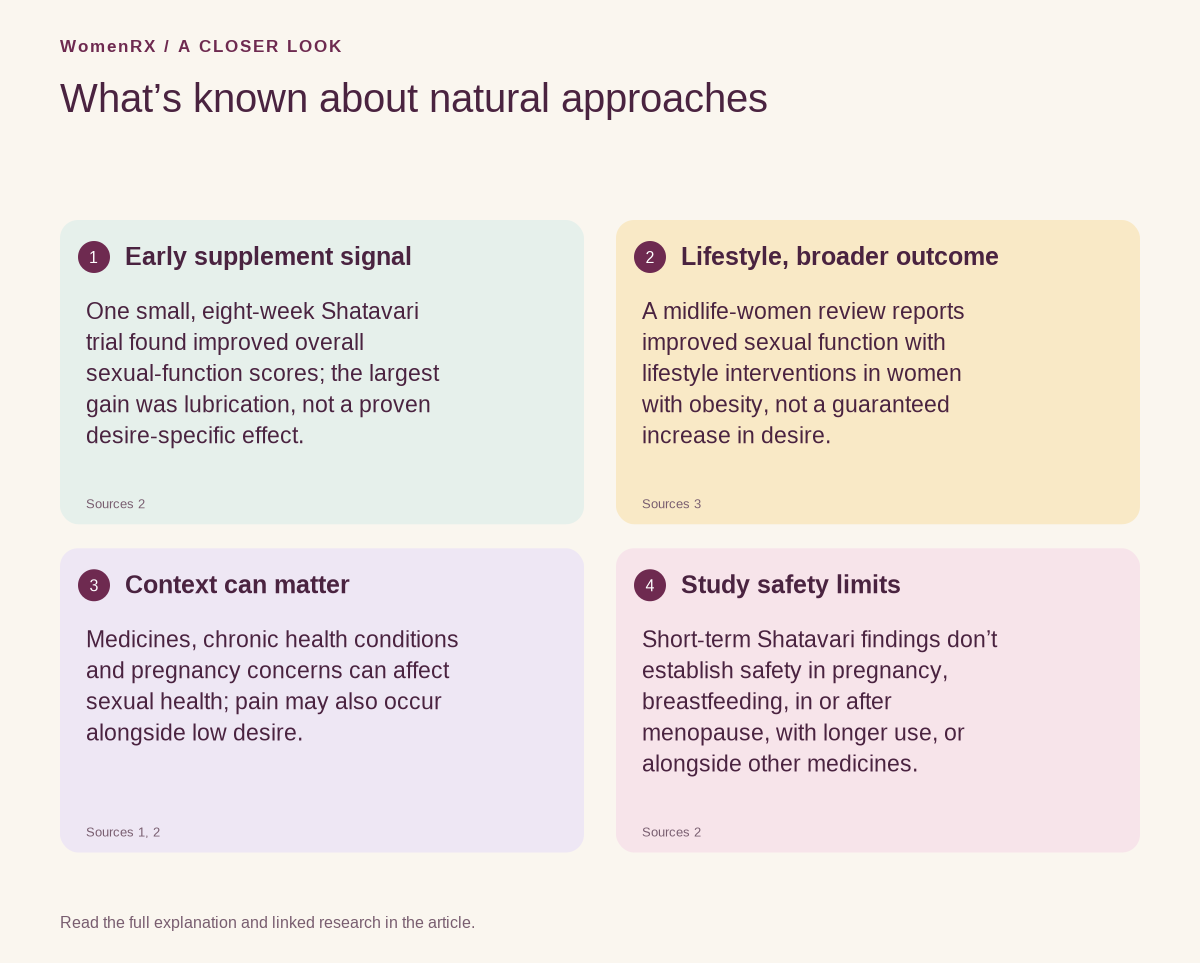
What’s known about natural approaches
Early supplement signal: One small, eight-week Shatavari trial found improved overall sexual-function scores; the largest gain was lubrication, not a proven desire-specific effect.2
Lifestyle, broader outcome: A midlife-women review reports improved sexual function with lifestyle interventions in women with obesity, not a guaranteed increase in desire.3
Context can matter: Medicines, chronic health conditions and pregnancy concerns can affect sexual health; pain may also occur alongside low desire.12
Study safety limits: Short-term Shatavari findings don’t establish safety in pregnancy, breastfeeding, in or after menopause, with longer use, or alongside other medicines.2
Read the figure as text
An early supplement trial and broader lifestyle findings answer different questions. The limits matter when weighing a product claim.- Early supplement signal: One small, eight-week Shatavari trial found improved overall sexual-function scores; the largest gain was lubrication, not a proven desire-specific effect.2
- Lifestyle, broader outcome: A midlife-women review reports improved sexual function with lifestyle interventions in women with obesity, not a guaranteed increase in desire.3
- Context can matter: Medicines, chronic health conditions and pregnancy concerns can affect sexual health; pain may also occur alongside low desire.12
- Study safety limits: Short-term Shatavari findings don’t establish safety in pregnancy, breastfeeding, in or after menopause, with longer use, or alongside other medicines.2
More questions, answered
Does the Shatavari study prove it increases desire?
No. The trial found a greater improvement in overall sexual-function scores among 70 women taking Shatavari than among those taking placebo. The largest reported gain was in lubrication, so the result doesn’t establish a specific effect on desire. 2
Does “natural” mean a supplement is safe with my medicines?
No. Short-term tolerability in the Shatavari trial doesn’t establish whether a supplement is safe alongside your medicines. Have a pharmacist or prescriber check the exact product and ingredients against what you take. 2
Sources you can check
- Sexual Health | MedlinePlusAccessed 2026-09-25Return to first citation
- Safety and efficacy of Shatavari in women with low libido: a randomized, double-blind, placebo-controlled trial.Satla M, Mudhigonda M, Surampalli G. · Journal of medicine and life · 2026Return to first citation
- Weight loss interventions and sexual function in midlife women: the emerging role of glucagon-like peptide-1 receptor agonists.Castaneda R, Sepulveda D, Sepulveda D, Hurtado Andrade MD, Shufelt CL, Faubion SS. · Menopause (New York, N.Y.) · 2026Return to first citation
- Sexual functioning and its determinants in individuals and their partners with unexplained infertility.Dreischor F, Dancet E, Laan ETM, Goddijn M, den Hartog JE, van Hooff MHA, Lambalk CB, van Wely M, Custers IM. · Human reproduction (Oxford, England) · 2026Return to first citation